




Follow us on social media:



Runtime: 10:39
0:00 Ford Jams Its EVs Into Reverse
2:25 EU Caves on 2035 ICE Ban
3:14 Stellantis Adds 1K Workers in Canada
5:16 1st Level 3 Permits Given in China
5:56 Twingo Undercuts ID. Polo by €5,000
7:34 BYD Offers 250,000 KM Battery Warranty
8:20 GM Sends Out Apple Music OTA
Visit our sponsors to thank them for their support of Autoline Daily: Bridgestone, CSP and Intrepid Control Systems.




This is Autoline Daily, the show dedicated to enthusiasts of the global automotive industry.
FORD JAMS ITS EVs INTO REVERSE
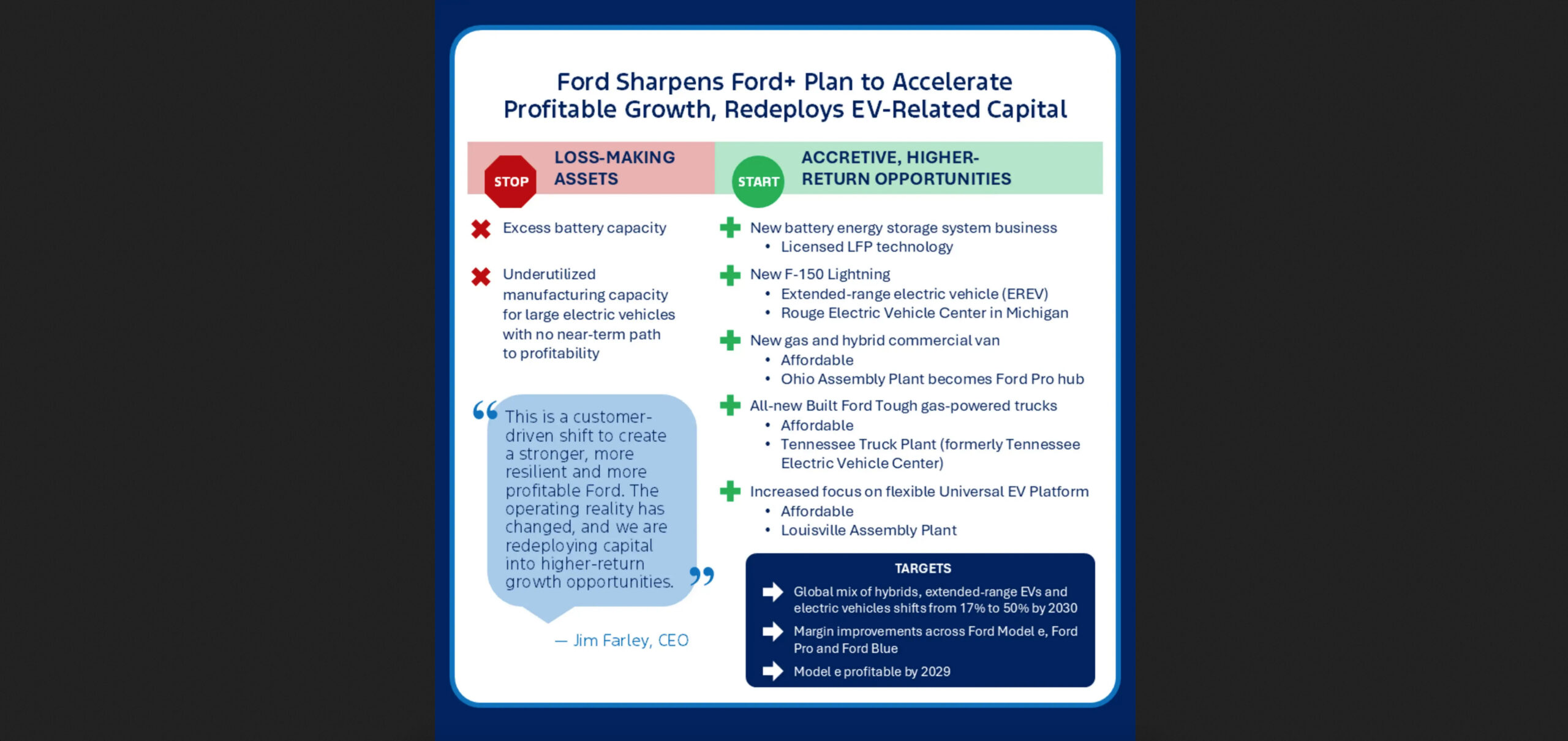
Ford took drastic action yesterday to stop the massive losses with its EV business. It will write off $19.5 billion in EV investments including a $5.5 billion cash charge in its Q4 earnings. While it’s not giving up on EVs, Ford is pivoting its main focus to hybrids and extended range EVs and expects them to account for 50% of its sales by 2030. But those weren’t the only highlights.
– The F-150 Lightning is gone, and an EREV version will take its place.
– The massive manufacturing complex called Blue Oval City will not make electric trucks. Instead it will make a new ICE truck.
– The battery plants that were going to supply Blue Oval City will pivot to making LFP prismatic batteries for energy storage.
– A gasoline and hybrid van will replace an electric van that was going into the Avon Lake plant in Ohio.
– A new electric van planned for Europe is scrapped, though the company will continue to build its electric Transit and Courier vans.
– There was no mention of the Mustang Mach-E, but we expect it to be phased out when it comes to the end of its life cycle.
Despite the massive write-off, Ford raised its profit guidance for this year to $7 billion and said it would generate $2-3 billion in free cash flow. It also expects its EV operations, called Ford Model e, to be profitable in 2029 after racking up about $5 billion a year in losses since it was created. Here’s our Autoline Insight. Ford is just the first legacy automaker to take a massive write-off of its EV operations. We fully expect others to do the same thing. The industry over invested during the EV frenzy that gripped the stock market 4 to 5 years ago. Ford is now putting all its EV resources behind its Universal Modular Platform, the clean-sheet design coming from its California skunkworks that will be built using a radically different assembly process to cut cost.
EU CAVES ON 2035 ICE BAN
The auto industry’s lobbying to rollback European emission standards paid off. The EU will propose new rules today that ease up emission requirements. Currently, vehicles must be 100% zero-emission by 2035. But now the EU will require that emissions be reduced by 90% by 2035. Plug-in hybrids and range extended electrics can continue to be sold after that time but they’ll have to use low-carbon or renewable fuels. The new rules are also expected to allow automakers to earn carbon credits for using locally produced green steel and a new category for small EVs will be created that will be exempt from certain safety and emission requirements for a 10-year period.

STELLA ADDS 1,000 WORKERS IN CANADA
Stellantis is trying to get back in Canada’s good graces. Earlier this month, the government served the automaker with a notice of default on financial aid it provided after Jeep relocated Compass production out of its Brampton, Ontario plant and into Illinois. So the company issued a press release reaffirming “Canada’s critical role in Stellantis’ global operations.” It says it hired more than 1,000 workers for a third shift at its Windsor Assembly Plant that starts early next year. That plant currently produces the automaker’s minivans, but the new shift is for the Dodge Charger. Stellantis says 240 workers from its Brampton plant, which is currently idle, have accepted transfers to Windsor and the remaining hourly workers at Brampton will continue to receive 70% of their salary, as well as health benefits.

1st LEVEL 3 PERMITS GIVEN IN CHINA
BAIC and Changan are the first two automakers to get approval for Level 3 driver assist technology in China. But the permits only allow for autonomous rides in designated areas. BAIC can operate in selected areas of Beijing at speeds up to 50 MPH or 80 km/h, while Changan can operate on designated highways in Chongqing up to 31 MPH or 50 km/h. BYD, Mercedes and BMW are also testing Level 3 systems in China but so far they haven’t received permits for more widespread use.

TWINGO EV UNDERCUTS VW ID. POLO BY €5,000
EV sales could explode in Europe next year as truly affordable electrics start to hit the market. The new Renault Twingo is going to undercut the VW ID. Polo that we talked about in yesterday’s show by about 5,000 euros. The small electric car will also launch in 2026, but with a starting price of about 19,500 euros. Renault was able to go that low by using an even smaller LFP battery and a less powerful motor than VW. The Twingo features a 27.5 kWh pack that returns up to roughly 260 kilometers or 160 miles of range and is powered by a 60 kW or 80 horsepower electric motor. A 500 euro charging package allows the battery to charge from 10-80% in 30 minutes as well as the ability to power other devices and gives it vehicle-to-grid capability. The base version comes with a 7-inch digital cluster, a 10-inch infotainment screen, air conditioning and a host of driver assistance features. The top-spec version adds a Google built-in infotainment system, adaptive cruise control with stop and go, one-pedal driving and a rear-view camera for just over 21,000 euros. With the VW Group and Renault entering the small EV market, some forecasts predict that the small electric car segment in Europe will be around 4 times bigger by 2033 than it is today.

BYD OFFERS 250,000 KM BATTERY WARRANTY
But no doubt the Chinese will also flood the space and they’re starting to offer the kind of peace-of-mind that the European automakers can’t match. Like most automakers, BYD offers an 8-year warranty on its battery, but now all plug-in models, past and present, with its Blade pack are covered up to 250,000 kilometers. Other warranties tend to top out at 160,000 kilometers, while the Long Range and Performance versions of the Tesla Model 3 & Y are good up to 192,000 kilometers. So, it’s a nice perk for customers and could make BYD’s EVs even more popular with Uber drivers and other mobility providers.

GM OFFERS APPLE MUSIC OTA
General Motors pulled the plug on Apple CarPlay in its models, but found that it couldn’t shake Apple altogether. It’s doing an OTA update for 2025 Cadillac and Chevrolet customers next Monday so they can get Apple Music in their cars. Buick and GMC will get the feature at a later date. But it does not apply to older models. And for reference, Tesla, Mercedes and Rivian also offer Apple Music without Apple Car Play. Some Cadillac models will also have access to Apple Spatial Audio, which features music that was mastered for Dolby Atmos. Cadillac is making a big deal about offering Dolby Atmos in its newest models, and we found that it truly offers a sensational audio experience. Apple does not charge automakers a fee to use Apple Car Play. But it does give Apple access to in-car data, and the car companies want to control that for themselves.
But that brings us to the end of today’s show. Thanks for making Autoline a part of your day.
Thanks to our partner for embedding Autoline Daily on its website: WardsAuto.com





With he political climate being what it against EVs and legacy OEMs getting moving away from electric vehicles as a result, should the US continue with policies that keep Chinese EV out of the US?! You hear a lot of people saying that not one wants EVs and that legacy automakers wasted money on EV investment, so why not open the gates and let them in since no one wants them? Who cares how much Chinese vehicles cost, if all anyone wants in the US are big, gas drinking SUVs and CUVs?!
@WMB: For better or worse the political climate will change to something else in the future. Be careful about letting the camel get his nose in the tent.
It’s hard to know what Ford plans near-term, except to have little to sell in most market segments. They talk about all of these hybrids, but everything I see is that the Escape is being dropped after 2026. That would leave the Maverick and F-150 as their only hybrids. They dropped the Explorer hybrid, except maybe for police markets. The F-150 hybrid gets barely better mpg than the standard truck in CR’s tests. If they drop the Mach-E, they won’t have anything to compete with Equinox EV, Tesla Model Y, or anything else in that growing segment.
I guess they must think the Bronco Sport will be a replacement for Escape, but unless they add powertrains, it won’t be even close. The only way Bronco Sport is sold is 3 and 4 cylinder turbos with 4WD. No hybrids, and no FWD.
BobK —
What difference would it make since the claim is that no one wants these vehicles? Stellantis and now Ford is backtracking out of this market, so GM will not be far behind! The thought is that, save for Toyota and Honda, most Americans favor gas powered SUVs and CUVs and not sedans. So, why keep Chinese EV sedans out of this market, since no one wants them anyway? Then, require that any EV pickups (a vehicle a number of individuals on this sight have suggested was a question no one on asked or needed answered), SUV/CUVs and trucks be built in this country, or face tariffs of 100%! No one wants EV sedans or trucks, especially when gas is so cheap, the electrical grid and infrastructure is poor and inconsistent in many places, there’s not enough charging stations (that work), they don’t have enough range and they take forever to refuel! Just keep the AI they use for AD from mapping the country and the market they will occupy will be niche at best!
From everything we read, Chinese EVs are excellent. They would sell, at the right price. With the unpredictability of tariffs, though, I doubt if Chinese companies would want to bother to federalize them, when the tariff could go to 500% overnight, after they spent the money to federalize them. They’ll sell their vehicles in markets with more stability in trade relations.
I for one am glad to see that the true EV interest is being finally realized. Development needs to continue and hopefully enough interest will keep sales going enough to help bring costs down and make further development worth investing in. I do believe EVs have their place and make excellent vehicles for certain niche markets. The whole idea that it could replace ICE as early as 2035 was a pipe dream that was concocted while smoking a pipe in my opinion. Reality is EVs have their place and filling that void is realistically maybe 20% of the US market without some major breakthroughs. Glad to see common sense prevailing when it comes to the policies that causes the automakers to waste billions of dollars on a pipe dream.
EVs would work well as one vehicle for a large majority of multi-vehicle households in single family homes. I don’t know the numbers, but there would be tens of millions of such households in the US. EVs would work well for the large majority of pickup owners I know in Indiana, but those people just don’t want EV trucks, even those who could easily afford them. Yeah, thinking EVs could replace everything by 2035 was clearly a pipe dream.
Price, price. price. I feel that ANY new vehicle that could be sold for 19K-25K with some features customers want would sell, sell, sell regardless of ICE, hybrid or EV power. As soon as a manufacturer cracks the code to be able to do this they will have a hit. If the manufacturers are writing off billions in failed ideas why not bring out a few reasonably priced WELL STYLED vehicles even at a loss and beat the Chinese at their own game. The Japanese did this to the US market in the 70’s and are still flourishing here because of it. Unfortunately all we continue to get from legacy are 100K trucks and super cars for the rich.
The look on Autoline reporters faces as they read to us about the temporary demise of the EV revolution is priceless. I realize that the next fruit loop ‘progressive’ regime will force it all on us again at some point. I am just happy to be able to live long enough on the ventilator to see the ‘pipe dream’ called out for what its worth.
Toyota Corolla base price is under $25K, well equipped, with AC, adaptive cruise, power windows, etc. It sells fairly well, about 233,000 in 2024 in the US and is on track to beat that in 2025. Still, many, or most Americans buy vehicles “by the pound” and will buy a 6 year old truck or big SUV, even if they have no need for it, over a new Corolla.
OEMs could instantly cut the cost of their vehicles by doing away with all the nanny systems that are standard on their vehicles that aren’t required by federal law, such as lane keeping assist, which I personally don’t know of anybody that wants it or uses it, it is turned off and left off. OEMs could offer those systems as an additional safety suite for those people that probably shouldn’t be driving anyway, but at least those that can drive and want to save some money won’t have to pay for systems that they don’t use.
It would be interesting to know how much lane keep assist and some other things add to cost. Yeah, I turn that off, like most people. I suspect that, since Toyota puts that on everything, it doesn’t cost much per car.
The only time I’ve found the lane assist useful is when I’m towing my boat. Helps keep the truck in the center of the lane and not wander as much. Which when it’s windy out a winding road it can be easy to get out of my lane a little. But for everyday driving it’s shut off.