




Follow us on social media:



Runtime: 9:22
0:00 Is Ford Eyeing Chinese Partners to Save $5 Billion Blue Oval City?
1:11 BYD Sales Plummet 30% In China
1:53 Canada Demands GM Pay Back Millions in Subsidies
3:53 Slate “Aspires” To Expand Model Line-Up
4:40 Scout Pivots to EREVs as 85% Of Customers Reject BEV
5:20 Jaguar ThermAssist Cuts EV Heating Energy 40%
6:21 Porsche Double-Sided Battery Cooling a World First
7:15 Vintage Vibes: U.S. And EU Vehicle Fleet Getting Older & Older
Visit our sponsors to thank them for their support of Autoline Daily: Bridgestone, CSP and Intrepid Control Systems.




This is Autoline Daily, the show dedicated to enthusiasts of the global automotive industry.
IS FORD EYEING CHINESE PARTNERS TO SAVE $5 BILLION BLUE OVAL CITY?
Last month President Trump told the Detroit Economic Club that he would welcome Chinese car plants in the U.S. And now come reports that Ford has been talking to at least two Chinese automakers to form a joint venture to make EVs in the U.S. The Financial Times reports Ford was in talks with Xiaomi and BYD. We think the FT is a pretty reputable source, but Ford and Xiaomi deny they’re in talks while BYD declined to comment. Here’s our Autoline Insight. While nothing may come of this, it would be sensible for Ford to explore possible options with Chinese automakers. We keep looking at that $5 billion, 5-million square foot manufacturing facility that Ford is building, called Blue Oval City. Located in Tennessee, that plant is supposed to make 500,000 electric pickups a year, but right now it looks like it could be a financial disaster. However, with a Chinese partner on board that plant would come closer to its targets.
BYD SALES PLUMMET 30% IN CHINA
And here’s a good reason why BYD would want to cut a deal with Ford. Its sales in China took a nosedive last month, falling an alarming 30%. While analysts were expecting a drop in car sales as consumers rushed into the market at the end of last year to take advantage of subsidies that were about to expire, a 30% drop at BYD caught everyone by surprise. That’s the 5th straight month sales have fallen and its stock went down by almost 7%. BYD wants to boost sales outside of China by 25% and if it could cut a deal with Ford to get into the U.S. market, that would be a mega achievement.

CANADA DEMANDS GM PAY BACK MILLIONS IN SUBSIDIES
Canada wants its money back. In December, Canada’s Industry Minister served Stellantis with a notice of default on its taxpayer backed financial aid, after the automaker canceled plans to build the Jeep Compass in Ontario. Now, Canada is seeking to retrieve taxpayer backed funds it provided to General Motors. In 2022, the federal and Ontario governments agreed to provide C$259 million for investments to upgrade GM’s two plants in Ontario. But last year, GM idled one of those factories, the CAMI plant which was building the BrightDrop electric van. And it also just reduced its Oshawa plant from three shifts to two, resulting in 500 workers being laid off. And because of that Canada says it’s seeking to recover “millions” from GM.
SLATE “ASPIRES” TO EXPAND MODEL LINE-UP
EV startup Slate, which is developing a low-cost electric pickup, plans to expand its lineup at some point in the future. The pickup, which will have a starting price in the mid-$20,000 range, is aiming to go into production by the end of the year. The pickup can also be converted into an SUV with a bolt-on kit that will cost around $5,000. While Slate is focused on bringing those models to the market, CEO Chris Barman tells InsideEVs that it “aspires” to launch different vehicles in the future. Slate’s platform is modular and can allow for different versions, including a cargo carrier. And we think that’s a smart move because it will be hard for Slate to hit its production goals with its current pickup and SUV.

SCOUT PIVOTS TO EREVs AS 85% OF CUSTOMERS REJECT BEV
When the Volkswagen Group revived the Scout brand, it was originally going to be all-electric. But with EV sales not growing as much as the automaker expected, Scout decided to offer extended range EVs as well and that decision is really paying off. Scout has more than 150,000 refundable reservations and according to CEO Scott Keogh, 85% are for the EREV. The company originally expected EREVs to account for 60% of sales. But because of its popularity, Scout will launch the EREV versions first, which are scheduled to go into production late next year.
JAGUAR THERMASSIST CUTS EV HEATING ENERGY 40%
Rumors swirled recently that Jaguar was considering adding combustion engines to its new electric platform, however the automaker came out to say that its EV-only plans haven’t changed. It revealed the first of those new EVs, a 4-door GT, has now begun its winter testing program. Jaguar says the model will be able to optimize its range, even in the coldest temperatures, thanks to a new thermal management system it calls, ThermAssist, which reduces heating energy consumption by up to 40%. The new Range Rover EV shares the same tech and they both also have an air suspension system with active twin‑valve dampers. But the Jag will feature all-wheel steering and a tri-motor AWD system that makes about 1,000 horsepower, instead of a dual motor system. The automaker says the production version of the 4-door GT will make its debut later this year. However, no official on-sale date has been revealed yet.

PORSCHE DOUBLE-SIDED BATTERY COOLING A WORLD FIRST
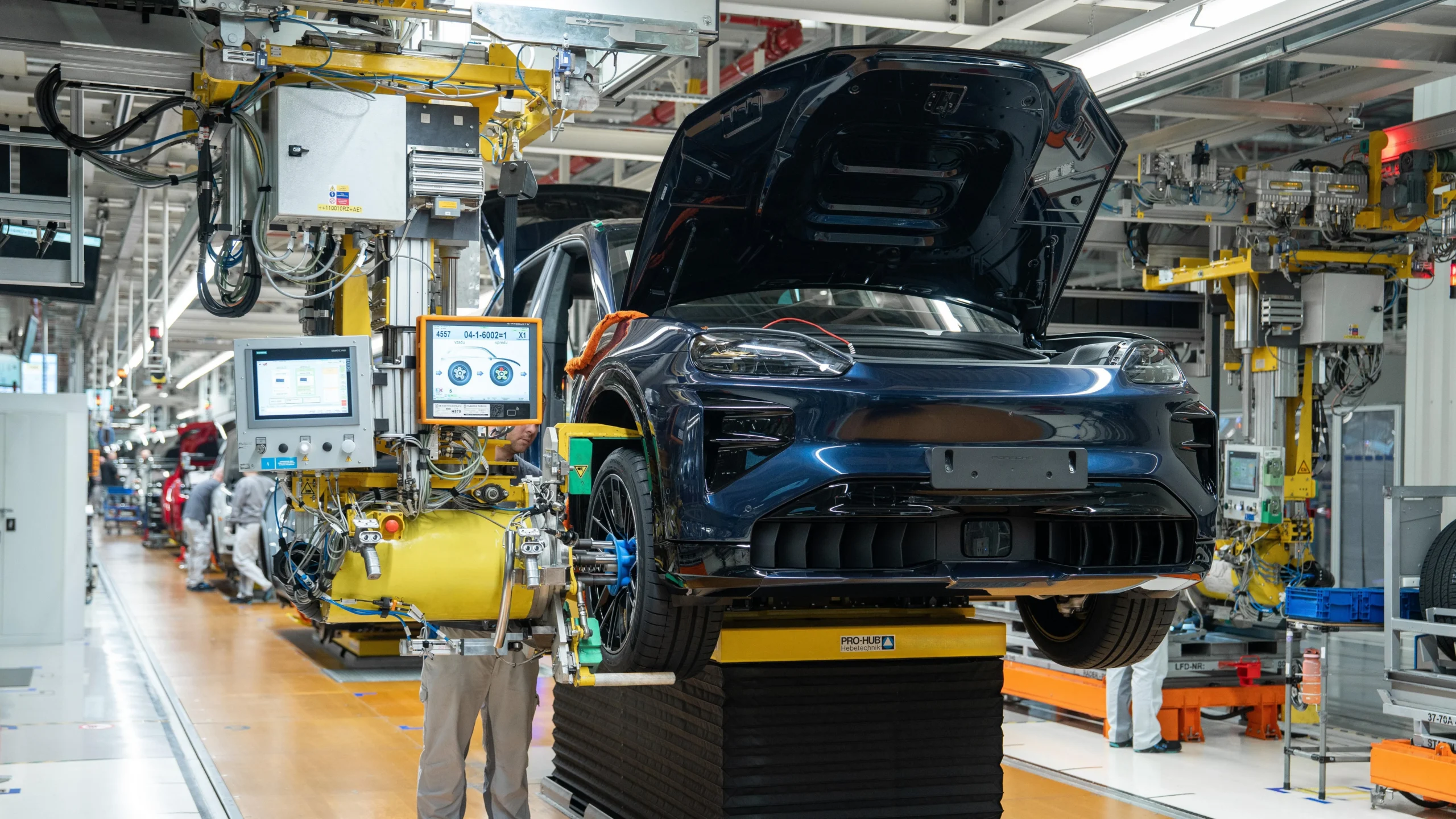
The new Cayenne Electric is an important model for Porsche. We talked about how it could help turn around the brand’s sales in China. Well, Porsche revealed that it has officially kicked off production of the Cayenne Electric at its plant in Bratislava. One way it says it’s gaining more control over the quality, precision and scalability of the model is by developing and building the battery modules in-house. While it doesn’t make the pouch cells, Porsche does all the cell preparation, stacking, laser welding, foaming, cold plate integration and end-of-line testing. That allowed it to do things like double-sided cooling, which can cool or heat the battery from above and below and Porsche claims is a world’s first. The Cayenne Electric is also built alongside hybrid and ICE models, so the automaker says it can more quickly react to changes in demand.
VINTAGE VIBES: U.S. AND EU VEHICLE FLEET GETTING OLDER & OLDER
Europeans and Americans are holding onto their cars and trucks longer than ever. But there’s a difference. Europeans keep their trucks, including SUVs, longer, while Americans keep their cars longer. According to the ACEA, the average car in Europe is 12.7 years old, while in the U.S. it’s 14.5. Meanwhile, the average age of trucks in Europe is 14 years, while in the U.S. it’s 11.9. And in Europe, the average age varies a lot by country. In Greece, the average car is 17.8 years old, while in Lithuania it’s only 1.8. But one thing’s for sure, in both Europe and the U.S. the age of the total fleet gets a little bit older every year.
And that brings us to the end of today’s show. Thanks for making Autoline a part of your day.
Thanks to our partner for embedding Autoline Daily on its website: WardsAuto.com





Scout refundable deposits are like high demand concert tickets. People put a deposit in hopes of getting one to sell for a nice markup for the fools willing to pay over sticker just to be first. Willing to bet if they change that to non refundable that number drops to 10% if the cybertruck was any indication. That went from 2 million reservations to likely ending production 4 years into production. They sold 14k in 2022
They sold 39k in 2023
They sold 26k in 2024
And managed to sell 20k in 2025. So they just might have sold 100k trucks from that 2 mill of reservations. I don’t expect Scout to fair much better even with it looking 100 times better than cybertruck
1,8 years in Lithuania? The pre-owned market must be flooded with some pretty good cars!
As for US and UK holding onto vehicles longer. I mean they certainly last longer so that’s to be expected. But with the pricing today it’s a huge investment that needs to have a longer return. I remember the days where 100k miles was the death of a car. The exhaust systems were mild steel and lasted a couple years. That all changed to SS. Cars needed points plugs wires every 20k miles now you don’t need to do much of anything for 100k. However they seem to be going the other way now with things like BMWs nonservicable transmissions and mega castings that a small accident can total the vehicle. Just this week ran into two people that went to change the transmission filter on a Stellantis vehicle with 100k and they have to replace the whole transmission pan. The filter is integrated into the pan. Really dumb ideas. Making vehicles so expensive to maintain that after those 12-15 years a simple repair or maintenance exceeds the value of the car. Sad
I think Slate guidance is pretty grounded. They’ve acknowledged that only some percentage of the 150,000 reservations will convert to orders. And they’ve been straightforward that they need to complete the Series C capital raise to reach volume production. And they state again and again that they are razor focused on getting the basic truck to market without distraction.
All good things. We’re all cheering for Slate. It’s tough sledding to be a low volume BEV truck startup in a BEV-hostile time period and market.. Cheering for Slate to navigate that famous startup valley.
I’m sure BYD sees the value in a partnership with Ford in TN. But I bet they slow walk any investment or technology transfer because of the unpredictability of the Trump administration. Ford is still stinging from the battery plant fiasco in Marshall, MI. Congress and the White House don’t let facts get in the way of a good PR opportunity, unfortunately for Ford.
Lambo2015 —
While not amounting to argue and start a war with anyone, as well as understand that it is okay to disagree and express a different point of view, but with health conversation. I would just like to respond to your comment the other day, which was a continuation of a conversation from Daily Driver about EV buses. The manufacturer had directed those who had purchased them, to charge them outside, due to a risk of fire. Part of your comment said:
“Almost all ICE vehicle fires are from poor maintenance. Typically while running. A loose/ broken fuel line, tank or oil leaking engine that was not serviced properly. Likely preventable. Where EVs are catching fire while being charged unattended.”
I know this is only part of your comment and much of the rest of what your said, I feel mostly holds true! EV fires do burn hotter, so municipal fire fighters many times let the burn themselves out. Yet, as quoted above, one would argue that when EVs ‘catch fire while being charged unattended’, as with ICE vehicles that catch fire, there was a failure some where that sparked the fire! For, unless it was a prop in a movie or some other type of stunt, something went wrong (be it poor maintenance or poor design), for no manufacturer ever wants their products experiencing a thermal run away.
I was just calling attention to the fact that ICE vehicles have done the same and sadly, i worked for the City of Detroit as a bus driver when it happened. Not only did they lose about 20 diesel buses, the bay areas where they parked those buses was severely damaged too! At more than $200K a bus, plus repairs to the bays where they were kept, the cost to taxpayers was pretty heavy. Only for it to happen again a few years later at a different terminal, was crazy! So, whether its ICE or EV, things like this might happen. Shoukd they? Never! Yet, that doesn’t mean they are not worth the investment, does it? Daily Driver was suggesting it was a waste of tax payer money to do so with EVs and I respect his opinion. Yet, since ICE vehicles can and have done the same thing, wouldn’t that also mean the same thing for them too?!
As battery tech evolves, eliminating rare earth materials and heading to solid state, many of the issues will resolve themselves with quick charge times and no thermal run-away/fire risk. I admit, I missed that conversation, but I do think busses are a great use for EVs as well as fleets with local routes.
I wonder if anyone has updated stats as to how EV fire stats look by year (like the battery life stats that were shared a few days ago). I bet the stats look similar, in that newer battery tech has better thermal management, just like newer batteries are lasting longer.
I have no doubt those stats about holding on to vehicles longer are true. Many folks I talk to agree that they can’t afford to buy new nowadays, and most purchase at least a few years old. The fleet of vehicles residing at my house were built in 1966, 1995, 2008, 2008, 2013, and 2016. Yes, the newest is 10 years old, but the average is well past 15 years.
If that is right about cars in Lithuania only being 1.8 years old, there must not have been any cars there until about 3 or 4 years ago.
I started driving in 1962, and the car I mostly drove at the time was a 1950 Plymouth. Everything on today’s cars lasts much longer. Before leaded gas was eliminated, plugs lasted about 12K miles, less than that in higher compression engines using premium gas. Plugs would lead foul so you had misfire after about 6-8K miles, and the electrodes eroded from the lead alloying with the steel electrodes. With unleaded gas, standard plugs would last ~60K miles, and iridium tipped plugs last well over 100K miles. Points would last 10-15K miles, and would need to be re-gapped a time or two to keep timing accurate. Mufflers would last maybe two years, and less than that if you did a lot of short trips. If they had salted roads in the ’50s and ’60s like they do now, car bodies would have been trash in about 5 years, rather than around 20 years as with today’s cars.
Basic engine life is much longer with today’s cars. That 1950 Plymouth had a flat head six with a stroke of 4 3/8 inch, and either a 3.7 or 3.9 rear axle ratio. The engine was turning far too fast at highway speed to last very long. Overdrive was available on those cars, which helped in that regard, but even with overdrive, the engine would have been turning about twice the rpm of today’s cars with similar size engines. It’s amazing to me that today’s extremely complex cars are as reliable as they are, accessories and electronics-wise, but it’s easy to explain why most powertrain parts last much longer.
I have another theory about the aging car population. First, I agree with statements above about the quality of cars and low maintenance of major mechanical systems. But I believe another dynamic is also at play. Six years ago, COVID and chip shortages caused a major reduction in the supply of new cars. The commensurate price increase for those vehicles that were available stimulated many returning lessees to simply buy their existing lease (at guarantee prices lower than the market price at the time). This took a sizable number of new vehicle buyers out of the 3-4 year lease turn cycle. I suspect Cox Automotive or similar stat group (NADA?) can dimension this.
wmb- I appreciate your post. Never trying to argue with anyone here either although I will certainly voice my opinion for what it’s worth. I’m not offended or upset if anyone disagrees. The point of the comment section is for people to express their various opinions. As for the EV buses: at this point I’d like to see a good old cost comparison of modern EV bus with batteries and the old trolly like cable car buses of the 1920s cause it seems like the 100 tech might still be cheaper overall to transport a city around.
Growing up in Hamilton Ontario, we had electric busses on tires with overhead electric lines. In Toronto they still have electric streetcars with overhead power. Always seemed to me to be a great solution. No pollution from ICE and I would expect much lower cost without expensive batteries. Ideal for regular public transit routes. I wonder why cities are going to battery busses.
I remember electric buses powered by overhead lines in Indianapolis from my childhood in the 1950s. They were referred to as “trackless trolleys.” Probably maintenance of the overhead lines is why they were replaced with gasoline, and later diesel buses.
At one time there were electric “interurban” trains that connected a number of Indiana towns. They used DC power from overhead lines, with motor/generator sets to produce DC from AC from the grid. My father used the interurbans, and said they worked well, but they were gone by the early 1940s, a few years before I was born. Cars and trucks killed them off.
Albemarle, how long did the electric buses run in Hamilton? I found that they last ran in Indianapolis in 1957, when I was 11.
Hamilton Street Railway stopped the electric busses in 1992
Overhead wires out in 1994. They have some battery electric busses on trial now. I still think overhead wires are a good economical option but many would hate the sight of the wires. Old fashioned you know.
Lambo,
It will be interesting to see how the Scout performs. It is at least normal looking compared to the ridiculous cybertruck. The interior is also a bit more upscale than cybertruck has even tried to be. Scout seems to have a unique proposition compared to other Truck/SUV EVs with the EREV option and more traditional off road focused drive systems from what I saw on their launch video. The EREV will solve the issue of towing range that everyone likes to point out and that may be just enough to make it sell well. Personally an EREV would work for me as I could drive it to work on battery power and then tow my things on the weekends using the EREV. It is also probably why the take rate is so high on the EREV option.
What I really see the issue being with them has nothing to do with their product. They will struggle that Scout is not a well recognized brand as Scout has not been a thing since it ended production in 1980. Very few will remember it. They also will struggle with a lack of dealer network(intentional) which means that they will take quite some time to gain total market access for their potential customers and that will limit sales. They are new so people will view them as risky when it comes to projecting reliability. They will see it as a risk for the potential for it to become an orphan and you are stuck with a truck that is not supported long term. The last thing will be their ability to make it affordable. If they launch at their initial projected base price at $50K they will have success. If they try to launch with a base price of $70K they will not last long.
Seems as much as things are new the proper answer might be 120 years old. For anyone interested that doesn’t already know. Look up the “Lake Shore Electric Railway” , formed in 1901 it ran between Cleveland and Toledo until 1939. Was an electric train with overhead power lines connecting the two cities prior to major paved highways. Seems better than having huge batteries. At least for designated routes.
Merkur- yea I agree the EREV is a smart move for Scout as people have been saying hybrid was the way to go to kill range anxiety, especially for an electric truck. It’s just been proven difficult to get decent mpg on the Highway with many EREVs because of the added weight. I remember the 90s where automakers were scrambling to save every pound here and there and now think nothing about throwing a 800lb battery into the mix. Seems to work better for the small cars that have no towing or hauling expectations but if they can figure out the right combo in this SUV it might do well. I still have my reservations.