





By John McElroy
The traditional automotive playbook says that to build a successful auto company you need an army of engineers, billions in capital, a coast-to-coast dealer network, and a vehicle packed with enough digital real estate to rival a Silicon Valley server farm.
Not Slate. It’s providing the industry with a master class in product and corporate frugality.
Its headquarters in Troy, Michigan is a former office building that the supplier Mahle vacated. Chris Barman, the company president, told me that all the chairs and desks inside were literally picked off the curbside from an office building up the street that was throwing them out to get new furniture. The carpeting around the desk of CEO Peter Faricy has a tear in it, but he has no plans to replace it.
Its design studio in California was an abandoned warehouse that had been stripped clean of all its wiring and plumbing, which saved Slate the cost of having to gut the building before updating it. This is a company that scrutinizes both sides of a penny before it spends it.
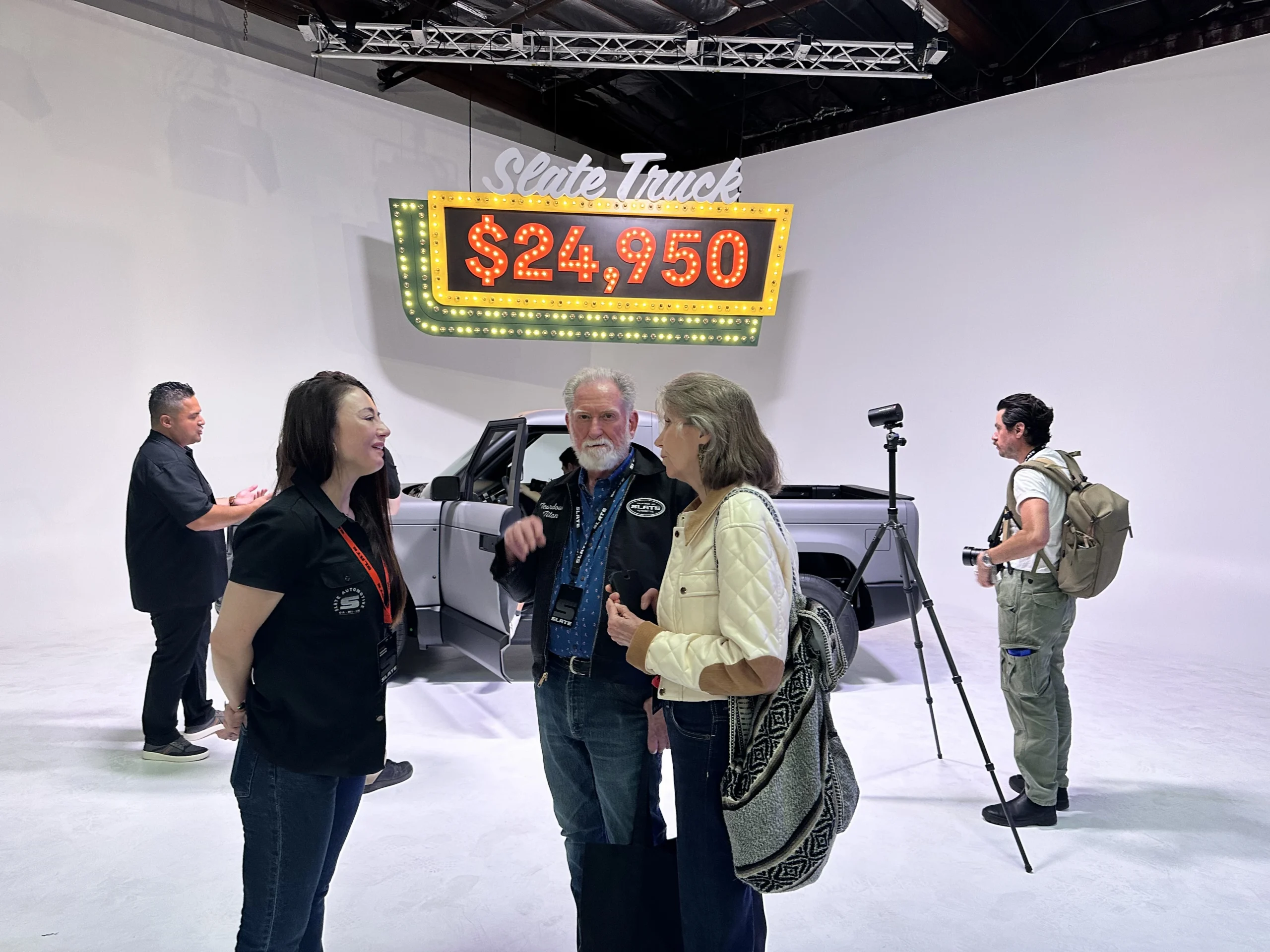
After visiting the company headquarters and its design studio, I walked away with one overwhelming impression: this company is obsessively, brilliantly frugal. While other EV startups bleed cash trying to out-feature the legacy OEMs, Slate has optimized its corporate structure, its vehicle design, and its manufacturing footprint to deliver a street-legal, design-validated EV pickup for just $24,950 (plus a projected $1,400 destination charge).
And the market is paying attention. Slate already has 180,000 reservations on the books, and pulled in 10,000 formal pre-orders on the very first day the order banks opened.
Here is how Slate is achieving what many thought was impossible: positive gross margins on a $25k EV.
1. Optimizing the Company Before the Vehicle
According to CFO Ryan Green, Slate’s cost reduction didn’t start on Catia design software—it started on the corporate balance sheet. The company is funded entirely by investors and carries zero debt.
By aggressively simplifying the vehicle’s design, they unlocked a domino effect of corporate savings. Fewer parts mean fewer suppliers, which translates to a radically lean overhead structure. As Green notes, because they have fewer parts to buy, they even need fewer purchasing people. They literally optimized the size and efficiency of the company before they even finalized the truck.
2. Shared Tooling and Smart Parts Binning
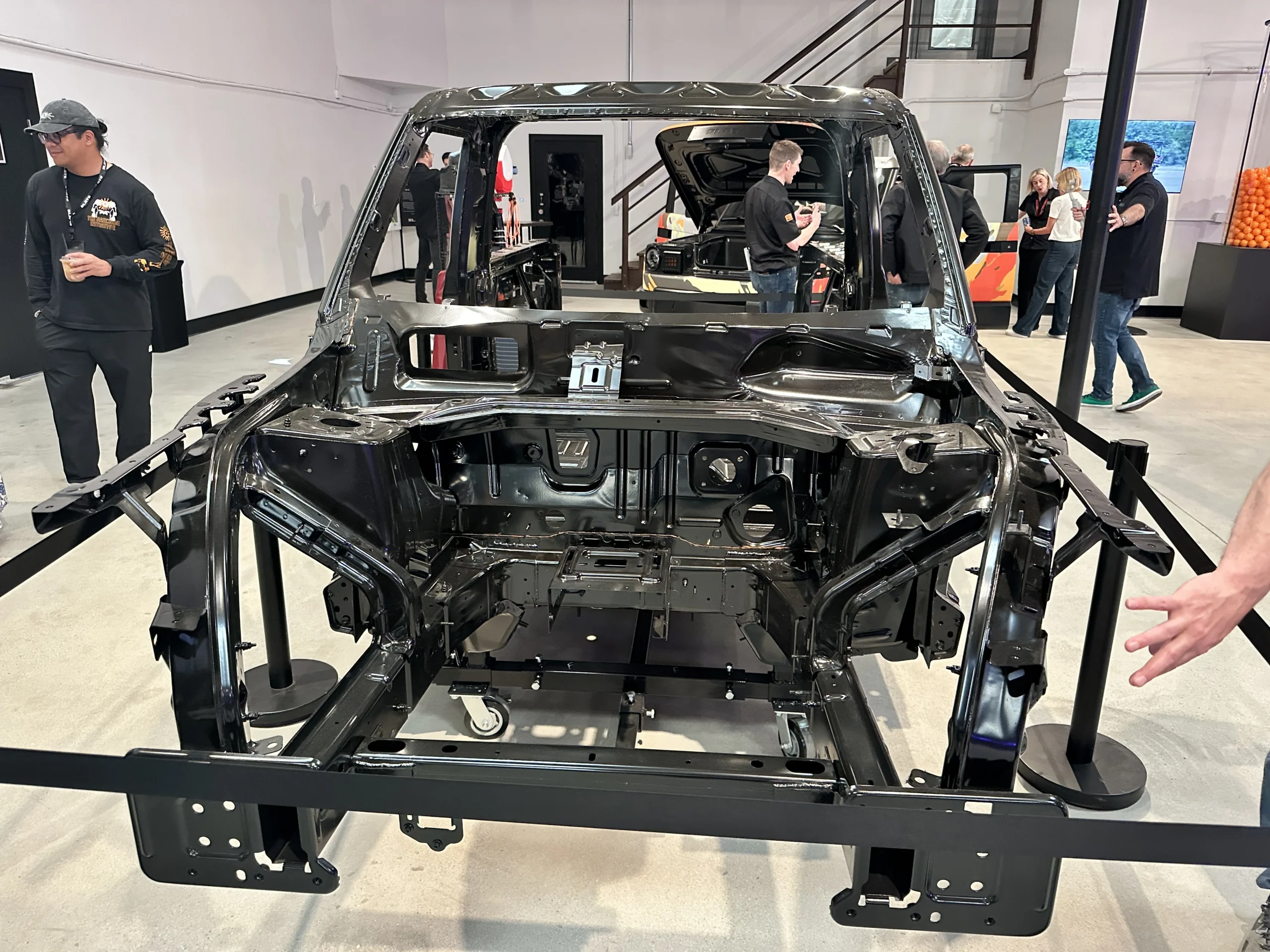
To hold down massive tooling expenditures, Eric Keiper, head of engineering, made sure his team looked for savings everywhere:
Simplicity of design: The original instrument panel required 27 parts. They kept reiterating that design until they got it down to 7. Door panels went from 15 parts to 10.
Shared tooling: The left and right armrests, as well as the center console, all come off the same tooling.
Symmetrical Safety & Glass: The left and right side airbag curtains are identical. On the SUV variant, the rear side glass is perfectly interchangeable from left to right.
The “Slateboard” Architecture: Originally, engineers planned a traditional body-on-frame structure. But protecting the battery required frame rails so tall that it compromised passenger ingress and egress. Instead, they engineered a high-strength steel structure they call the “Slateboard.” It’s like a frame with a roll cage, with a very robust 35 hertz bending frequency. That got rid of the big door sills. The stampings for the Slateboard are shipped in by suppliers. Slate welds them together and dips them in a black e-coat.
Rather than building a complex infotainment system, Slate’s centralized zonal compute platform relies on a simple USB port and a dashboard mount for the customer’s phone. It handles over-the-air (OTA) updates, was developed entirely in-house, and Slate has no intention of selling the software to anyone else. Every component on the vehicle runs on a standard 12-volt architecture.
3. Radical Body Engineering & The No-Paint Factory
Painting a car is historically the most capital- and energy-intensive part of automotive manufacturing. Slate completely bypassed it.
Jamie Standring, the propulsion and engineering leader, notes that the outer skin is made from inexpensive polypropylene panels–the same kind of plastic that milk jugs are made of. But to strengthen them, vertical panels are blended with talc to add stiffness and prevent warping, while horizontal panels are blended with glass for superior impact resistance. The front and rear fenders simply bolt on for easy repair or replacement, while the doors and hood are bonded to steel inner structures for impact strength.
Instead of paint, the vehicle uses vinyl wraps. To make the wraps easy to install, Tisha Johnson, the head of design, made sure that the body panels feature simple curvatures—the only compound curves exist on the corners of the hood and rear fenders. A distinct “coach line” running the length of the body below the beltline allows the wrap to be divided up into smaller, bite-sized pieces for easier installation. Customers can choose from 54 standard factory wraps for $500, or completely customize their own. CEO Jim Faricy says that for $450 the factory will install them. Or you can do it yourself.
4. Turning the Vehicle into an Open Ecosystem
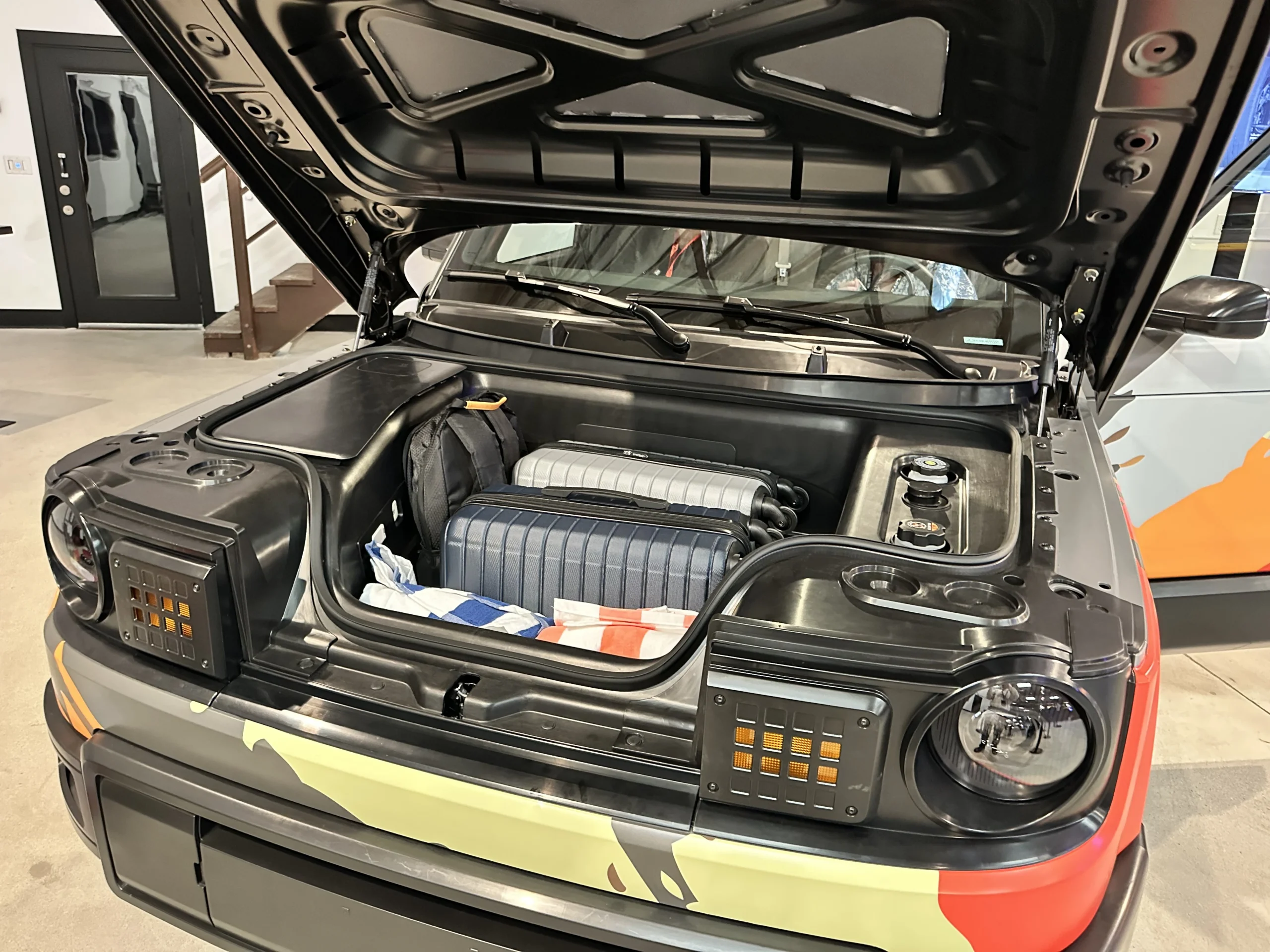
Slate is banking on an aftermarket accessory model to drive recurring revenue over the vehicle’s lifespan. It believes customers will continue to add features as they own it, or that second or third owners will. And this is how Slate plans to transform a gross-profit vehicle into a net-profit one. They developed over 200 accessories (engineered by Slate, built by tier-1 suppliers), ranging from in-mold color trim pieces for the audio system (developed by Tomo Ishiwata’s team) to lift kits, roof racks, wheels and more.
The pricing structure for these add-ons is deliberately accessible:
30% of accessories cost less than $100
50% cost less than $250
80% cost less than $500
For $5,000, buyers can purchase an SUV cap package. For $7,000 they can buy a fastback version. This isn’t just a plastic canopy; it includes the cap, extra structure to support it, the rear seat, seatbelts, side glass, rear glass and integrated air curtains and sensors. All that transforms a 2-seat pickup into a 5-seat family hauler. There’s also an open-air version, where the rear seat passengers don’t have a roof overhead (they’re protected by that extra structure that functions as a roll cage) but the price on that hasn’t been released yet.
Instead of building expensive standalone service networks, Slate has partnered with 3,000 independent repair shops across the U.S. to handle maintenance and fleet service, a move that the head of fleet sales, Drew Walker, says is already drawing interest from both small and large commercial fleets. Slate is hoping for 10,000 to 20,000 fleet sales a year.
5. Manufacturing: Scrappy, Repurposed, and High-Yield
Rich Schmidt, Slate’s head of manufacturing, set up shop in a 1.4-million-square-foot facility in Warsaw, Indiana that used to be a printing plant. The location was chosen deliberately. Warsaw is the “orthopedic capital of the U.S.,” offering a deep talent pool skilled in precision medical manufacturing, and it sits close to Indiana’s big RV manufacturing sector, which has plenty of workers with vehicle assembly experience.
The plant is tooled to make 150,000 vehicles a year with fewer than 2,000 employees. To maximize asset utilization without burning out staff, the plant will run on three, staggered 40-hour shifts, Monday through Sunday, with zero overtime.
The sheer thriftiness of the factory floor is stunning:
Recycled Infrastructure: When prepping the site, Slate found part of the floor wasn’t strong enough for what it needed. So it dug up and ground up 700,000 square feet of old concrete and re-used that to pave the new floor.
Used Automation: Almost all the safety fences, racks, robot risers (which cost $50,000 new), and cable trays were salvaged from closed automotive plants.
The $188 Million Discount: Slate acquired and installed a used skillet-type assembly line—originally bought brand-new by General Motors for $200 million—for under $12 million.
To save time and money, Slate built and validated its body shop “live” inside the plant, skipping the traditional supplier-site pre-assembly, validation, and disassembly process. By using Siemens simulation software, it had the confidence this would work. This single manufacturing risk alone saved them six weeks of lead time and a bunch of money.
The Specs at a Glance:
Code name: FN
Powertrain: Rear-wheel drive, LFP (Lithium Iron Phosphate) prismatic cell-to-pack battery supplied by Gotion from its plant in Illinois.
Capacity: 63 kWh usable battery capacity.
Range: 205 miles standard (upgraded from the original 150-mile target with no price increase after 80% of customers demanded more range).
Charging: 11 kW onboard charger; 120 kW DC fast charging (20% to 80% in 20 minutes).
Warranty: 10-year/110,000-mile battery warranty; 5-year/50,000-mile bumper-to-bumper warranty.
The Bottom Line
With a late 2026 launch on track, on time, and on budget, I think Slate has a good chance of making a go of it, thanks to its radical simplicity, industrial recycling, and extreme corporate frugality. Now we get to sit back and watch how the market responds.
What do you think? Can Slate’s bare-bones, highly customizable approach convert the American truck buyer? Let’s discuss in the comments.







I’m 100% pro Slate. It’s the only electric vehicle I could buy brand new and Afford The Highlander home of kindness is always free😀
It is so refreshing to read about Slate’s frugality and approach to sensibly cutting the bloat out of new vehicles. I’m in…
I decided on the Slate for a number of reasons.
1. It has Lithium Phosphate batteries. Being an large plane RC guy, I’ve seen my fair share of Lipo battery fires!
2. Size, at 62 yrs old I had a 1980 Datsun 720 pickup that got 200 miles on a ten gallon tank with the equivalent bed.Americans have gone large and are paying large at the gas pump and auto makers had to make larger trucks to accommodate the pollution requirement per liter of engine size. (Look it up, non-fiction)
3. I am a certificated Aircraft Mechanic and Electrician for the past 40 yrs, and raced electric race buggies for ten and have flown electric RC for 20yr. I have a 2002 Subi WRX I built and it gets 18-20 mpg on a 12 gallon tank at $5.21 a gallon. You do the math!
4. Tesla electrical engineers and big three structural engineers should get this right. (Built right at home)
5. Price point, I bought a 2024 Mini Countryman fully loaded. Leather power seats, twin turbo, great gas mileage, but 39k out the door! $505.payments on 72months 2.9 percent interest. Buy the time my Slate is ready, fingers crossed, interest on a new vehicle goes down, I sell my Countryman for a good little profit. Lower payment at 60 months!! 👀🐢
American Auto manufactures need a breakthrough. But this is not it. Putting the patriotic feeling aside. What is so innovative about it? And at what cost? A similarly Spec truck in China is $7000-9,000 . That is an offering that makes you think about electric cars. If the USA can not make an affordable EV ( I mean, why pay 3 times as much? ), then do something else. Today, you build for the world. A KIA Seltos cost the same in the USA and you can not compare the quality and content in every respect. Why do no journalists address the company that will build it? a company that is set to take advantage of every government loan and incentive. Bezos has demonstrated that he knows how to become a billionaire (and is not afraid to work with the government). Time will tell, I have seen Fisker, Mullen, CODA, Think, and more. Slate promised a $20,000 EV truck. And we still do not know what engine and why we use a South Korean company for batteries. If 180K people placed a non-refundable deposit, I consider it one of the best PR campaigns in the auto industry.
Great article, John. BTW – have watched you (and now your son) for my entire automotive career.
I think you have a great thesis from a corporate strategy standpoint, and your argument is well articulated.
From a product standpoint, I would be in the target market. With four kids between 18-24, I have a lot of experience in ~5-7 year-old used cars. Watching them interact with poor and non-intuitive in-vehicle tech is hilarious — it’s fully ignored in favor of a phone.
And I’m also a target customer (remarkable to have a product fit across two generations). For context, my two daily drivers are a model 3 and a transit connect — both 2022 MY. I picked the transit for simple utility. I have never interacted with the touch screen, navigation or the vehicle app except when forced to for basic functionality (it’s hopeless vs the model 3). Like my children, I just use my phone (and not through car play). The van is the most simple, affordable and durable vehicle I could find at the time. It’s slate-like.
Thanks for this!
In 1969, when everyone was driving land yachts, muscle cars and station wagons, plus gas was cheap, VW sold 367,000 bugs and over 500,000 total vehicles in the U.S. alone. Cheap, reliable and simple vehicles are highly popular no matter the era.
IMHO Slate will be looking for a second plant location in year 2.