




Follow us on social media:



Runtime: 9:42
0:00 China Calls Donut Battery a Scam
1:08 Renault to Build Drones for France
1:50 Former BMW Designer Pens New Chinese EV
3:45 Renault’s 2025 Global Sales Results
4:42 Lamborghini Sets Sales Record… Barely
5:09 Jaguar Targets Only 10K Sales/Year
6:07 XPeng Expanding Around the World
6:44 GM EV Share Lower Than Overall Market
7:30 Humanoid Cost Less Than Expected
Visit our sponsors to thank them for their support of Autoline Daily: AlixPartners, CSP and Intrepid Control Systems.




This is Autoline Daily, the show dedicated to enthusiasts of the global automotive industry.
CHINA: DONUT BATTERY IS A SCAM
Everyone was going crazy two weeks ago when an unknown startup from Finland called Donut Lab announced at CES that it had achieved a stunning, solid-state battery breakthrough. It claims to have hit 400 watt-hours per kilogram, a 5 minute charging time, and 100,000 charging cycles. Even more, Donut said it can quickly scale up for mass production. But the chairman of SVolt, a battery maker in China, says Donut is a scam. He said “Any technician with basic knowledge would recognize it as a scam.” And he may be right. But, to be fair, SVolt is working on its own semi-solid state batteries, so Donut’s tech could be a threat to its business. Moreover, SVolt’s chairman also let a bit of his bias show through. He told the media “China’s technology is the most advanced globally. If China can’t produce or perfect it, companies from other countries certainly can’t either.”
RENAULT TO HELP BUILD FRENCH DRONE INDUSTRY
As the world becomes a more contentious place, and as governments ramp up their defense spending, a number of automakers are starting to make military hardware. General Motors develops military vehicles with its GM Defense unit. Volkswagen is looking into building military vehicles in Europe and Renault says it has been approached by France’s defense ministry to help it develop a French drone industry. The automaker will work in partnership with the French aeronautics and defense contractor called Turgis Gaillard. There aren’t many other details but Renault says it’s participating because of its capabilities in designing, industrializing and mass-producing high-tech products.

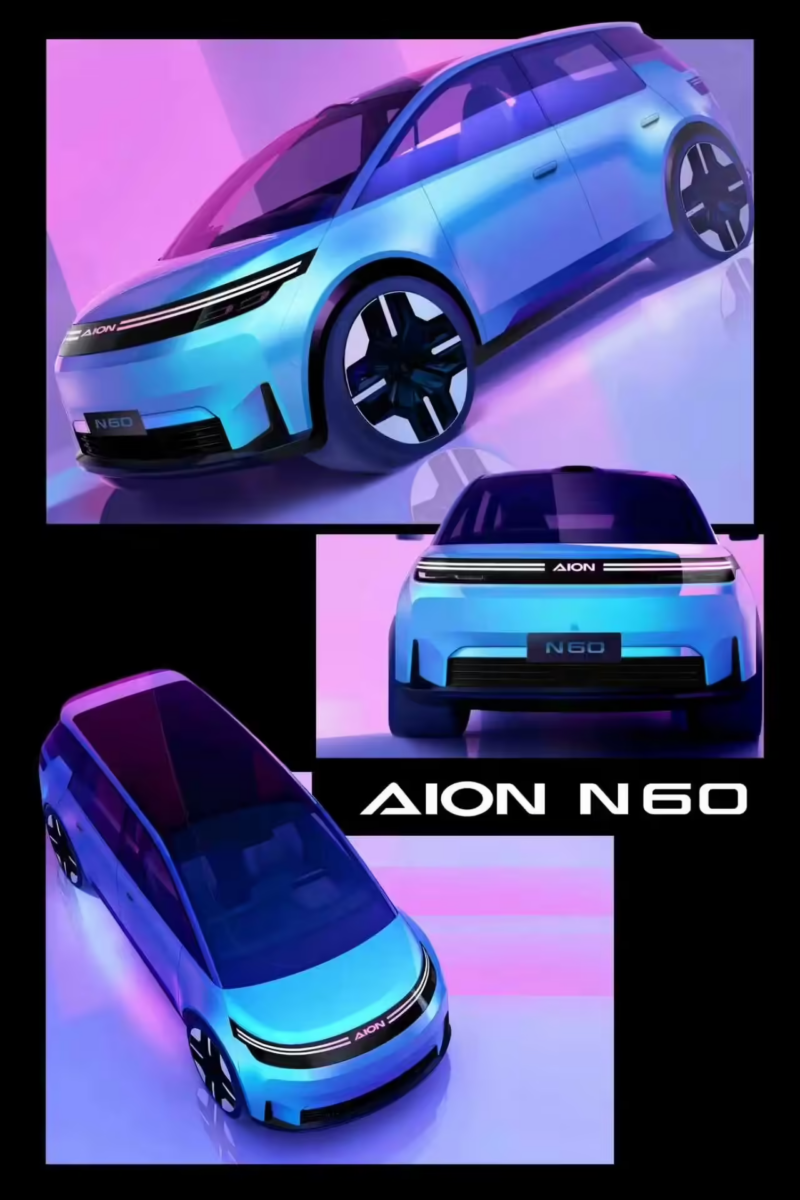
FORMER BMW DESIGNER PENS NEW CHINESE EV
Chinese automaker GAC revealed design sketches of its upcoming Aion N60 EV. The model will offer two electric motor configurations with outputs of 110-kW and 165-kW, or 148 horsepower and 221 hp, respectively. The motors are paired with LFP batteries which achieve a range between 410 kilometers and 630-km or 254-391 miles. But what caught our attention with this model is that it was styled by former BMW designer Benoit Jacob. Jacob created the first-gen BMW i3 and i8, as well as the 4 Series Gran Coupe and 5 Series GT.
PASSENGER CARS DRIVE GROWTH AT RENAULT
The Renault Group, including Dacia and Alpine, saw a double digit drop in its commercial vehicle sales last year, but growth in passenger cars at all the brands pushed global sales up 3.2% to a little over 2.3 million units. An expanding electrified lineup also helped. Hybrid sales hit about 400,000 units, up over 35%, and EVs were up nearly 77% to 194,000 sold. Thanks to new models, like the A290, Alpine’s version of the Renault 5, and the A390, Alpine’s 1st SUV, the brand turned in a record year, selling nearly 11,000 vehicles in 2025, an increase of almost 140% compared to 2024. And the A390 only launched at the end of last year, so there’s a good chance that momentum carries into this year.
LAMBORGHINI SETS SALES RECORD… BARELY
Speaking of record sales, Lamborghini sold more cars in 2025 than it ever has before. Like Alpine, it also delivered nearly 11,000 vehicles, driven by models like the Urus SUV and the Revuelto, the company’s 1st hybrid V12. However, Lambo only sold 60 more vehicles than it did in 2024, so its growth was just over 0.5%.

JAGUAR TARGETS 10K SALES/YEAR
It was only a couple of years ago that Jaguar sold 64,000 vehicles in 2023, but that was nearly halved in 2024 to 33,000 units with the automaker’s decision to stop making all of its models and transition into a high-end luxury brand. And according to dealer sources, Jaguar is only targeting annual sales of roughly 10,000 vehicles with its all-new lineup of EVs based on the Type 00 concept. While dealers will make a lot more money on each vehicle they sell with starting prices at 112,000 euros or $130,000, they’re still concerned about shifting EV policy and demand for the types of EVs that Jaguar is coming out with. Camo test vehicles appear to be a big 4-door sedan, even though the concept is a 2-door, and we notice some productionization efforts, like longer overhangs and a less fast-back roof design.

XPENG EXPANDING AROUND THE WORLD
As we reported yesterday, Chinese automakers exported 7.1 million vehicles last year, up 21% from 2024. Xpeng was part of that growth. The automaker’s overseas deliveries were up 96%, to more than 45,000 units and it expanded into 30 new markets last year, now operating in 60 countries. To help support that expansion, XPeng now has more than 1,000 sales outlets worldwide. While the majority are in China, close to a third of the outlets are in Europe and it also has some in the Middle East and Africa.

GM’S EV SHARE LOWER THAN OVERALL MARKET
GM CEO Mary Barra says she’s still committed to selling EVs, but based on its EV sales numbers the company still has its work cut out for it. GM sold almost 170,000 EVs in the US last year, accounting for almost 6% of its sales. But that’s lower than the US market overall, where EVs accounted for almost 8% of sales. Even so, GM did have one brand that outperformed that. Cadillac sold over 49,000 EVs, accounting for more than 28% of its sales. And with the Chevrolet Bolt now hitting showroom floors, GM has the opportunity to boost its EV sales, assuming it doesn’t see a fall off with its other electric models.
HUMANOID COST LESS THAN EXPECTED
Yesterday we did a story on humanoid robots, pointing out they could pay for themselves in less than a year, even if they cost $250,000 apiece. But then we came across some sales and revenue projections from Hyundai and Morgan Stanley, and it looks like those robots will be a lot cheaper than we thought. Once Hyundai hits its production target of 30,000 humanoids a year, Morgan Stanley says they’ll cost about $150,000 each. Keep in mind that the total labor cost for a UAW worker is about $140,000. And since each robot would be able to work two shifts it would pay for itself in a little over 6 months. We’re not saying that robots are about to replace all the workers in car plants, but it’s pretty clear we’re going to see humanoids in factories before the decade is over.
And that brings us to the end of today’s show. Thanks for making Autoline a part of your day.
Thanks to our partner for embedding Autoline Daily on its website: WardsAuto.com








It’s sad what has happened to Jaguar. The marque will soon go the way of SAAB.
Heard one commenter suggesting that Donut lab was calling their device an electrical storage unit not a battery and many people have said it definitely has capacitor characteristics? Certainly a lot of unanswered question on what it is and does it do what Donut says it will do or is it a misrepresentation in a major way or minor way?? Time will tell.
Kit —
IMHO, I believe Jaguar can serve selling 10K vehicles, just not at that their current projected price point, or with just one vehicle! Rolls Royce and Bentley do pretty well selling nearly the same number of vehicles Jaguar wants to sell, yet RR has 4 or 5 models and Bentley has a least three, plus each OEM has their own divison for coach builds. Jaguar only has the one coming soon, with at least two on the way. Sadly, to your point, I don’t see them selling 10K of the street version of the Type 00 concept and they don’t seem to be in a hurry to get the support models on the road any sooner.
wmb, I guess we’ll see what follows. For now, it looks like they will have one model, an expensive electric sedan. I guess they are going for the market between BMW/Mercedes/Audi, and Bentley/Rolls-Royce, but an electric sedan seems the wrong place to start.
So, if I had and extra $150K in my pocket, I could either buy a Jaguar, or my own personal worker robot? I think I’d rather have the robot. I would send him to work to earn the money back. I would even let him work only one shift a day for a one or two days a week, so I could have him clean the house and help with projects after his first shift. I might even give him weekends off, if he is fun at parties!
The Boston Dynamics robots of a few years ago danced pretty well.
https://youtu.be/fn3KWM1kuAw?si=somMjfuJar8kp1oz
Kit,
I agree with the sentiment that Jaguar has kind of lost what it is in more recent times. In recent history they were effectively trying to compete with BMW/Audi/Mercedes/Cadillac as a mass market luxury brand. From older history though, until they changed sometime in the 70s to chasing the Germans and higher volume, Jaguar was always the alternative to Bentley. Bentley style/comfort was paramount, but at a bargain price.
That usually meant you gave up a little in size, power(I6 versus V12), and interiors were not bespoke hand made masterpieces but mass market using cheaper materials that looked the part but not as durable/bespoke as Bentley. Think more fake vinyl/wood appliques instead of hand chosen leather hides from the finest pampered cows and real wood hand made in a shop by a guy named Martin who made sure every grain pattern from multiple pieces matched perfectly. It still looked the part of a Bentley alternative from a few feet back, and way more luxurious than a Mercedes/BMW/Cadillac of its time. Along that vain the $130K price tag is not that bad. The cheapest Bentley right now is $200K. That puts them back to their original roots as the cheap Bentley alternative pricing wise.
What I am concerned about is that their quest to get back to the historical roots price wise is not matching up with the 00 Concept car. That concept car to me could be any one of the Germans or even a Cadillac. It is just a generic design both interior and exterior. It would not make me think that I was driving a bargain Bentley, more of an expensive Cadillac. With Cadillac and the celestique being a bargain Rolls Royce and by all metric measures matching or beating the electric RR in every direction including curb appeal for 100K less. It will only be a matter of time before Cadillac moves to making a bargain Bentley thus going head to head with the new Jaguar. Only difference will be that Cadillac has a less problematic reliability history than Jaguar both ICE and EV. Given the choice I would pick a bentley-esque Cadillac well before a bentley-esque Jaguar. At least I am reasonably assured that GM will be around for the foreseeable future. I am not so sure about Jaguar and their partner TATA though.
The donut scam won’t change my view of a donut, still a fan
Well considering forklift or tug drivers have already been replaced with AV vehicles in many assembly plants I can see the robot being the next step. For over 20 years I’ve seen self driving deliveries being made in the assembly plants. As robots increased in popularity they managed to do some tasks and heavy lifting. Then cobots that are allowed to work around humans without being fenced in. The tech is changing and I’m kind of surprised that with every possibility available designers are still choosing to mimic the human form. Certainly 3 or 4 legs would be more stable having 3 or 4 arms could be handy and is walking the best way for a robot to be mobile especially on concrete? I fully expected robots to take advantage of things we humans don’t have like having more than two hands. As I’ve worked on many things where I could have used just an extra set of hands. Maybe that’s just me. But I foresee the practical robot being more capable and not be modeled after a human. Designed for the task and even better when they design the cars to be assembled by robots. Things like mega castings that can be lifted by a robot would change the assembly process all together. Gonna be interesting
Yeah, two legged two handed walking robots don’t make sense to me as the best option for factory automation. Are they doing them thinking it’s the “easy” way to replace people with machines, replicating how humans did the jobs?
Merv/Ukendoit —
Hilarious!!!
Kit/MERKUR —
While people may think of stately sedans when they hear the names Rolls Royce and Bentley, half of what those brands sell are SUV/CUVs, each starting at the price point that Jaguar is looking to enter. The one thing that Jaguar always had to compete with those two, were driving dynamics and lust worthy curb appeal! The concept Type 00, doesn’t seem to have the drop dead gorgeous appeal, resembling more of a more softly shaped Phantom with a few Jaguar-like cues to it. To my eye the last XJ, at almost ten years old, still carries the Jaguar torch better than the Type 00. I’m not saying it’s a bad looking vehicle, just not the shapely beauty that most have come to expect!
Even at half the price of a Flying Spur, I have a hard time seeing Jaguar sell 10K sedans. If they had more models in their lineup, sure, maybe more the that. Outside of lip service and an obscure teaser image, there has yet to be the slightest indication of a second model, which they have said will be an SUV. The issue with that is Land Rover has been the thorn in Jaguar’s side regarding SUV/CUVs. After in house wrestling for years, they finally were able to bring out the compact F-Pace, which was a hit, to which Range Rover immediately got their own version! Now with Range Rover set to bring out their own EV, when fully equipped, may hover around the same price point of this Jaguar electric SUV, if just wonder, with Land Rover Range Rover being the money maker, how much internal support this vehicle Jaguar SUV will get?! Time will tell!
Lambo/Kit —
I think the addition of humanoid robots and AI is a slippery slope for all employees that work in manufacturing, especially in the automotive sector. On top of the humanoids replacing assembly workers, with vehicles looking so much alike as a result of aerodynamics having some much to do with the final product. There being only slight variations in the end product to highlight the brand or automaker (case in point: look at the last generations on the Chevy Malibu, Ford Fusion and the Chrysler 200 C), most of that can be done with only a few designers and powerful AI! Think about this: one of the glitches with autonomous driving, is that some of the systems do not acknowledge the lights of emergency vehicles. Here is the question: would there have been an accident/collision, requiring the need of emergency vehicles, if the vehicle(s) involved were autonomous?! If there was no emergency vehicle, there would be no need to have or acknowledge emergency lights?! Then pedestrians would have to look out for Autonomous vehicles and not Autonomous vehicles needing to look out for pedestrians!! So, we’d have AI designing the vehicles, building the vehicles and driving the vehicles! Now would that be scary!
It seems fantasy to me to think that universally autonomous vehicles will eliminate all crashes, like Windows, Android, iOS, sensors, wiring connectors, etc. never fault/fail. Then, there is rain, snow, fog, and ice. When, if ever, will autonomy deal with all of this as well as even mediocre drivers, especially mediocre drivers who are not being distracted while driving? Maybe sometime, but long after I am gone.
Kit —
I agree that AD still has a ways to go, before it is ready to take over driving duties full time. Even in the places where WAMO and others are having success, they are in places where there may not be a lot of “rain, snow, fog, and ice”, let alone all at the same time, like it does in Michigan, Ohio, New York and a number of other states in the US, Canada and other parts of the world! The places where it is “working”, there may be a case made that those are big, geo fenced in areas and, in a sense, they are beta testing the technology for future wider applications.
I think it’s similar with the humanoid robots, for, while there may be some limited applications for these AI driven products, wide spread replacement for human works by 2030 might be a big ask! If you can get AI to run these products on the assembly floor, why not design and engineer those products too?! So, not only would they eliminate assembly workers, but the designers, engineers and a boat load of middle managers may be looking for work too! If all this were to happen, it would take much longer then some in the world of finance may seem to think. Yet, would/should it all go to plan, there will still be breakdowns, faults and failures and therefore the need for someone (probably human) to fix all those billion dollar systems when they do!
While this report talks about how quickly humanoid robots can be paid off, there is still the question of how do you charge them? Does the company that has them have the electrical recourses and infrastructure to support charging? What about the threat of thermal root runaway? Will they have the ability to “park” or charge them outside, away from the facility?! Having both a father and brother that have or are working for an assembly plant for one of the Detroit Three, one of their complaints has always been that when it’s 80 to 90° outside, it’s at least a 120° inside the plant. Excessive heat is the one thing that is bad for both computers and batteries, so how does an OEM plan to get around this at an assembly plant?
wmb,
120F is really not that hot for industrial electronics. It is for humans, but industrial electronics would use that for cooling. Standard off the shelf industrial electronics get wonky around 275 degrees Fahrenheit. Consumer electronics have different behavior to industrial electronics because consumer electronics use the cheapest of the cheap and that makes them sensitive to heat. There is a tell in the plant already as most plants already have fixed arm robots, lots of sensors, screens, conveyors, motors, computers and they are all working side by side with the humans in the same 120 degree heat without stopping today. The humanoid robots make things that are already in the plant, mobile.
What I see with these humanoids is that their tolerance for temp extremes and ability to lift very heavy objects will make them ideal for certain roles in the plants. The more dangerous the role the better to use these robots so that humans are not injured. That would include extreme hot plant environments where a robot should take the heat before a human does. They are not going to be good for other roles particularly where fine motor skills come into play. I have not seen any robot that is going to be able to apply fine motor skills. They are not going to completely replace humans in my lifetime or probably not in my niece/nephews life time. It will be more like fixed arm robots that can do certain tasks well but not all tasks. The humanoid is an evolution of that tech and will work in some, but not all situations for decades to come. There may be a time when robots are able to take on almost everything in a plant, but we are many decades away in my view.
I’m old enough that I’ve experienced the growth of robots in manufacturing. When I started practically everything was manual and robotics were just making their way into manufacturing. Some of the first applications were paint shops. Horrible environments and inconsistent when painted by humans. Robots were the perfect answer. Then engineers found other hazardous uses like loading presses or welding which again provided better consistence and improving quality. But for safety the robots had to be fenced in separated from humans. Then more recently Cobots that have sensors and can work in conjunction with an operator. This has provided a new level of interaction between human and robot tasks. Certain places like Canada still don’t allow for the use of a robot without the fencing so I’m not sure how a standing walking humanoid robot will be allowed to be used. Hopefully the legal departments are staying on top of this. But just like AV cars they were behind and still are. Not prepared to protect us from technology that is changing faster than they can regulate.
Lastly robots work great in horrible conditions day after day as long as everything goes as planned. They don’t handle change real well it obstacles they have not been programmed for like emergency lights mentioned above. San Fran still sees backups on AV when they experience stuff they are not familiar with. Not sure if AI can resolve the unknown but I doubt it. The robots will have their problems for sure.