




Follow us on social media:



Runtime: 10:49
0:00 Lithium Pricing Crisis Pushes CATL To Accelerate Sodium-Ion Car Batteries
1:03 The Scout Standoff: Why Audi Is Stuck in Import Limbo
2:08 Luxury Leaderboard: BMW Keeps the Crown, Cadillac Climbs the Ranks
2:43 Detroit Three Meet with CARB as California Launches $200M EV Incentive Program
3:51 Canada & South Korea Sign Auto Manufacturing Deal; Could Hyundai Take Over GM’s CAMI Plant?
4:44 Stellantis Denies UAW Claims Of 7-Month Delay for Belvidere Jeep Plant
5:50 New Mercedes S-Class Debuts with 60-Mile PHEV Range and Advanced L4 Hardware
7:20 Mercedes Partners with Nvidia & Uber For L4 S-Class Robotaxi Service
Visit our sponsors to thank them for their support of Autoline Daily: AlixPartners, CSP and Intrepid Control Systems.




This is Autoline Daily, the show dedicated to enthusiasts of the global automotive industry.
LITHIUM PRICING CRISIS PUSHES CATL TO ACCELERATE SODIUM-ION CAR BATTERIES
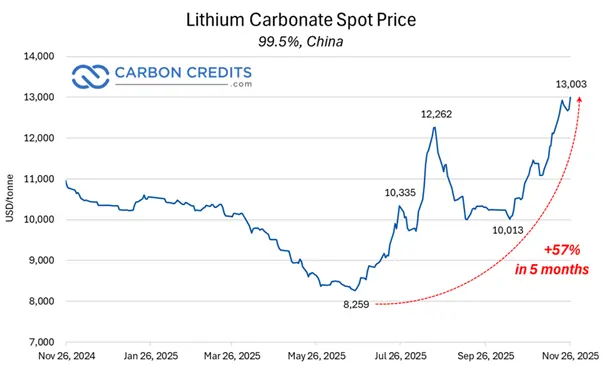
CATL, the world’s big battery maker, is developing sodium-ion batteries. At first, they were used for commercial vehicles, but now CATL says they’re going into passenger cars, too. One reason why it’s pushing into sodium batteries is that the price of lithium carbonate, which is the material that gets processed to make lithium batteries, has shot up. CarbonCredits.com reports that lithium carbonate prices in China went up 57% from July to November last year. Since then they jumped another 70% to more than $20,000 per metric ton. Lithium accounts for 20-25% of the cost of a battery, and with the price fluctuating wildly, it’s no surprise that CATL is so interested in sodium batteries, since they don’t use any lithium and sodium is a much more abundant resource.
THE SCOUT STANDOFF: WHY AUDI IS STUCK IN IMPORT LIMBO
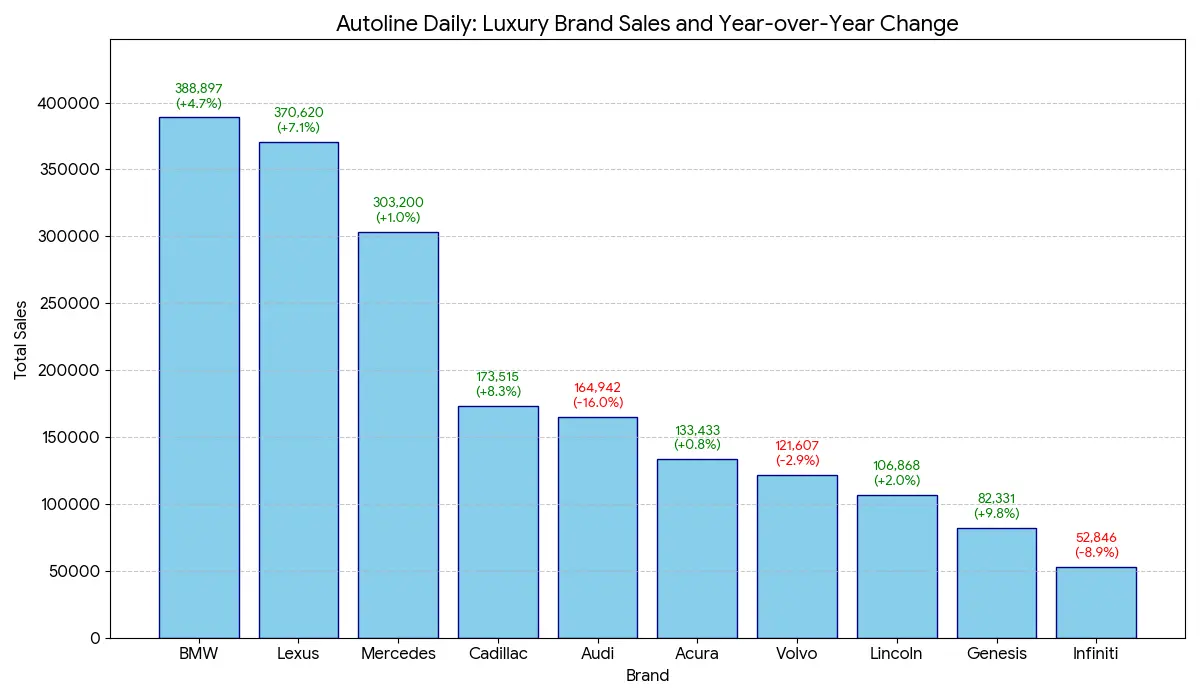
Here’s something that slipped past us. Last year Cadillac outsold Audi in the U.S. market, moving into 4th position amongst luxury brands. One of Audi’s problems is that it imports all its vehicles to the U.S. so they’ve all been hit with tariffs. And yet, Audi’s works council in Germany is dead set against the company building a U.S. assembly plant. There’s been rumors that Audi might assemble vehicles in Scout’s plant in South Carolina, but there’s a problem with that, too. Scout wants to bypass VW dealers and sell vehicles directly to consumers. It claims that it’s a completely separate company from VW and so those dealer franchise agreements do not apply to it. But if Scout starts building Audi’s in its factory and those vehicles are sold through franchised Audi dealers, then it weakens Scout’s legal standing. Here’s our Autoline Insight. We probably won’t hear about any plans for Audi to make cars in the U.S. until Scout’s legal battle has been settled one way or the other.

LUXURY LEADERBOARD: BMW KEEPS THE CROWN, CADILLAC CLIMBS THE RANKS
Speaking of luxury car sales in the U.S., do you know how the different brands stack up against each other? Well, here’s the latest. BMW took the top spot last year, selling over 388,000 cars and SUVs. Lexus was in second place, not too far behind. Mercedes trails quite a ways behind them and then there’s a big drop to Cadillac, followed by Audi, and then Acura and Volvo. Lincoln came in ahead of Genesis, which had the biggest percentage gain, while Infiniti fell further behind.
DETROIT THREE MEET WITH CARB AS CALIFORNIA LAUNCHES $200M EV INCENTIVE PROGRAM
The Detroit Three automakers are meeting with regulators from the California Air Resources Board this week to discuss the state’s regulations for greenhouse gas emissions. California is trying to move forward with its zero-emission goals after Congress revoked its waiver to set its own emission standards and on top of the Trump Administration weakening fuel economy rules and eliminating financial penalties for missing targets. Next week, California will reveal details for a $200 million EV incentive program, to help offset the elimination of the $7,500 federal EV tax credit. We think it’s a good idea for automakers to keep in touch with regulators because at some point Democrats will regain power and that way automakers won’t be blindsided by policy changes.
CANADA & SOUTH KOREA SIGN AUTO MANUFACTURING DEAL; COULD HYUNDAI TAKE OVER GM’S CAMI PLANT?
Canada is slowly reducing its reliance on U.S. car companies. Earlier this month, Canada reached a deal to slash tariffs on Chinese EV imports and now Bloomberg reports that it signed a non-binding agreement with South Korea to bring Korean car manufacturing to Canada. It’s part of a broader industrial cooperation that would see the two countries also collaborate on critical mineral supply chains, clean energy transition and energy security. Hyundai and Kia currently don’t build vehicles in Canada but they sell a combined 220,000 cars a year in the country. And perhaps Hyundai and Kia could take over General Motors CAMI plant in Ontario which has been idle since October and faces an uncertain future. Besides the Detroit Three, Toyota and Honda also build vehicles in Canada.

STELLANTIS DENIES UAW CLAIMS OF 7-MONTH DELAY FOR BELVIDERE JEEP PLANT
And in other manufacturing news, Stellantis is delaying the reopening of its Belvidere plant in Illinois. The plant closed in 2023, but last October, the automaker announced plans to invest more than $600 million to retool the facility and hire 3,300 workers, to start building the Jeep Compass in 2027 and the Jeep Cherokee in 2028. But the president of UAW Local 1268, which represents the plant, says Stellantis is delaying the start of production seven months until mid-2028, citing discussions between the union and executives as well as documents from the automaker. But Stellantis disputes that and says its plans haven’t changed. However, the delay has the union concerned because its current labor contract is set to expire in April, 2028 before it says Stellantis will reopen the Belvidere plant. And the union is worried Stellantis won’t follow through on the reopening and use the plant as a bargaining chip in its next contract negotiations.
NEW MERCEDES S-CLASS DEBUTS WITH 60-MILE PHEV RANGE AND ADVANCED L4 HARDWARE
Here’s the new Mercedes S-Class, which we first reported on a little over a week ago. While the styling is not that much different, the company claims more than 50% of the car is newly-developed, updated or refined. That includes things like a new Operating System, which features a more powerful computer and enables broader OTA update capabilities, driver assistance and a host of features through the new standard display, which merges the passenger and center screens under one piece of glass. The new S-Class is offered in short- and long-wheelbase versions and, thanks to a 48-volt starter-generator on every gas and diesel setup, the luxury sedan is technically only available as a hybrid now. It also offers a PHEV that gets an estimated WLTP EV-only range of about 100 kilometers or roughly 60 miles. There’s a ton of other upgrades we could go through, but a couple we find interesting are heated seatbelts for the front passengers that feature thin filaments integrated into them and smart headlights that not only adapt to other road users, but also can project an icy road warning or a light carpet so you know where the vehicle is aimed down a narrow street. Orders for the new S-Class are open now and in Germany prices start at over 121,000 euros, including the VAT.

MERCEDES PARTNERS WITH NVIDIA & UBER FOR L4 S-CLASS ROBOTAXI SERVICE
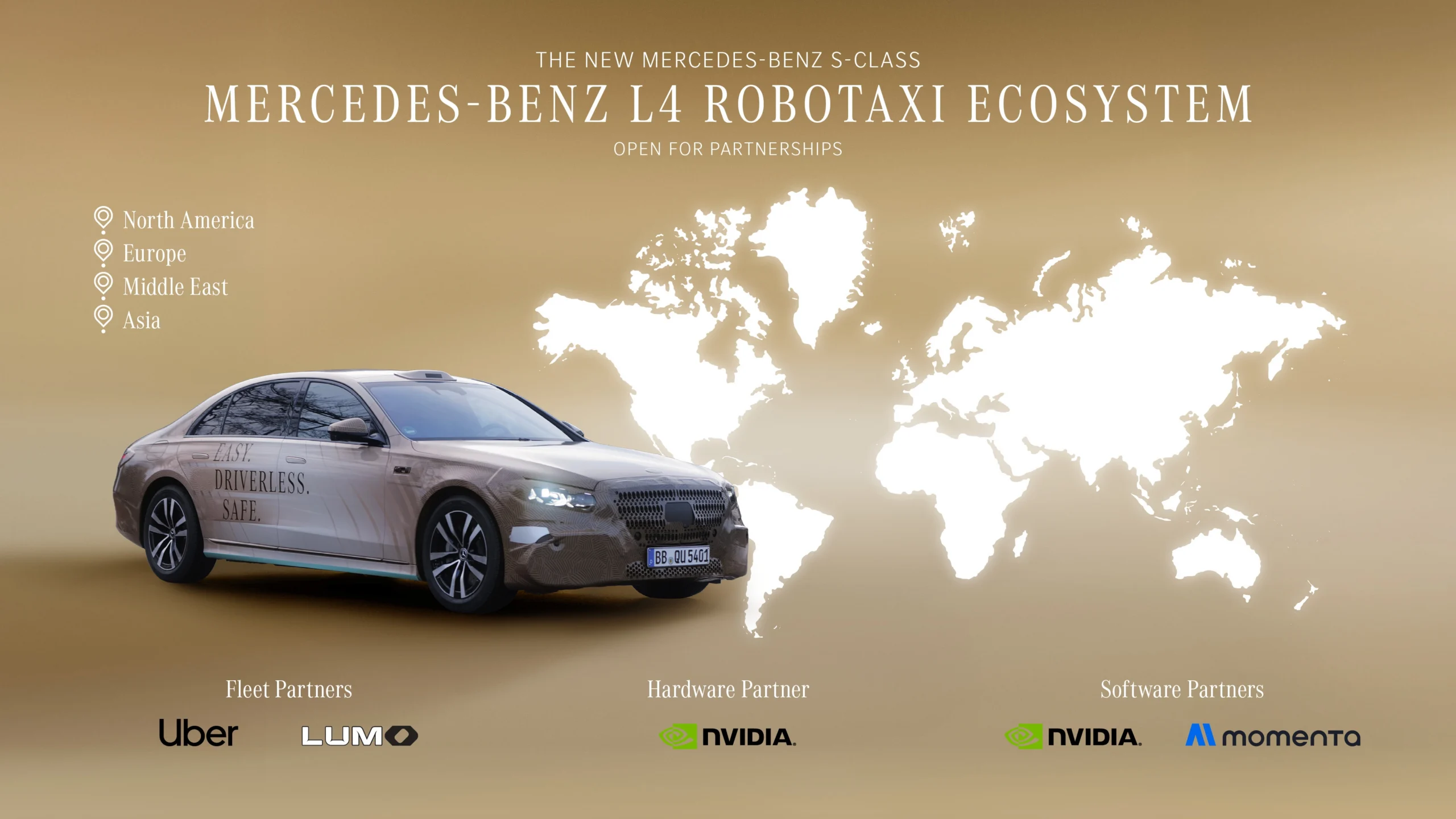
Speaking of when we first reported on the new S-Class, we also reported that CEO Ola Källenius claimed the luxury sedan is ready for Level 4 driving. Well, it turns out the automaker is using the sedan to launch a luxury robotaxi service around the world. Mercedes is working with NVIDIA for the system’s hardware, which includes redundancies for steering, braking, compute and power supply. And it’s working with NVIDIA and Chinese AV company Momenta for the software. Mercedes has signed partnerships with mobility providers Uber and Lumo, the latter of which will start tests in Abu Dhabi later this year, with the hope of launching in that market first, then followed by other locations after. So, it looks like Lucid is getting some competition in the luxury robotaxi space.
But that brings us to the end of today’s show. Thanks for tuning in and I hope that you have a great weekend.
Thanks to our partner for embedding Autoline Daily on its website: WardsAuto.com





Lithium price is 1/3 the peak price but certainly up since the summer. A lot to the cost is refining of lithium less so finding it like refining gold out of Virginia City NV in the 19th century. Maybe Donut Lab will solve it with their electrical storage device but then that is a gamble
The CAMI plant would be perfect for KIA’s electric van plans, since the plant already was setup to make electric vans. Personally, I was hoping that it would be bought by BYD so that it could manufacture Shark pickup trucks.
Heated seatbelts? Really?? My guess is, if you’re comfortable enough to be out in the cold without a jacket, you’re likely not going to be bothered with a heated seatbelt either.
But, now MB gets to chalk another one up under, “…because we can.”
That was a nice stretch of hiway in California. Driven it on a number of occasions.
Regarding subscriptions, I have followed Formula 1 for years, no, decades. I rarely “subscribe” to anything, but if I want to watch F1 races now, I will need to subscribe to Apple TV. I haven’t decided yet, and I haven’t found any “work arounds” at this point. This whole thing is quite disgusting, that the F1 “owners” would broadcast the races only on a streaming service with limited appeal.
I saw another Autoline YouTube video proclaiming that EV is still the future!!!!
Well here’s another real life news story of reality smashing the EV mind virus fantasy in the face: Burlington’s $8million “fleet” of 5 EV buses out of service because they have to be parked outside due to a battery fire risk notice from the manufacturer but they can’t be charged outside because it’s too cold…in Vermont in winter. Bwahahahahaha.
How many all weather diesel buses that will run fo decades could have been bought for $8 million I wonder?
https://vermontdailychronicle.com/5-gmt-e-buses-bought-for-8-million-out-of-service-due-to-fire-risk-frigid-weather/
They probably should have gotten BYD buses, more of a known quantity in electric buses.
Daily Driver —
What of the ICE semi that was hit by a train because it was struck on the railroad tracks due to the extreme cold, a day or two ago?! Does that mean that we should all give up on the dream of ICE vehicles? ICE vehicles catch fire a lot more often than EV, simply because they are more of them on the road, but how often do they make headlines? I just saw at least ICE vehicles on the side of the road in the last couple days, but does that mean that ICE vehicles are unreliable and dangerous in the winter? Working for the municipality that I do, sadly I have come across several instances where a person’s garage and/or home was severely damaged, as a result of a ICE vehicle, catching fire and burning the property! The vehicles weren’t that old and the insurance pay out into instances would indicate that there was nothing nefarious taking place. On top of that, in Detroit, Michigan, two of their municipal DDOT city bus terminals within the pass 10 tens, have caught fire and destroyed one thermal and severely damaged the other, as a result of the diesel buses catching fire! For a time they too had to park their ICE buses outside, to help prevent fire risk!
Sorry, my bad, but that fire at DDOT was about 30 years ago! My has time flown by since I worked there! Two fires at different terminals, where the diesel buses caught fire in the storage bays! After that, the stored them outside those bays and it was winter time during one of those fires.
I know the report on Tesla stopping/phasing out the manufacturing of the model s and x was last week and replacing them with humanoid robot construction. Yet, I had a few questions that I had that I didn’t get a chance tto ask last week. How does Tesla justify the business case for humanoid robots? At least with the model S and x, there is a business case they could pattern after existing OEMs. With humanoid robots, though, with it being so new, they might sell a million copies for X amount of money, but how do you justify whether or not it was a success or not? They might sell 20 and it could very well be a success, or sell 200000 and it’d still be considered a flop. What are they using as a basis to justify what they’re selling? Then, who might they be selling these humanoid robots to? I don’t imagine that they will be placing them at the homes of individuals, like you might at with a vehicle. In the Hyundai case, you can see their attempt to use them first and foremost in their own manufacturing. However, based on all the messaging, it appears that Tesla will be selling them to others for them to use. Where and who are the manufacturers? Do they already know and have them programmed to be used in those places that they sell them to? Maybe warehouses and storage facilities? They seem pretty clear on how many they plan to sell, with no real direction as who they plan to be selling them to and in what format will they be sold? Will they be 3 or 4 armed units? Will they have lower limbs/appendages or roll on wheels instead of having legs? Why does a humanoid robot need to have a head?
The Tesla humanoid robots my be the next Cybertruck. What is the market for them? Non-humanoid robots make a lot more sense for manufacturing.
Wmb – None of your what-ifs or anecdotes would be pertinent in this scenario unless BMG had opted to buy the EVs because their diesel buses were not safe or couldn’t handle the winter. And that is not the case. They bought them to “fight climate change” as noted in their rollout press releases. An expensive virtue signal courtesy of the tax payers.
The facts are that the EV buses are unusable in their climate and they had to park them and put their old diesel buses back into service. Those diesels are doing the job that the $1.6 million per unit EVs couldn’t.
Kit – Tesla, Samsung, Hyundai, and some Chinese companies are all working on humanoid robots. There are factory worker variants, like for Amazon or autoplants, and domestic versions that they 100% plan to market for home use. Housework, maintenance, companionship, medical assistance – there are limitless applications. They already have impressive dexterity and fine motor skills – at the last CES, one was doing needlepoint and another was doing full-on Kung Fu. So, that’s the plan anyway.
Daily Driver —
That’s the thing, I worked at DDOT when the diesel buses carts fire! It is not a what if! My point is: both EV and ICE vehicles can catch fire, but this is not a reason to abandoned the technology! The damage to the DDOT diesel buses, the facility they were stored in, cost the City of Detroit millions of dollars in losses, if not twice as much in tax payer money to repair and replace! Just as EV have trouble in cold weather ICE vehicles do too! On January 31, 2016, a Norfolk Southern train collided with a semi-truck, stalled on snow-covered tracks in Gastonia, North Carolina! Colder and snow stalled an ICE vehicle and it was hit by a train! This is not a what-if, anecdotal or hypothetical, it really happened! After all this time driving ICE vehicles, something like this STILL happens! Does this mean we give on the tech? No! Does this mean that with continued use, we’ll never see something like this happen again? Probably! That being the case, why would EVs be treated any differently? In almost every instance where something negative is pointed regarding EVs, the same thing has or still can be said about ICE vehicles! One of the only exceptions is refueling, but AutoCar has an artificial dated for 1 February 2026, that Nyobolt has taken an Elise EV, put in their proprietary battery tech and can recharge the battery in about 6 minutes! Nyobolt says that they are already in talks with about ten OEMs to use use their tech, which is based on existing technology and suggest that this may circumvent the need for solid state batteries. So, even refueling may not be an issue in a couple of years!
wmb- The biggest difference between the ICE fires and EVs are ICE vehicles don’t catch fire while sitting in the garage not in use. Almost all ICE vehicle fires are from poor maintenance. Typically while running. A loose/ broken fuel line, tank or oil leaking engine that was not serviced properly. Likely preventable. Where EVs are catching fire while being charged unattended. Also the big difference is when a ICE vehicle catches fire a single personal fire extinguisher can typically squelch the fire if caught early on. Where once an EV starts to smoke the best thing to do is get far away. They are not easy to extinguish and in most cases the fire dept allow them to burn out and just try and reduce the spread to other structures and vehicles. Like the difference of a fire cracker and a stick of dynamite.