



Follow us on social media:



Runtime: 9:25
0:00 Farley To Trump: Force Chinese OEMs Into U.S. Joint Ventures
1:16 Chinese OEMs Target Global Mid-Size Pickup Market
2:20 Stellantis Defies Market Data with Diesel Resurrection in Europe
2:59 VW Faces New Criminal Trial in France
3:55 Toyota Teaches Joby Aviation “TPS” To Scale eVTOL Production
5:14 Chinese Suppliers Still Struggle with Payments
6:31 Cathode Costs Remain the Primary Hurdle for Solid-State Scaling
Visit our sponsors to thank them for their support of Autoline Daily: Bridgestone, CSP and Intrepid Control Systems.




This is Autoline Daily, the show dedicated to enthusiasts of the global automotive industry.
FARLEY TO TRUMP: FORCE CHINESE OEMS INTO U.S. JOINT VENTURES OR FACE “EXISTENTIAL THREAT”
President Trump says he would welcome Chinese automakers to build cars in the U.S. And Geely says it will make an announcement in a couple of years to make cars in South Carolina. But Ford CEO Jim Farley’s advice to the Trump Administration was basically, if you’re going to let the Chinese in, then make them play by their own rules. Here’s what Farley means. China forced foreign automakers that wanted to come into China to form joint ventures with Chinese car companies in which the foreigners were the minority partner. They also had to share their technology with their Chinese partners, had to develop new cars from scratch in China and had to train Chinese designers and engineers. Bloomberg reports that Farley is not in favor of letting Chinese OEMs set up joint ventures in the U.S, but told Administration officials that if they were going to let the Chinese in, that would be the way to do it. So, here’s what we’ll all be watching. In April, President Trump will meet Xi Jinping in Beijing for trade talks, and that might be one of the bargaining chips he’ll bring along with him.
CHINESE OEMs TARGET GLOBAL MID-SIZE PICKUP MARKET
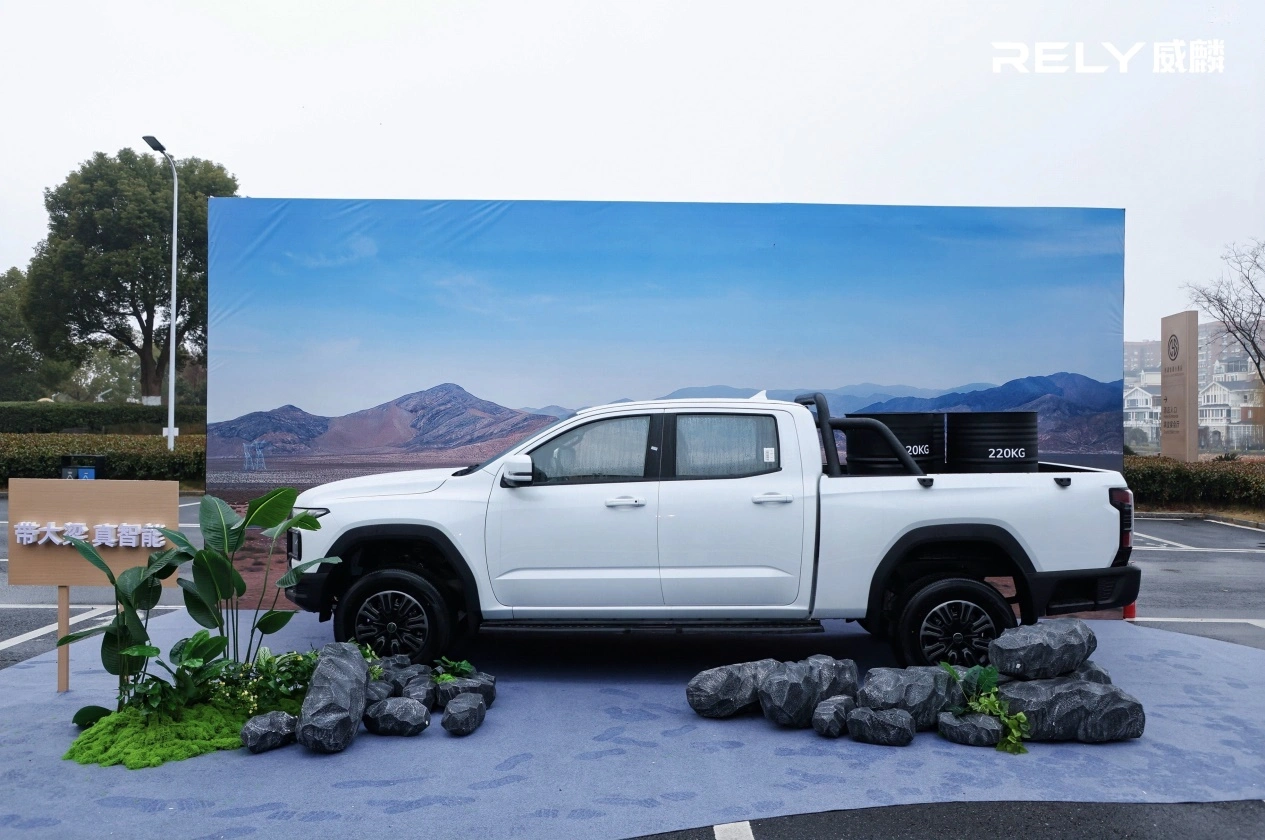
Meanwhile, a number of Chinese automakers see mid-size pickups as the next big segment they want to jump into, not so much in China, but in the rest of the world. Pickup sales in China are relatively small, hitting about 258,000 units last year, and down more than 6%. But exports of pickups hit 300,000 units. Gasgoo reports that Chery is targeting strong pickup markets with a multi-powertain strategy: EVs and hybrids for Europe and diesels for Australia, New Zealand, South America and Africa. Chery’s electric mid-size pickup, the Rely R08, is a body-on-frame design that sells for $18,000 to $23,000 in China, has a max range of about 300 miles and can carry 1,800 pounds. The global mid-size market for pickups is led by Toyota, Ford, Isuzu, Nissan and Volkswagen. It’s a very profitable segment for them and they’re going to have a massive fight on their hands trying to protect what they’ve got.
STELLANTIS DEFIES MARKET DATA WITH DIESEL RESURRECTION IN EUROPE
Stellantis is going back to diesels in Europe as it pivots away from electric vehicles. It’s reintroducing diesel versions of at least 7 models to help boost sales. But that strategy is a bit puzzling. According to the ACEA, diesel sales plunged 24% last year in Europe and it’s now the smallest powertrain segment by sales volume. In 2015, diesels accounted for half of new car sales but last year that dipped to just 7.7% of all sales. Hybrids are now the largest segment in Europe, accounting for 34% of new sales.
DIESELGATE’S GHOST: VW FACES NEW CRIMINAL TRIAL IN FRANCE
And speaking of diesels, Volkswagen is still facing consequences over its diesel-emission cheating scandal from more than a decade ago. The automaker has been ordered to face a criminal trial in France related to the cheating and is being accused of deceit “concerning goods that endanger human and animal health.” But the trial isn’t expected to start until sometime next year and Volkswagen didn’t immediately respond to requests for comment. France is also taking action against Renault and Stellantis for similar emission violations but both automakers deny any wrongdoing.

TOYOTA TEACHES JOBY AVIATION “TPS” TO SCALE EVTOL PRODUCTION 5,000%
The flying taxi industry is using automotive production knowledge, which has been built up over the last 120+ years, to improve the aircraft making process. Joby Aviation plans to have its eVTOLs offering a limited amount of rides in Dubai this year and then expand similar operations into other parts of the world in 2027, including the U.S. Since Joby is trying to bring an entirely new class of aircraft to the market with a lot of new technologies, it sounds like the company has kind of had to invent how these eVTOLs are built. Right now, it’s able to make one of its aircraft a month, but Toyota is doing more than just infusing $900 million into the company. It’s teaching Joby the Toyota Production System, doing everything from training workers, to improving the manufacturing process and acting as a supplier in some cases. With Toyota’s know-how, Joby plans to go from building one eVTOL a month, to 4 a month by next year and then eventually hit 500 a year, once its facilities in California and Ohio are fully built out. The Joby aircraft seats 4 passengers, plus a pilot, and is said to be able to travel up to 100 miles at up to 200 MPH.
THE 60-DAY DECEPTION: CHINESE SUPPLIERS STILL STRUGGLE WITH PAYMENTS
Automotive suppliers the world over always complain how long it takes automakers to pay them for the parts they bought. Payments typically take 60 to 90 days. In China, it could take even longer than that, and it was threatening the survival of a lot of small and medium-sized companies. So, the government stepped in with regulations, stipulating that automakers had pay suppliers within 60 days. And on paper it looks like it’s working. The data shows that automakers are now paying suppliers in 54 days or even sooner than that. Yet, suppliers are still complaining. Gasgoo reports they have a saying “Good data, bad experience”. That’s because some automakers simply delay sending out invoices, and then pay within 60 days of that. Some only send out part of the payment, then pay the rest later. Some demand concessions before paying. Others send out what are called bank acceptance bills, which a bank will honor, but have a maturity date 180 days out. Gasgoo says regulators need to put more teeth in their regulations and automakers need to be more responsible.

CATHODE COSTS REMAIN THE PRIMARY HURDLE FOR SOLID-STATE SCALING
Solid-state is supposed to be the next big breakthrough in battery technology, but its progression to market has been slow. One battery expert in China says that it’s cathode development, not the solid electrolyte, that’s been keeping the batteries from going from the lab into commercial production. While some companies will come out with solid-state batteries this year and next, they’re only expected in low volume. And it sounds like companies are still looking for the right combination of materials to achieve the levels of safety, performance and durability that solid-state batteries are supposed to provide. Here’s a little bit of a fun fact, the cathode active material is by far the most expensive part of a typical battery, accounting for about half its cost.
But that brings us to the end of today’s show. Thanks for making Autoline a part of your day.
Thanks to our partner for embedding Autoline Daily on its website: WardsAuto.com







Stellantis introducing Diesel in any continent is confusing to me. Everyone around the globe seems to be going Hybrid these days. Maybe they are doing a Diesel Hybrid? That could be a unique market offering.
As far as reintroducing diesels, I say ‘different strokes for different folks’. If Stellantis ended up as the only company in the world selling diesels, they might be able to make money at it. If they focussed on markets like Africa, there might even be enough volume to justify it. If they could produce an engine that was simple, reliable and maybe multi-fuel, then their could be military, marine and agricultural sales involved as well. And by ‘multi-fuel’ I mean able to run on diesel, home heating oil, or soybean or other organic oils. Just because something doesn’t work for Europe or the US doesn’t mean it couldn’t work in the rest of the world. I can’t wait for air-cooled twin cylinder diesel dune buggies made in India and sold in Kazakhstan!
… sold under the Citroen 2CV name, of course
Side note, late week Toyota showed off the Highlander EV. With the Grand Highlander eating a lot of the standard versions sells, that seemed like a wise move to use a respected and popular nameplate to enter a smaller segment that the EV9 has gotten a late of praise for and not have to build brand awareness like Hyundai/Kia had to. My question is, with the standard Highlander sharing so much with the Lexus RV, would this mean that the next RX may become an EV too?! With the RX having been Lexus’ bread and butter model for years, would they be willing to go all in with an EV with that model?!
With the market for diesels getting smaller, being one of the few players in that club, could be a win for Stellantis having fewer competitors. Yet, with Stellantis being one of the companies found guilty of diesel cheating, I just can see the consumer having confidence in that type of model. The only way it makes since, to me, would be if the EU countries were to a complete reversal on emissions standards and eliminate most or all, like the US is doing. Then they would need cheat equipment and the consumer would be sure of what they are getting. I just doubt that those countries will do that. Stellantis could sell diesels at rock bottom prices, but the Chinese vehicles entering the UE and UK may have them at a cost advantage there too?!
Diesel gate: the gift that keeps on giving for the VW Group, with the EV antidote not providing to be as effective as they may have hoped! That said, if regulators and lawmakers could speak with one voice and not make rules, mandates and offer support, then back off of them and remove support, change the rules and move in a different direction, maybe VW‘s challenges might not be as dire as they appear. All-in-all, VW’s problems came as result of their own making and the leaders of the company financial gains by any means possible, ahead of doing the work to get the truthful end result. However much it would have cost them to do the engineering work and sold those vehicles at a loss, may not have cost them nearly as much as all the fines from around the world, the hit to the image and reputation of all the brands affected, as well as all the court costs and legal fees they have had to payout over the years!
While I don’t think it will happen, but as Chinese companies look to build vehicles in other countries, making them play by the same rulers they had in place for years in that country, only seems to make sense.
Did I hear that right that Joey wants to, at some point in the future, build 500K sky taxis a year? I just do see how they could ever become that popular?! I’m sure they are thinking global sells, but for a market that does not quite exist yet and they are essentially making from scratch, that seems like a tall order!
@MERKUR DRIVER: Mercedes showed diesel-hybrid prototypes which I really liked. I just checked my photos: at the 2008 Detroit Auto Show they had a S300 Diesel Hybrid (on the W221 platform). I loved that vehicle and a pity it did not make it to production. In itself I believe a diesel hybrid is a very good solution with the electric drive for the shorter distance and the diesel engine for longer distances and on the freeway. I tried to paste the picture here but cannot.
@Sean: if you are interested I can send you the picture through e mail to you. Just let me know in that case.
wmb,
Lets only hope that VW has learned it is cheaper long term to do things by the book and they never repeat this mistake again. It is also a good cautionary tale to the other OEMs.
@MERKUR DRIVER: Volkswagen AG has had scandals ever since I started following them in 1987. I just checked with CHAT GPT:
“The Volkswagen AG stock options scandal occurred in the late 1980s, specifically in 1988.
What happened?
In 1988, several top executives at Volkswagen were involved in a controversy surrounding stock option deals and insider trading allegations. The issue centered on the improper handling of share options and financial transactions that raised concerns about transparency and corporate governance.
The scandal contributed to:
Leadership shake-ups within the company
Public criticism over executive compensation
Increased scrutiny of corporate governance practices in Germany
It was one of the early major corporate governance controversies in post-war German industry.
If you’d like, I can also explain how this scandal differed from Volkswagen’s much later 2005 corruption case or the 2015 diesel emissions scandal.”
It looks like at least one of Stella’s diesels will be a “traditional” European diesel, Opel Astra, a VW Golf competitor. I had one diesel, a 2004 Jetta wagon, and rented a pre-Stella Citroen C4 in 2012. Both had manual transmissions, drove decently, and were very efficient. I assume any diesels now sold in Europe would need urea fluid, but I guess it is cheap, and doesn’t need to be added very often. Yeah, diesel hybrids would be very efficient. I’m averaging about 55 mpg with my Prius over all types of driving. A car with a similar powertrain, but diesel would probably average 70+ in similar driving. I’d still rather have the gas engine, with cleaner exhaust, no urea fluid to mess with, and cheaper fuel. The cheaper fuel may be a uniquely U.S. thing, though.