




Follow us on social media:



Runtime: 10:03
0:00 Ferrari Halts Shipments to the Middle East
0:28 War Forces Japanese Automakers to Cut Production
0:56 GM CFO: Gas Price Spike Won’t Hit Sales for 4-6 Months
1:22 Automakers Could Face More U.S. Tariffs
2:26 Uber & Rivian Form Potential $1.2 Billion Robotaxi Partnership
4:25 Hertz Adds INEOS Grenadier to U.S. Rental Fleet
5:00 U.S. Getting its 1st G-Wagon Convertible
6:17 New Lexus ES Debuts As An EV
7:00 Exports Drive Record Profits for Chery
Visit our sponsors to thank them for their support of Autoline Daily: AlixPartners, CSP and Intrepid Control Systems.




This is Autoline Daily, the show dedicated to enthusiasts of the global automotive industry.
FERRARI HALTS MIDDLE EAST SHIPMENTS
The war in Iran is having an increased impact on the global auto industry. The Middle East is a significant market for high-end luxury cars, but with the Iran war turning that part of the world upside down, Ferrari announced it will stop shipping cars there. And if Ferrari is stopping shipments, then we think others will follow too.
JAPANESE AUTOMAKERS FORCED TO CUT PRODUCTION
Meanwhile, Japanese automakers are already cutting production in their home market because of the war. Japan gets 70% of its aluminum and naphtha from the Middle East. Bloomberg reports that some Japanese and Korean automakers are even talking to a Russian supplier to get the aluminum that they need. And Naphtha is a basic feedstock needed to make plastics. Japan also ships 800,000 vehicles a year to the Middle East.

GM CFO: GAS PRICE SPIKES WON’T HIT SALES FOR 4-6 MONTHS
And yet, General Motors says it has not seen any shift in sales so far due to higher prices at the pump. GM’s CFO Paul Jacobsen says it usually takes 4-6 months of sustained higher prices before consumer preference changes. He may be right, but when prices go up suddenly, like they’re doing right now, we’re going to see some car buyers panic a lot sooner than others.
TRUMP ADMINISTRATION EYEING MORE AUTO TARIFFS
Automakers could be facing a new round of tariffs within months. The Trump Administration has launched trade investigations into sixteen trading partners including Canada, Japan, South Korea, China and the EU, all over policies it claims lead to excess capacity and production and cause trade deficits with those countries. The investigations are taking place under section 301 of the Trade Act of 1974 and experts say it’s an unprecedented use of the law, which is normally reserved for one country or a single issue involving a small number of countries. And the results of these investigations could lead to more tariffs. But unlike the reciprocal tariffs that the Administration implemented last year, which the Supreme Court recently ruled were unconstitutional, section 301 requires feedback from the public before they’re put in place. If the results are negative, any new tariffs would likely be implemented in July.

UBER INVESTS $1.2B IN RIVIAN FOR 50,000 R2 ROBOTAXIS
Rivian is getting another big cash infusion. It’s going to supply Uber and its partners with robotaxi versions of its new R2 SUV and as a result the ride-hailing company is investing $300 million in Rivian. The plan is to deploy 10,000 autonomous R2s starting in San Francisco and Miami in 2028 and then expanding to 25 cities by 2031, which will also include areas of Canada and Europe. If Rivian is able to hit certain milestones set by Uber to reach those 2031 goals, then Uber’s investment rises to $1.25 billion. And there’s the option for Uber to buy another 40,000 R2 robotaxis starting in 2030. It’s been wild to see all the autonomous deals the ride-hailing company has made in the last year. It clearly views driverless rides as a core part of its future business.
HERTZ ADDS INEOS GRENADIER TO U.S. RENTAL FLEET FOR OFF-ROAD ENTHUSIASTS
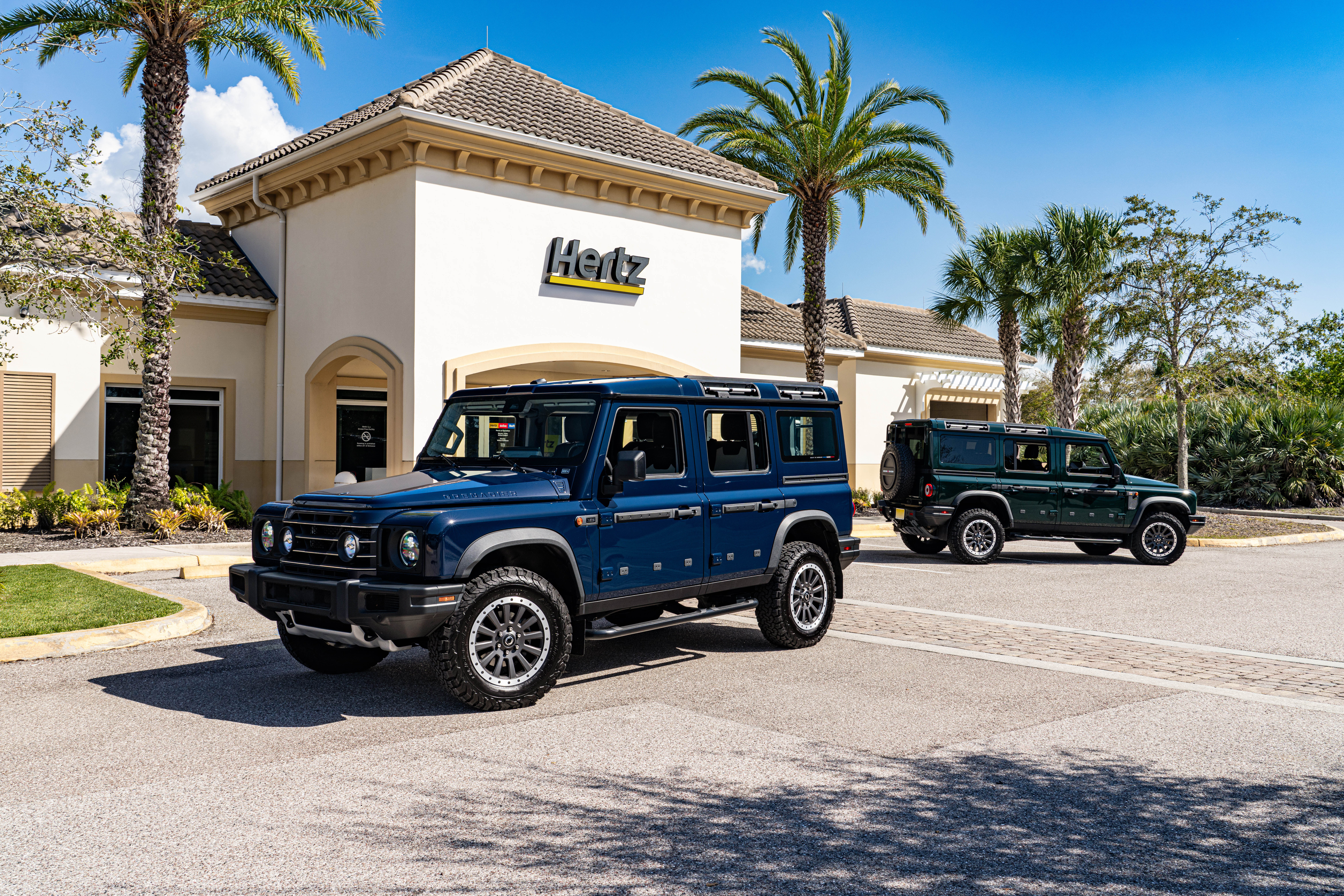
Car rental company, Hertz, is adding INEOS Grenadier SUVs to its U.S. fleet. Starting this spring, customers can rent the off-road vehicle at 21 airport locations across the country. The British based brand launched the Grenadier in the U.S. in 2023 and it’s now the company’s largest market. But INEOS wants to gain a bigger foothold in the U.S. and is making brand awareness its top priority this year. Adding its vehicles to Hertz’s rental fleet can be a great way to expose the company to more potential customers.
MERCEDES-AMG EXPANDING ITS LINE-UP; TWIN TURBO V8 FOR G-CLASS
Last year in the U.S. Mercedes sold about 303,000 vehicles, which was a 1% increase. But it’s launching a number of new models in the market and hopes for a steady increase in sales by the end of the decade, eventually hitting 400,000 units. EVs will play a role in that growth. Specifically, performance EVs. According to company dealers, Mercedes-AMG plans to launch three all-electric models that are based on its new performance EV architecture, which uses the axial flux motors it’s developing with a company called Yasa. The first to come out will be a sleek coupe early next year. It will be followed by a crossover later in the year and a fastback version of that crossover will launch in late 2028. On top of these models, dealers say there will also be a convertible version of the G-Class, a first in a decade and a first-ever for the U.S. However, it’s expected to feature a twin-turbo V8 under the hood. The option for a powered fabric roof should come late next year or in early 2028 and should generate some extra revenue from a vehicle that already has a starting price tag of nearly $154,000.

2026 LEXUS ES DEBUTS AS FULLY ELECTRIC SEDAN WITH 307-MILE RANGE
The Lexus ES is now available as a fully-electric vehicle for the first time. The EV features a nearly 75-kWh lithium-ion battery. Front-drive models with a 221 horsepower electric motor have up to an EPA estimated 307-miles of range. And AWD versions with 338-horses get up to 276-miles of range. The electric ES, which features new styling inside and out, arrives at dealerships in the U.S. next month with a starting price just under $49,000. Hybrid versions, that are built on the same platform and share the same overall design, will launch later this year.

CHERY AUTOMOTIVE EXPORTS DRIVE RECORD $2.8 BILLION PROFIT
A lot of Chinese automakers don’t make a profit, but Chery Automotive isn’t one of them. It sold 2.6 million vehicles last year, up more than 14%. Its revenue jumped more than 11%, hitting more than $43 billion. And it posted a net profit of $2.8 billion, up a whopping 36%. About 46% of Chery’s total sales came from exports and that helps explain why its profits shot up so much. With the price war still raging in China, Chery can sell its cars for a lot more money overseas.
AFTER HOURS: BYD ACQUISITION RUMORS AND CHINA’S SOLID-STATE BATTERY BAN
Be sure to join us for Autoline After Hours this afternoon. Some of the topics on the list for today include:
– Who could BYD end up buying?
– The FTC says dealers should only advertise prices including all fees, but will that really happen?
– China says automakers shouldn’t sell solid state batteries for two years. So what’s that about?
– And the US House is considering hefty road maintenance fees for EVs and Hybrids. Will they do it?
That gives you a flavor for some of the things we’ll get into, so join John and Gary when the show goes live at 3 pm eastern time.
But that’s a wrap for this show. Thanks for tuning in and I hope to see you later.
Thanks to our partner for embedding Autoline Daily on its website: WardsAuto.com








Trump, like too many Americans, believes that every country should accept American made products over products made by local manufacturers. They believe this in spite of the fact that many of the local manufacturers in those countries are American owned! When the US imposes constantly changing tariffs on foreign countries, it hurts the American owned manufacturers in the foreign country as well. As sentiment grows against the US in those foreign countries, the easiest reaction to protect themselves is to replace US imports with other countries imports AND to nationalize or otherwise exclude US manufacturers from their country. In Canada, I fully expect BYD to buy GM’s closed BrightDrop plant, LEAP to buy a Stellantis plant (perhaps as a joint venture). Another option is for Ford to joint venture the Oakville plant with BYD to product BYD shark pickups and SUVs.
I was behind a INEOS Grenadier yesterday, and didn’t know what it was, until I got up close behind it when stopped. I guess its competition is G-Wagon or something like that. Searching, I found that it uses a BMW turbo six, and gets horrible mpg, 15/15 city/highway and 15 combined. It is heavy, about 6000 pounds, and would be draggy.
Where I am in Florida, gas has gone up more than a dollar a gallon since the Trump/Netanyahu disaster started. Gas price doesn’t directly affect me much, since I’m driving a 55-60 mpg car, but this orgy of death and destruction is causing global havoc, and is affecting others, even in the U.S. in a significant way. Of course, the indirect affects of various shortages, increased shipping costs, etc. will soon be affecting everyone, everywhere.
These tariffs will just force erstwhile U.S. allies and trading partners to buddy up with everyone else, including China. As Kevin said, Chinese companies will probably buy some plants in Canada, like the Brightdrop plant, Stellantis Brampton, and probably others.
Although the INIOS Grenadier is a big pig of a vehicle, they sell well enough to have been the primary sponsor of previous America’s Cup campaigns. Lots of spare cash there. Don’t think they have a large R&D department.
Reading about the INIOS Grenadier, it sounds like it is meant to be like a certain discontinued Land Rover, more than a G-Wagon.
Uber has enlisted a number of OEMs to serve as the vehicle of choice for their autonomous robotaxis, none of which to date appear to be Tesla products. Could it be that they see Tesla and its cyber cab as a competitor, as opposed to the Model Y being a suitable vehicle that they could use in their services?
The upside to the higher gas prices is my bicycle is getting more use
If BYD purchased the naming rights to Packard, Sterling or Bristol with the intent of selling their cars under those names, many old heads would fall over dead, just so they could role over in their graves!
With the Lexus ES going EV, what does that mean for the Camry, since, in many respects they share a common vehicle platform?! Does that mean that an EV Camry is in the works, too?
On top of that, the design and styling of the new ES, has little in common with the previous generation version, visually! Outside of the vehicle footprint, just to look at it, one could be forgiven if the last vehicle they could have ever imagined it to be was the Lexus ES.
wmb, being 79, I remember Packard, but it was on a very steep downward slide in my early memories. My dad, though, remembered Packard as a genuine competitor with Cadillac and Lincoln in the 1930s. Packard never really recovered after WW II.
It looks like Lexus ES will be made both EV and hybrid. It will be a different platform from Camry. I doubt if Camry will go EV any time soon, unless they use the Camry name for an EV, while keeping the hybrid under some other name, like Camry Classic or such.
I’d like to see a Lexus version of Prius, similar size, but nicer interior and quieter. To me, cabin noise at high speed is the main shortcoming of the current Prius, other than poor visibility in some directions.
I would rent an ineos, but won’t come within a mile of a Hertz rental counter. That company is either going to get you jailed or charge you thousands after the rental for “damages”