




Follow us on social media:



Runtime: 11:05
0:00 EU Gas Price Spike Raises Used EV Interest
0:59 Honda Motorcycles Under Pressure from Chinese
1:42 Toyota Tells Suppliers to Boost Productivity or Risk Survival
2:36 Robotaxis Could Cut Private Car Sales by 30%
4:00 Magna Turns to Chinese to Help Save Austrian Plant
5:09 China Price War Destroying Dealer Profits
5:56 Skoda Leaving China Altogether
6:32 Hyundai Plans Aggressive Growth
7:06 Jeep Off-Road Event Also Important for Designers
Visit our sponsors to thank them for their support of Autoline Daily: AlixPartners, CSP and Intrepid Control Systems.




This is Autoline Daily, the show dedicated to enthusiasts of the global automotive industry.
USED EV SALES SURGE IN EUROPE AS GAS PRICES SPIKE
Rising gasoline prices caused by the war in Iran is ramping up used EV sales in Europe. Since the conflict began, gas prices in the EU have risen 12%. They now average about $7.40 per gallon and in some northern countries it’s nine bucks a gallon. Thanks to that, online platforms tell Reuters that more car buyers are searching for and choosing a used EV. One French online used-car dealer has seen used EV sales nearly double since the middle of February. Similar retailers in Norway, Sweden and Denmark also have seen a jump in used EV sales after the war started. But it’s not just used EVs, according to the ACEA, sales of new EVs are up nearly 15% so far this year in Europe as well.
HONDA MOTORCYCLES UNDER PRESSURE FROM CHINESE EV RIVALS
Japanese automakers are quickly losing market share to Chinese automakers in many markets. And for Honda it’s a double-whammy because it’s also threatened by Chinese motorcycles. With Honda’s car business taking a massive $15.7 billion write-off of its EV investments, it’s the motorcycle side that’s keeping the company financially afloat right now. But the motorcycle business also has to go electric to keep up with the Chinese. BloombergNEF estimates that 87% of all motorcycles sold globally will be electric by 2040. And Chinese motorcycle companies dominate the market for electric motorcycles and scooters.

TOYOTA CEO WARNS SUPPLIERS TO BOOST PRODUCTIVITY OR RISK SURVIVAL
Toyota’s outgoing CEO Koji Sato warned suppliers they better boost their productivity or they’re not going to survive. Automotive News reports he specifically cited work stoppages caused by recalls, and equipment breakdowns. He wants suppliers to do a better job of building quality into parts, but Toyota is also taking steps to help them. For example, it wants to commonize components across its models, so suppliers need fewer tools, and get greater economies of scale. It wants to eliminate overly stringent specifications, such as rejecting parts for minor cosmetic flaws like wire harnesses that had slightly discolored plastic. Toyota is calling this effort SSA, for Smart Standard Activity, and it’s part of an effort at the company to create a crisis-mode mentality.
ROBOTAXI MARKET FORECAST TO REACH $465 BILLION BY 2035
Everywhere you turn today, robotaxi services are popping up in cities all over the world, and it’s just getting going. The Boston Consulting Group says there could be as many as 700,000 to 3 million robotaxis by 2035, potentially generating $465 billion a year in revenue. Boston Consulting says costs will drop to only 80 cents a mile in the U.S. That’s about the same cost of owning your own car, based on numbers from the AAA, and is much cheaper than taxis or ride-hailing services. McKinsey says robotaxis could eliminate as much as 30% of private car sales by 2035, which would have a major impact on automakers, suppliers and car dealers. And we’ve just reached an important milestone. Pony.ai in China says it posted a net profit of $23 million in the fourth quarter, about 4 years after it started offering driverless rides.

MAGNA TURNS TO CHINESE EV MAKERS TO FILL AUSTRIAN PLANT
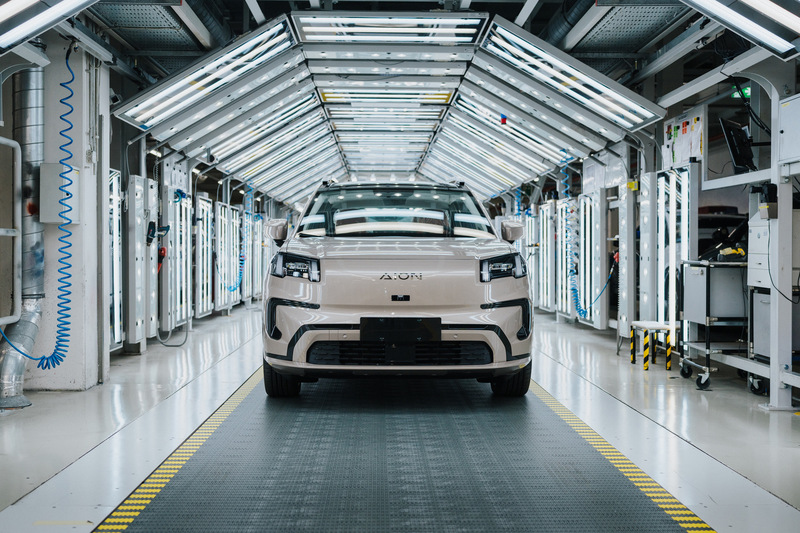
Magna is trying to make up for the vehicles it used to contract manufacture in Austria by turning to Chinese automakers that want to avoid EU tariffs on Chinese-made EVs. The plant lost models from BMW, Fisker, Jaguar and Toyota, but last year Magna signed deals with XPeng and Aion, which is a brand under GAC. It’s already making three models for the two automakers and now Aion is adding another, the UT. While they’re still mostly assembled with parts from China, there’s enough local content to avoid the EU tariffs. We’ll be interested to see how much these Chinese models fill out the plant. It’s big enough to make about 150,000 vehicles a year, but even when it had all those other brands in 2023 it still ran at roughly half capacity. However, XPeng and Aion left the door open to add more models and with the success of Chinese brands in Europe there’s a real possibility of that happening. They sold nearly 811,000 vehicles in Europe last year and are close to cracking double-digit market share.
PRICE WAR LEAVES MAJORITY OF CHINESE CAR DEALERS UNPROFITABLE
The price war in China isn’t just eating into automaker profits, it’s also hurting car dealers. According to the China Automobile Dealers Association, 56% of dealerships reported losses last year, up from 42% in 2024. And only 24% of dealers turned a profit, down from 39% the year before. Because of the price war, 82% of dealerships said they had to sell new cars below wholesale prices. In addition to the price war, China’s car market is also shrinking right now with sales dropping 20% in the first two months of the year. As a result, more than three-quarters of dealers expect sales to either contract or stay flat this year.
SKODA TO EXIT CHINESE MARKET FOLLOWING SALES PLUMMET
And due to that fierce competition in China, Czech automaker Skoda, which is owned by the Volkswagen Group, is dropping out of the market altogether. The company announced it will stop selling vehicles in China by the middle of this year because it wasn’t able to keep up with the shift to EVs. China was once Skoda’s largest market, with sales peaking at more than 300,000 units between 2016 and 2018. But last year that plummeted to just 15,000 vehicles. Skoda says it will now focus on expanding in India and southeast Asia.
HYUNDAI PLANS AGGRESSIVE GROWTH IN CHINA AND NORTH AMERICA
But it’s not all doom and gloom for automakers in China. Hyundai is planning to significantly grow sales. CEO Jose Munoz announced it’s aiming to sell half a million vehicles a year in the country in the medium-term, which is double what it currently sells. But it’s not just China, Hyundai is also planning big growth in North America. Munoz says the automaker will introduce 36 new models into the market by 2030, which includes variants of each model, like gas, hybrid and pure electric.
JEEP REVEALS RETRO CONCEPTS FOR EASTER JEEP SAFARI IN MOAB
The Easter Jeep Safari is coming up in Moab, Utah and every year Jeep designers create a number of concepts to show off to their most hard-core customers. It will be interesting to see how people react to the front end of the Wrangler ANVIL 715 concept, which is meant to be inspired by the SJ-series Jeeps of the 1960’s. But we bet the most popular is the Cherokee XJ Pioneer concept. Designers tastefully modified a near mint first-gen 1984 donor vehicle, whose original, and first owner, took exceptional care of, even meticulously writing down each trip to the gas station. On top of getting to work on these fun projects, Jeep designers also benefit from attending the Easter Jeep Safari. For some of them it’s their first time off-roading, so they learn more of what the brand is really all about. But it also helps retrain how they approach design. Most designers want to make vehicles that are lower, longer and wider, but that doesn’t work for off-roading. Even on SUVs they want to push the belt line higher, but that’s also bad for sight lines when you’re trying to crawl over an obstacle. So, overall Jeep designers aren’t able to exaggerate proportions as much as some other brands.

We’ve got a lot of great topics to dive into on Autoline After Hours later today, like the mad scramble to convert battery plants from EVs to data storage, Uber potentially buying up to 50,000 robotaxis from Rivian, and whether or not General Motors should drop its joint venture with SAIC and go it alone in China. We’ll have Gabrielle Coppola from Bloomberg and Stephanie Brinley from S&P Global, so join John and Gary when the show goes live at 3 pm eastern time.
And that wraps up today’s show, thanks for watching.
Thanks to our partner for embedding Autoline Daily on its website: WardsAuto.com








I’ll bet a weeks pay that if Jeep were to build the Cherokee XJ shown in the story with modern mechanicals it would sell everyone it could make, I know I’d be in that line! What a sweet body style and two doors to boot! I wish more had survived the rust rot and could be restored to almost new, love to see them on the rare occasions I pass one on the road. Come on Jeep, build us a modern Cherokee with old stampings!
Magna Steyr’s recent business has been low volume, but fairly pricey products like G-Wagon, Z4, Supra, and I-Pace. With the Chinese products, they may have more volume in number of vehicles than they’ve had in a while, but the money value will probably be lower. I think G-Wagon will stay, but the others I mentioned are gone, or will soon be gone.
I remember Magna Steyr and its predecessor in Austria building Chrysler minivans for the European market years ago. You could get one with a diesel/manual transmission powertrain in Europe.
Ziggy, that current turbo six should work well in a revived Cherokee XJ, with more than twice the power of the AMC six used in the XJ.
Yeah, that 2 door Jeep Cherokee with a modern engine and brakes etc . It would be nice seems those babies ran forever with minimum care. Classic looks to boot.
I’ve been to Moab twice,it is truly an amazing place,but instead of a jeep I would recommend seeing it by mountain bike.
Kit, I’d even settle for the new turbo four!!
Yep, the turbo four would have more than adequate power.
While Robotaxis might cut private sales by 30%, someone still has to make the robotaxis and so other than Tesla who are making their own, most other robotaxis are probably going to be build by other OEMs with parts from their supplier base. Now perhaps these fleet/upfitted vehicles will be less profitable, but it not like the OEMs are going to lose 30% of their volume. The bigger unknown to me is what do you do with all these robotaxis when they come off service? What will it take to convert them back into the used car market? Or do they just run them death like the old Checker cabs and then scrap them?