




Follow us on social media:



Runtime: 10:16
0:00 Tesla FSD Faces European Skepticism
1:33 Tariff Threat Lights Fire Under EU
2:38 2026 U.S. Sales Could Fall 4%
3:21 Geely Misses Q1 Expectations
4:23 Harley-Davidson Targets Younger Buyers
5:30 BMW Improves Paint Thickness Measuring
6:20 ‘China Speed’ Gets Even Faster
7:30 Volatility Is the New Norm
Visit our sponsors to thank them for their support of Autoline Daily: AlixPartners, Bridgestone, CSP and Intrepid Control Systems.




This is Autoline Daily, the show dedicated to enthusiasts of the global automotive industry.
SOME EU REGULATORS SKEPTICAL OF TESLA’S FSD
We thought Tesla had the potential to get permission to use Supervised FSD throughout Europe, but maybe that’s not the case. Last month Tesla got a big boost when the Netherlands Vehicle Authority, known as the RDW, approved Supervised FSD for use in the country. The RDW is seeking EU approval for the technology and today it will meet with regulators from other European countries about why it approved FSD and why other members should do so. And while Elon Musk has expressed confidence Tesla will get widespread approval in Europe, Reuters reports that regulators in Sweden, Finland, Denmark and Norway are skeptical about the safety of the technology. They’ve raised concerns about a tendency to speed, whether it’s safe in icy conditions and the driver’s ability to bypass features designed to prevent phone use. They also criticized Tesla for publicly encouraging owners to pressure regulators to approve the technology. For FSD to be approved, committee members representing 55% of EU member states and 65% of the region’s population must vote yes. But there is no vote scheduled today and the next committee meetings are in July and October. So, FSD approval won’t happen until the second half of the year at the earliest.
TARIFF THREAT LIGHTS FIRE UNDER EU
President Trump’s threat to raise tariffs on European cars to 25% sure lit a fire under the EU. The U.S. and the EU agreed to a trade deal nine months ago, but the EU still hasn’t reduced any tariffs on U.S. goods. It was going to, but after Trump threatened to invade Greenland, it hit the pause button. Now there’s a big push to get the deal done this month, even though some European politicians say they shouldn’t cave to Trump’s threats and should take more time. But European automakers are deeply worried. President Trump says the tariffs will go from 15% to 25% next week and as we reported yesterday, Bernstein calculates that would cut $6 billion in profits a year for European automakers. Audi is especially worried. It’s about to launch its Q9 SUV and the new tariff could add $20,000 to the price tag. So look for the auto industry to put enormous pressure on the EU to get a deal done ASAP.

U.S. SALES FORECAST TO FALL NEARLY 4% THIS YEAR
Speaking of the President and his automotive policies, analyst Warren Browne provided us with his forecast of how they will impact the U.S. auto industry this year. And it doesn’t look good. Browne says U.S, sales fell 6.2% and production fell 1.3% in Q1. And he thinks it will get worse as the year goes on. He’s forecasting a 3.7% drop in sales to 15.7 million vehicles, a 3.4% increase in prices and delivery charges, and a loss of 2,000 automotive manufacturing jobs. To quote Warren Browne, the “moderate benefits promised on Liberation Day remain elusive.”
GEELY MISSES EXPECTATIONS
Despite delivering a record high number of vehicles in the first quarter that boosted revenue 15%, Geely’s profit fell and missed analysts’ expectations. The automaker’s net profit tumbled 27% to $614 million, which Geely blamed on foreign exchange fluctuations. And while it raised its international sales target to 750,000 vehicles this year, up from 640,000, the slowdown in China’s car market is having a bigger impact on Geely. But it’s not just Geely. BYD’s profit also slumped 55% in the first quarter, which is a sign that China’s car market is still weak.

HARLEY GOES AFTER YOUNGER BUYERS
With approximately three quarters of its components sourced from suppliers, Harley-Davidson was hit especially hard by tariffs in the first quarter, paying out $45 million. While its global sales increased 8%, thanks to strong growth in North America, overall motorcycle shipments fell 3% and its revenue dropped 12% in Q1. To help turn things around Harley announced a new strategic plan it calls ‘Back to the Bricks.’ Leveraging its motorcycles, both new and used, as well as parts and accessories and even its apparel, the company says it will have a renewed commitment to its dealers. They’ll be getting a refreshed Sportster line, more customization and a new entry-level Sprint bike priced around $6,000 that’s aimed at younger buyers. So, the affordability problem is not just limited to the auto industry. With ‘Back to the Bricks’ Harley is targeting cost cuts of $150 million and profits from motorcycle sales to top $350 million by 2027.
BMW MOVES TERAHERTZ MEASUREMENT TO SERIES PRODUCTION
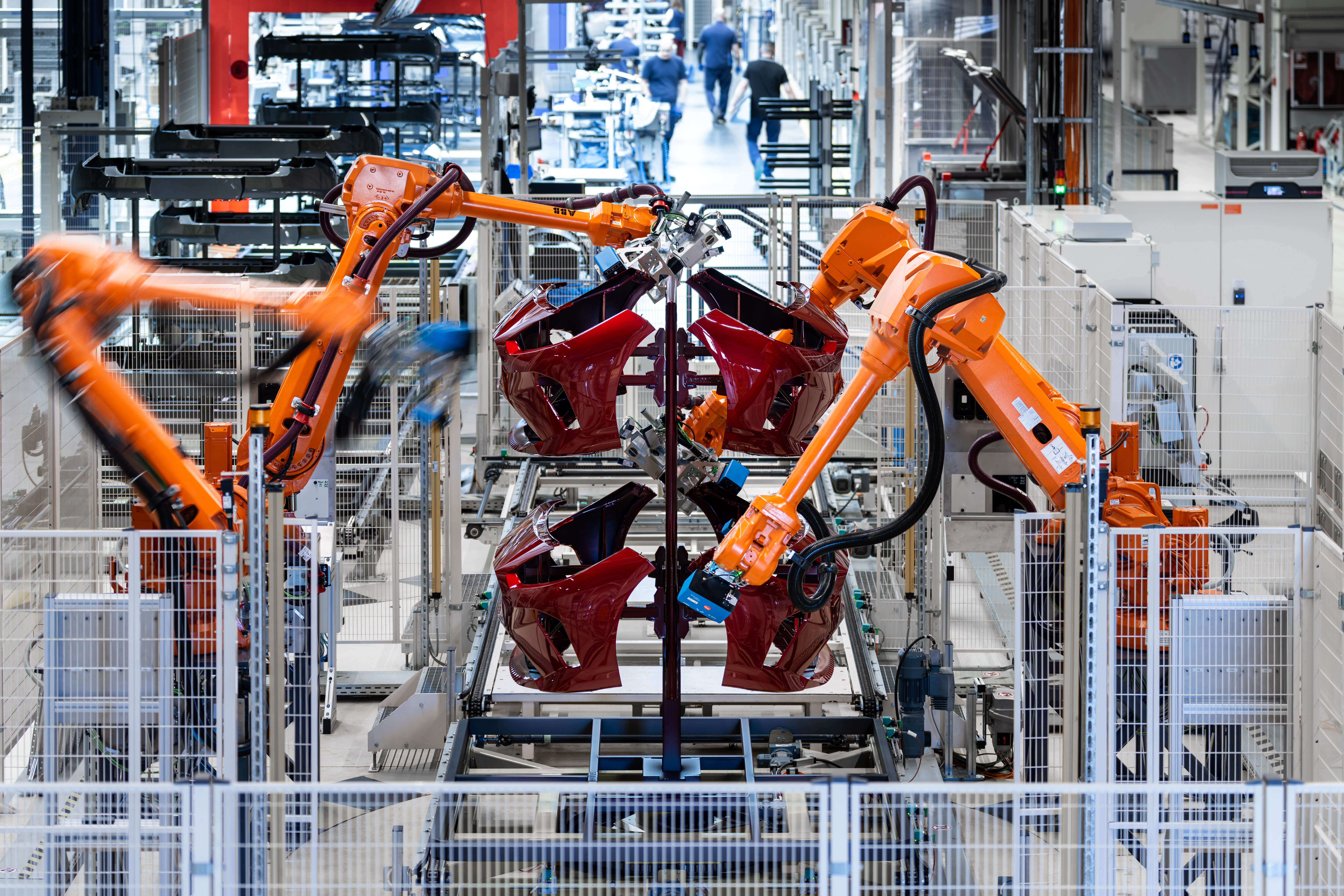
Two years ago BMW started testing out a new piece of technology at one of its paint departments that it’s now expanding into series production. It’s called terahertz-based measurement and consists of sensors mounted on two robots that measure the paint thickness on plastic parts. Before paint thickness was measured manually, requiring sections to be cut off and inspected under a microscope, which took time and pretty much rendered the part unusable. The new process is non-distructive, it measures down to the micrometer level in seconds and can detect any issues faster. BMW says there’s the potential for the technology to spread to other plants and in the future it will also use AI to analyze this data to optimize the process even more.
‘CHINA SPEED’ GETS EVEN FASTER
They call it China Speed and it’s the breath-taking pace at which Chinese automakers and suppliers can get projects done. A new car program is typically accomplished in 18-24 months, versus the 36-42 months it usually takes outside of China. Now Gasgoo reports that 18 month programs are no longer the target, they’re the norm. And China’s auto industry is moving to 12 month programs, with suppliers even doing product iterations on a monthly basis. China has turned the product development process on its head. Traditionally, automakers used highly specified steps and procedures. Suppliers were given thousands of specifications they had to meet. A program was not allowed to move forward until each step of the way achieved defined quality targets. That worked well, as long as everyone in the industry played by those rules. But China moves much faster, demands top quality, and has relegated the old way of doing business to the trash heap of history.
VOLATILITY IS THE NEW NORMAL
Every week Autoforecast Solutions publishes the latest data on new models from all over the world. This week’s newsletter lists 21 new model updates just from China. That’s more than we typically see from the rest of the world put together. If you’d like to learn more of what Autoforecast Solutions sees coming for the auto industry, check out the first of the quarterly updates we’re doing with them. CEO Joe McCabe and top analyst Sam Fiorani dissect the data from the first quarter and talk about what lies ahead for the industry this year.
But that’s a wrap for today’s show. Thanks for making Autoline a part of your day.
Thanks to our partner for embedding Autoline Daily on its website: WardsAuto.com







I have to really question Chinas ability to conduct the proper production validation testing of vehicles. Getting vehicles built in 12 months is quite an accomplishment but crash tests for safety and validation of a vehicle that was built using the production process and materials takes additional time. Not to mention the information gathered during those tests that can drive redesigns or changes to correct failures. Otherwise you just start producing vehicles and make corrections on the fly making those first year of production vehicles basically test beds with multiple issues that get corrected later. But hey China is known for cutting corners then ask for forgiveness later.
While Europe drags its feet on approval on FSD for Tesla, FSD will continue to get better all the time with each iteration the changes in FSD since last December will be that much more by next December.
Speaking of faster iterations and changes in automotive tech in China one can look at what is happening at the Tesla factory in Austin Texas just this year over 20 Cybercabs have been crash-tested that I can see [design change then crash test right then and there change again to maximize safety of whatever the team wants done]. Tesla is also building a 2 million square foot factory to do this with chips design make test then do it all over again till it is better yet. Which came first Chinese automotive or Tesla or is it time to make the dinosaurs dance?
@Dave
If FSD has so much room for near-term and intermediate-term improvement then why should EU regulators consider approval of the current iteration?
Chinese automakers fast development of new vehicles maybe as a result of them not playing by the same rulers and, as others have suggested, the need to make changes on the fly. Whike that may be the standard in China, especially with their manufacturing cost being so low (you get what you pay for!), that approach may not work in other parts of the world. Fortunately for them, based on what some industry leaders have said, their tech is already top notch, so there may not need to be a lot of change once the their products get on the road. Yet, therein therein comes the question of value! Would individuals be willing to purchase a vehicle a that might give them a few inconveniences, for leading edge technology, luxury creature comforts and arguably class leading perceived quality, at rock bottom prices?! Tesla has shown that people are willing to do so with what some might say are premium vehicles, so I wouldn’t be surprised if people would do so with vehicles that I a lot less expensive!
There are significant numbers of Chinese cars sold in “mature” markets. They have 14% market share in the UK, and about 25% in Australia. It shouldn’t take too long to know if the cars are any good, beyond the initial wow factor of some of them, and the good pricing.
China seems to be known mainly for EVs, but I’m curious about how Chinese ICE and hybrid cars compare with others in efficiency, performance, and reliability. Is there a publication in Australia similar to Consumer Reports in the U.S., that would test cars and do reliability surveys?
Let’s face it. China will be overtaking the U.S. in about everything. China has done a good job of stealing technology in the past, and are taking advantage of it. While the current U.S. regime is actively killing all types of scientific research, China is full speed ahead. While Trump is at war with renewable energy, China is supplying the world with hardware to produce it. Demand for that hardware has increased great over recent weeks because of the chaos in the middle east.
Dave, your comments have a curious undertone. 120 years of experience and 70 years of litigation and laws have driven traditional OEMs to safety practices that are lacking in China and at Tesla. Calling other OEMs “dinosaurs” is akin to suggesting they should ignore history (those who don’t learn from it are doomed to repeat it).
In the case of Tesla, the US government’s zeal (Obama and Biden) to promote an EV agenda resulted in regulators being caught flat-footed as Tesla over-promised and mis-named AutoPilot and FSD. Tesla made their customers into crash dummies. For all other OEMs, safety systems are required to operate with 0% failure. Tesla cut corners. Others couldn’t.
In the case of the Chinese, they have operated in markets with less stringent safety requirements. You’ll quip they operate in Europe and Australia. Those markets use EC safety protocols where safety compliance is assumed via a demonstration test, but NOT required to be 100% assured for all production variations. FMVSS requires 100% compliance for all production variance… leading to more testing and time. OEMs that overly cut development and testing have experienced high recalls.
This is a complex business and not for the faint of heart. Engineering and scientific discipline will win over the latest magic elixir.