




Follow us on social media:



Runtime: 9:56
0:00 Car Loans & Lease Rates Going Up
0:49 AM Radio Mandate Has Strong Support
1:55 Volvo Wants to Double Market Share
2:49 Toyota Asks Dealers to Lobby Against Tariffs
3:41 Europe Tries to Limit Chinese Hybrid Imports
3:59 EU Wants “Made in Europe” Rules
4:25 Mercedes Updates Vehicle Software on Production Line
5:09 Wave of Old Batteries Hitting China
5:46 Porsche Gets Raw Materials from Old Batteries
6:14 More Automaker Consolidation in China
Visit our sponsors to thank them for their support of Autoline Daily: AlixPartners; Bridgestone; CSP and Intrepid Control Systems.




This is Autoline Daily, the show dedicated to enthusiasts of the global automotive industry.
CAR LOANS & LEASE RATES GOING UP
In a unanimous vote yesterday, the U.S. Federal Reserve raised interest rates by a quarter point, bringing the prime rate to 4%. That’s going to raise the cost of car loans and lease rates, and automakers are either going to have to raise incentives or watch sales drop, or both. The average new car loan before the rate hike was 7% for a 60-month loan. Used cars are in the 9-11% range. Car sales were already dropping before the Fed’s move. They fell 6.3% last month. And when you add the soaring cost of gasoline and diesel on top of higher interest rates and the cost of tariffs, there’s tough times ahead for the automotive industry.
AM RADIO MANDATE FOR VEHICLES HAS STRONG SUPPORT
It looks like AM radio in automobiles will survive for years to come. The U.S. House just approved a bipartisan bill to mandate AM radio in all vehicles. The legislation now heads to the Senate where a similar bill has 60 co-sponsors and strong bipartisan support. Some automakers began removing AM radio from EVs about a decade ago because they claim currents from electric motors can interfere with AM broadcast signals. An industry-funded study by the Center for Automotive Research found it would cost automakers $3.8 billion to fix that interference. But others say the industry just does a lousy job of containing electromagnetic interference and that it’s a relatively easy fix. Government officials and advocates say it’s necessary to keep AM radio in vehciles for government emergency broadcasts when the power goes out. Automakers say AM radio is no longer widely used and there’s other options for drivers to get emergency warnings.
VOLVO LAUNCHES BIGGEST PRODUCT PUSH IN ITS HISTORY
Volvo wants to double its EV and hybrid market share by 2030 with the biggest product push in the company’s history. It will roll out 13 new models in the next four years, relying on Geely for the platforms. That’s a pretty ambitious goal and Volvo isn’t the only one thinking this way. Remember, Ford says it will have 5 all new nameplates by then. Toyota and Lexus have 30 BEVs coming. Nissan has 30 new models in the pipeline. Stellantis has 60, and the Hyundai Group has 100. And those are just the ones that have been publicly announced. So we’re about to see a tsunami of new products hitting the market by the end of the decade. All of these automakers are sure they’re going to boost sales and market share, but that’s a mathematical impossibility. So there’s going to be a war and someone’s going to lose.

TOYOTA ASKS DEALERS TO LOBBY AGAINST TARIFFS
Toyota is asking its U.S. dealers to help lobby against tariffs. Even though its sales were up 8% last year and are up slightly this year, Toyota is losing money in North America because of tariffs. The company posted a $1.2 billion operating loss in North America in its most recent fiscal year, which was a nearly $2 billion drop from the previous year. So, Toyota is asking dealers to communicate with regulators and law makers about the impacts of tariffs on prices and affordability.
EUROPE WANTS TO LIMIT CHINESE HYBRID IMPORTS
Chinese automakers are ramping up exports to help offset slumping sales in China. And now the EU is asking China to voluntarily restrict exports of hybrid cars to the region to avoid a trade war. Europe wants to limit Chinese hybrid sales to around 15% of the market.

EU WANTS “MADE IN EUROPE” RULES
In addition to trying to limit imports of Chinese-made cars, the EU is also crafting new “Made in Europe” rules, which set local content requirements for EVs. As a result, Chinese automakers are searching for existing plants in Europe to buy in order to meet the new rules. BYD’s European adviser says buying a plant instead of building a new one will allow it to start production more quickly.
MERCEDES UPDATES VEHICLE SOFTWARE ON THE PRODUCTION LINE
Mercedes’ new Operating System that’s debuting in models like the new GLA allows vehicles to get software updates when they’re being built, rather than embedding it in the hardware, which means each vehicle rolls off the line with the latest software. But there’s a couple other reasons Mercedes and likely other automakers want to update software right on the production line. With software already embedded in hardware, which comes from suppliers a lot of the time, there’s a level of uncertainty about what an automaker is actually installing in its vehicle. But updating right on the line gives the automaker more control over the software, which will improve security and could also cut down on vehicle defects.
WAVE OF OLD BATTERIES ABOUT TO HIT CHINA
It’s estimated that if you added up all the EV batteries that China has ever produced it would come to about 1,200 GWh. And since the first serious EVs started coming out around 2018 it means a wave of end-of-life batteries are about to hit the country. So, China has issued new guidelines that aim to set 50 new standards in battery recycling by 2030. But even though the country produces and sells more EVs than anywhere else, Gasgoo reports that China’s current battery recycling industry isn’t big enough to handle all the old packs that are coming.
PORSCHE RECYCLES OLD BATTERIES FOR RAW MATERIALS
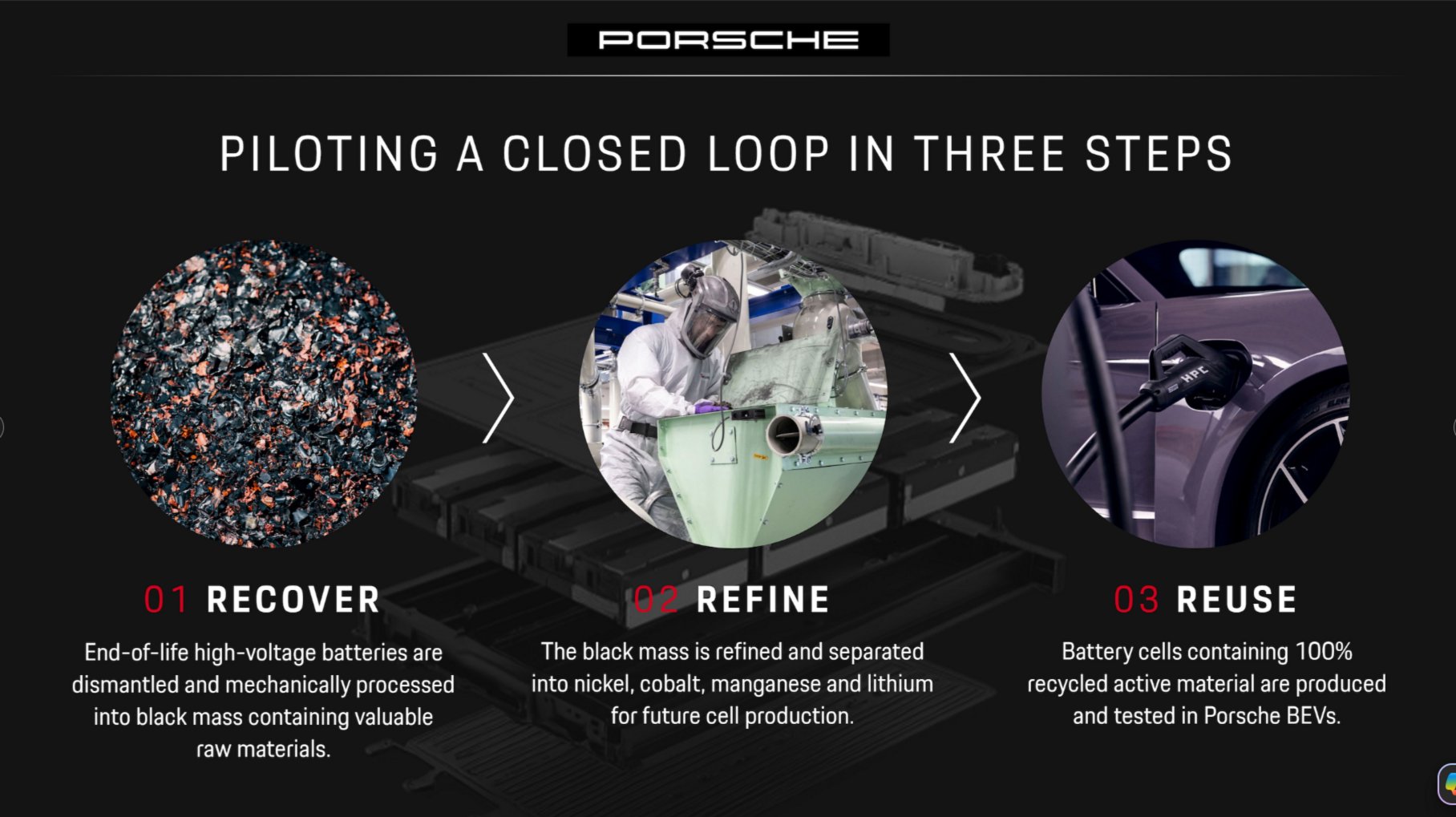
So maybe we’ll see more Chinese automakers doing the same as Porsche. It’s working with a recycling company to break down end-of-life batteries into raw materials, like lithium, nickel, cobalt and manganese, which are then used to make cathode active material for new batteries. Porsche says the batteries are now going through extensive testing and in 2028 it will start supplying the recycled materials for new battery cell production.
MORE AUTOMAKER CONSOLIDATION IN CHINA
China’s auto industry is reaching a tipping point. It has too many companies making too many cars in too many factories. Several government agencies have warned automakers that they’re headed for disaster. And we’re starting to see some of the first moves to restructure before it becomes a full-blown crisis. This week we reported on how Beijing is forcing government-owned FAW and GAC to consolidate some of their operations. Today we learned that FAW is also teaming up with Leapmotor. And Aito, which is a joint venture between Huawei and Seres Motor, will see Huawei back out of the JV and just become a tech provider, while Aito becomes a sub-brand to Seres. Don’t worry if you can’t keep track of that all. The point is, the Chinese auto industry is starting to show some serious cracks and we’ll be documenting it all as it happens.
Be sure to join us for Autoline After Hours later today. Wow is there a lot to talk about, like, is President Trump really going to let Chinese automakers into the American market? We’ll have Joe White from High Speed Rodeo and Liam Rappleye from the Detroit Free Press on the show. And you can watch it live on the Autoline website or our YouTube channel at 3 pm eastern time.
But that’s a wrap for this show. Thanks for tuning in and I hope to see you later.
Thanks to our partner for embedding Autoline Daily on its website: WardsAuto.com








Indiana U.S. senator Todd Young posted this on X, formerly twitter:
“Earlier this week, the House passed the AM for Every Vehicle Act. The Senate should pass this bill to ensure Hoosiers – especially in rural areas – continue to have access to weather updates, local news, and emergency and disaster response information on AM radio.”
The senator seems to be rather clueless. I am in a medium size Indiana city for the summer, and the local AM station shut down in May, 2025, after being on the air since 1948. You don’t get any “weather updates, local news, and emergency and disaster response information” on AM radio here, and even less so in more rural parts of the state.
Not to be flip about the new AM legislation, but couldn’t the OEMs meet the requirement by giving each car buyer a cheap, hand held AM radio? If there a requirement that AM be ‘integrated’ into the car? Maybe a rechargeable AM radio that could be charged from the existing USB port would be enough. Itt woulld certainly have to be cheaperr and easier!
All of these “new” models, and there probably still won’t be any station wagons, two door cars, or “mainstream” convertibles, but there will be a lot of trim levels for the dozens of various CUV/SUVs. I guess those will count as new models.
Toyota dealers complaint has to go one step further..The dealers should get their staff involved and give them guidance on who to vote for on Nov 3. There is some low information MAGA types that still believe that they’re going to get $5000 from Trump. Trump and his commerce secretary Howard Lutnick are the cause of why the auto industry being iin bad shape. Lutnick ( a real Trump yes man) is the cause of the trades war with Canada. As for Trump letting a Chinese company make cars in the U S. It could happen…give Trump several million for himself and it will happen. He floated the idea and now the Chinese are aware that the ball is in their court.
The OEMs would rather customers stream AM broadcast through a service that they have to purchase through them! Have the custard get it for free, then it would cost too much money to make it work. Yet, if the customer had to pay them for the service, they would figure out a way to do so as cheaply as they could for them, but charge the customer as much as they possibly could, or as much as the market would bear!
Having unlimited data, I tend to stream both FM and AM stations, even ones I can receive on the radio, as the reception is better/more reliable for stations 50 miles away. Of course, I often stream stations a thousand miles away, where over-the-air is not an option.
Radio, both AM and FM could be useful in an actual emergency, like an attack shutting down the internet, nuclear war, etc. FM would be more useful most places in the US, since there are still actual local FM stations, but few AM stations.
Regarding AM, I’m glad some stations still exist, because it’s fun to occasionally fire up the 66 year old Heathkit transistor radio I built when in 8th grade.
Look at the EU getting all Trumpy with their “made in Europe” rules. They also have used tariffs for years. Double standard much? Guess it’s ok when they do it to protect their industry. But it’s an outrage when the US does the same.
Unfortunately for them, they’re trying to secure the hen house after already letting the fox in. BYD has been eating their chickens for a while.
You didn’t mention it but I’m sure Mercedes’ software move is directly related to the US ban on Chinese automotive software due to spying concerns.
About Senate Bill 315 (“AM Radio for Every Vehicle Act of 2025”):
Maybe the Senators (especially those of states with much automobile industry) should ask the bill’s supporters what concessions the AM radio companies are willing to make (in the public interest), as they ask this concession of the auto makers.
For example, would they reduce the minutes of advertising per hour? Would they make sure the top three stations in each market do not take their commercial breaks at the same time, so the public could change channels to continue hearing non-advertising content?
I like radio, but not all the ads.