




Follow us on social media:



Runtime: 9:41
0:00 BMW To Slash Custom Parts Usage
0:47 Toyota Opens Michigan Battery R&D Hub
1:28 Toyota To Build EVs In Argentina
2:12 Chinese Automakers Target Growing EU Market
3:23 Premium vs. Regular: Do You Need It?
4:11 Hyundai Unveils All-New Tucson
5:49 Toyota Targets AI Bots for Marketing
6:30 Chris Theodore Breaks Down Corporate Management
Visit our sponsors to thank them for their support of Autoline Daily: Bridgestone; CSP and Intrepid Control Systems.




This is Autoline Daily, the show dedicated to enthusiasts of the global automotive industry.
BMW TO SLASH CUSTOM PARTS USAGE
BMW is planning to significantly increase the use of generic components in its vehicles, while reducing its reliance on custom-made parts. The automaker says off-the-shelf parts will account for the largest share of its annual $90 billion purchasing budget by 2032 and at the same time it will cut the use of bespoke parts in half. BMW says suppliers now offer more standardized parts that meet its requirements and the new strategy won’t compromise its quality or performance. This is a similar strategy Chinese automakers use, which allows them to reduce cost and develop vehicles faster.
TOYOTA OPENS MICHIGAN BATTERY R&D HUB
It may take a while for EV sales to pick back up in the U.S., but Toyota is still committed to building an EV infrastructure in the country. It just opened a brand-new battery R&D hub in Michigan. The center will help boost the company’s testing and evaluation capabilities to develop battery technology, from sourcing raw materials to customer applications and recycling. The facility will also evaluate batteries for Toyota’s battery plant in North Carolina, as well as its manufacturing plants across North America. Toyota will even open the new battery center to other companies, which includes access to research with the University of Michigan Electric Vehicle Center.

TOYOTA TO BUILD EVs IN ARGENTINA
Legacy automakers didn’t believe South America was ready for electric vehicles but BYD and Great Wall Motor are not only selling, they’re building EVs in Brazil. So now Toyota is planning to invest $1.3 billion to build fully electric vehicles in Argentina. According to Argentina’s Economy Minister it represents the single largest investment in the country’s automotive history. It’s not known when the new plant will open or what models it will build. But Toyota has been building vehicles in Argentina since 1997 and currently produces the Hilux pickup, Hiace van and the SW4 SUV, which is called the Fortuner in other markets.
CHINESE AUTOMAKERS TARGET GROWING EU MARKET
As new car sales stall out in China, Europe has become a major target for Chinese exports. Chinese automakers doubled their sales in the first half of this year, capturing more than 9% of the EU market. And they’ve only just started. The Paris auto show in two weeks will be full of Chinese automakers, with 7 global reveals and 20 Chinese brands exhibiting their line-ups. Meanwhile, GAC announced that it will add 200 more dealers and 12 new models to its line-up in France by 2030. Magna currently makes cars for GAC at its plant in Austria, but GAC says it wants to ramp up local production even more. With German automakers announcing plant closings and hundreds of thousands of layoffs, Ford CEO Jim Farley said it’s already too late for Europe to protect its domestic industry.

PREMIUM VS REGULAR: DO YOU NEED IT?
Do you put premium gas in your car? Well Consumer Reports says it’s got good news for you. It tested two luxury SUVs and found that premium gas provides virtually no difference in fuel economy or acceleration. Premium gas does have higher octane and your car will run slightly better on it. But unless you’re racing the car next to you, most people will never notice the difference. Consumer Reports says that if your car recommends premium, you probably don’t have to use it. But if it requires premium, then you’d better use it. I say there’s also a higher risk of carbon buildup inside the engine by not using the recommended fuel, but if you’re looking to save a few bucks, filling up with regular every now and then probably won’t hurt things.
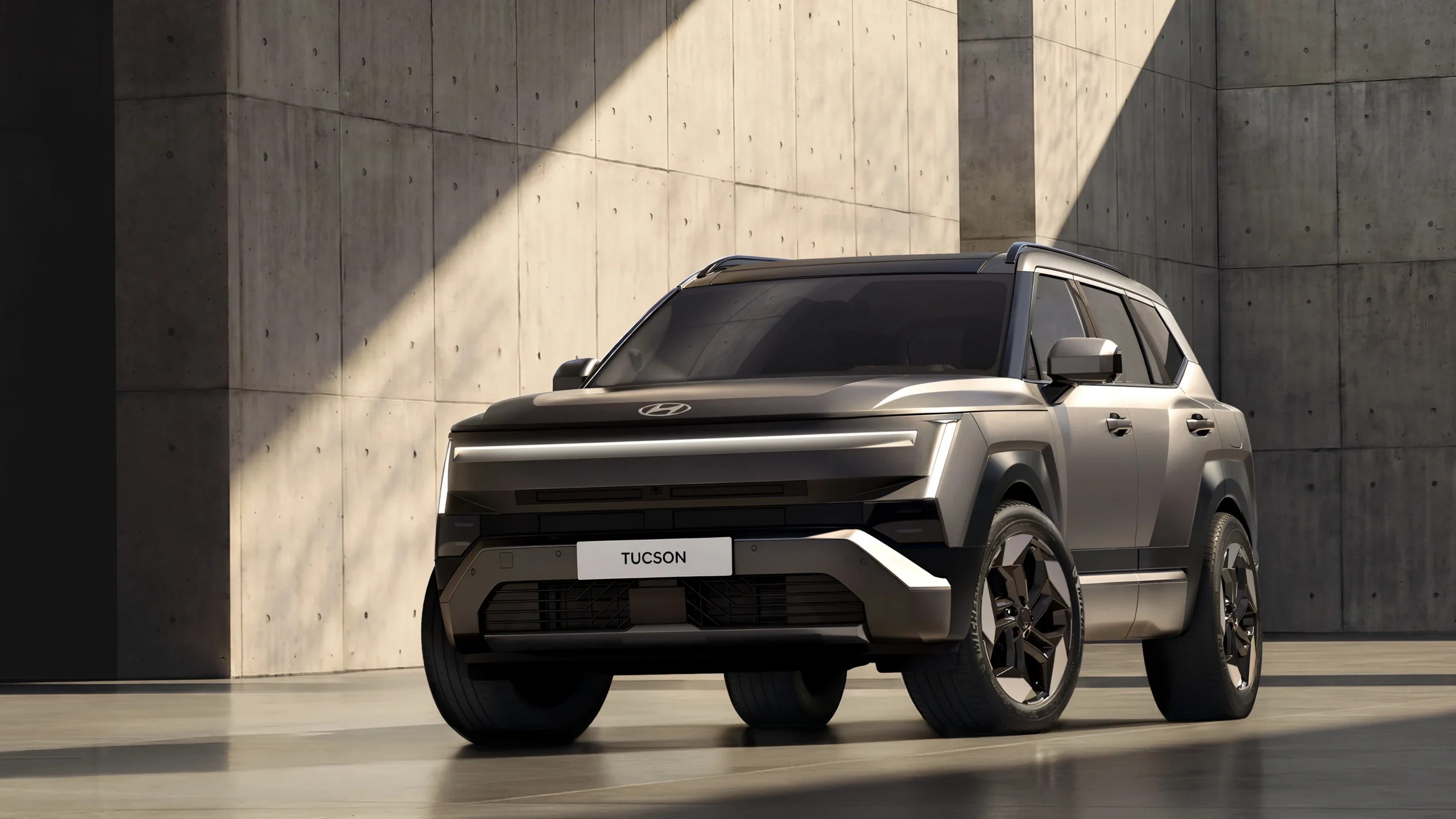
HYUNDAI UNVEILS ALL-NEW TUCSON
Hyundai’s best-selling vehicle in North America just got a bold makeover. The all-new 2027 Tucson features the company’s “Art of Steel” design philosophy and is longer, wider and taller than the current model. There’s gas, strong hybrid and plug-in hybrid options that all use a turbocharged 1.6L 4-cylinder engine or a non-turbo 2.0L gas engine is available in select markets. Both the hybrid and plug-in use a dual-motor setup, but the main motor in the plug-in is much more powerful and it also has a 17-kWh battery pack, which is significantly bigger than the hybrid. That setup is estimated to return about 50 miles or 80 kilometers of EV-only range. Moving to the interior, the dash is highlighted by a thin, high-mounted nearly 10-inch display in front of the driver and a roughly 13-inch or 17-inch infotainment screen in the middle. But more importantly the new Tucson will be the first model from Hyundai in the U.S. to feature the company’s new infotainment platform, called Pleos Connect. It’s based on Android Automotive’s operating system, but users can still wirelessly integrate Apple CarPlay or Android Auto. Breaking Pleos down to its basic functions; the platform brings a new interface that’s meant to be more modern and user-friendly; it offers more advanced navigation and a new AI voice assistant, called Gleo AI; plus new apps, like YouTube can be added to the system. Sales of the all-new Tucson kick off in Korea later this year, followed by the U.S. and Europe in 2027.
TOYOTA TARGETS AI BOTS FOR MARKETING
While most companies try to avoid AI bots, Toyota is actively seeking them out. Automotive News reports that AI bots or agents are being used more and more by consumers when researching a vehicle, which resulted in traffic at Toyota.com dropping by about 20%. So the company switched from SEO or Search Engine Optimization to GEO or AEO, which stands for Generative or Agent Engine Optimization. Toyota now reviews its marketing prompts and content to specifically target AI bots in the hopes that they get used in AI-generated answers.
CHRIS THEODORE BREAKS DOWN CORPORATE MANAGEMENT
The next installment of our 18-part video series with Chris Theodore will get posted later today. And it’s all about Corporate Management. Chris talks about the lessons he learned of different management styles and compares the approach of different leaders like Lee Iacocca, Bob Lutz, Roger Penske, Alan Mulally, Ferdinand Piech and even Steve Jobs and Elon Musk. All of you Autoline members already know that because you got access to that video a week ago. Today, you’ll be getting access to Part Two of Corporate Management, which discusses different types of corporate structures, along with the advantages and disadvantages each one offers. And as always, we really thank our Patreon and YouTube members for your support. We hope to bring you the kind of information and insight on the automotive industry that you’re not going to find anywhere else.
But that wraps up this week. Have a great weekend and we’ll be right back here again on Monday.
Thanks to our partner for embedding Autoline Daily on its website: WardsAuto.com







I, just last week, saw a BYD auto in Nassau, Bahamas; getting close folks.
Also, as far as using what gasoline in your vehicle; check your owner’s manual for grade recommendations. Premium will not make your engine run any better if it is not required, it may if it is recommended, and possible the best advice I can confer it to use Top Tier Plus gasolines (they provide the best cleaning and maintaining cleaning) than possible brands not adhering to the Top Tier standards.
My experience has been that for normal driving, few recent cars really need premium gas. I made the same 1100 mile trip with a C7 Corvette using regular and premium, and got the same ~29.5 mpg with both. If doing a track day where I’d be using heavy throttle much, I’d certainly want to use premium, but for normal driving, it didn’t need it. I’ve had two Minis, a base 2010 with the Peugeot “Prince” engine, and a more recent S with the 2.0 BMW turbo. Both were fine with 87 octane. The 2.0 turbo in a recent Mini S is very mildly tuned, making only 189 hp. I always used premium in the 718 Cayman with a 300 hp 2.0 turbo.
I make it a point to use “top tier” gas in my current Toyota hybrids, for the detergent packages, since the engines have GDI.
Chuck, was the BYD you saw in the Bahamas right hand drive, as it would be if sold new there by a regular dealer?
I know that this is off-topic, but with Audi no longer building the A8, now that there is one fewer competitors, would this be a good time for either Lincoln or Cadillac to get back into the full-size luxury sedan business? While they may never be able to compete with the 7 series on driving dynamics (as all the yearsvtrying have proved), but a powerful luxury sedan would definitely be something that’s in their wheelhouse! If it were a Lincoln, I’m sure it will probably be a twin Turbo V6, yet, Cadillac coming out with their (new?) V8 for their new CT5, that might be just the car they would need. The CT6 had won critical acclaim, but the interior was just too small for the size of car was. If Genesis with it’s G90, can make inroads into the full size luxury car segment, by aiming for AMG and Bentley aesthetics, but pricing it like other mass market luxury vehicles, why can’t Lincoln and Cadillac do the same question? With the A8 no longer and the running, will the G90 take its place? Why couldn’t that third spot go to either Lincoln or Cadillac?!?! Just a thought.
With automotive grade, solid state batteries supposedly just 18 to 36 months away, when will that battery technology make it to cellphones, laptops/ computers and other battery operated equipment? Automotive grade EV batteries are several degrees higher than that used for this other equipment. So why is it taking so long to get that technology and smaller devices? Since the demands are as critical for automotive applications, it would seem that it would be easier to prepare those type of batteries for the these lesser applications. The higher spec, EV batteries, have been documented as lasting over 10 years with little degradation. Why is it that we don’t have cell or computer batteries today that least the same amount of time?
The Ford HP ratings on my Mustang GT and my son’s Explorer are stated with 91 octane. Both owner’s manuals state that 87 octane is acceptable but no HP rating is given with the 87.
Gary, can you feel a difference in power of the cars between 91 and 87 octane? I’d guess barely, if at all.
Cadillac should make an S-Class/7 series size sedan with a Chevy V8. Make it as roomy and quiet as the Germans, and sell it for $70K, a $30-50K discount from the Germans. They could call it Sedan DeVille.
To me, a big problem with the CT6 was that the only available engine with RWD was a 2.0 turbo four. You had to get AWD to even get the 3.6 V6. Anyway, a big RWD sedan with a basic V8 would be a great entry to the U.S. market. Offer AWD as an option, but don’t make it mandatory. The car should be very quiet and comfortable, and to do that, the engine might need to be slightly de-tuned from Corvette duty.
Kit —
A number of auto journalists are praising the Genesis G90 and I don’t see why Cadillac or Lincoln can’t at least produce something as good as that full-size luxury upstart. Especially Cadillac, with their Celestiq and now offering Escalades in both ICE and EV forms that run better than six figures (with the iQ version again getting high marks from many journalists)! Personally, I wouldn’t give a full-size Cadillac sedan a fast/hatch back like the Celestiq, but I’m sure not everyone wanting such a vehicle, wants to settle for large SUV like they have to now.
The G90 is nice, but $100K for a Hyundai with a V6? They sold ~1700 in the U.S. in 2025. They might depreciate nicely, and be available for ~$40K 3 years old. Still, I’d rather have a 7 series, and those also depreciate quickly.
I suppose it would take a new, or significantly changed platform for Cadillac to make a true G90/7 series/S-Class competitor. A stretched CT5 wouldn’t do it, because it is too narrow. Still, I can’t help but think even a revived CT6, 2 inches narrower than the Koreans and Germans, with a Chevy V8, for $30K less than those others, if made quiet and comfortable, would sell in much larger numbers than G90. I would think it could be profitable selling for $70-75K. Somehow, a CT6 with a turbo 4 didn’t appeal to me, even if it drove ok.
Kit —
I agree with you, but their was a time that even the A8 was not taken seriously as a 7 Series and S-Class rival and paying that much for a better VW, sounded like crazy talk. Over time, though, it has grown to, arguably, stand shoulder to shoulder with them (while it is in a class lower then these three, but the A6 was recently the preferred choice in a Car and Driver, four car comparison test, between it, the G80, 5 Series and the E-Class. Even though it was the preferred choice, the E-Class record the win due in part to its pedigree)! That is the track that the G90 appears to be on (especially when you look at what they are doing with their GV90) and with the A8 now gone, being the the bona fide third choice among those giants, could be huge for that young brand! That said, there is no reason that Lincoln, but especially Cadillac couldn’t produce something to vie for that space! Building a powerful, opulent, technically advance and finely appointed full-size luxury sedan, that under cuts its rivals, but matches them step for steps on everything else, seems to be in their wheelhouse.
Sadly, the car that launched the Lexus brand, the LS, is gone. When new, it was considered a better S-Class at a bargain price. Then, generation by generation, it was downgraded from what the original excelled at, while the price went up to near that of the Germans.