




Follow us on social media:



Runtime: 9:36
0:00 Subaru Unveils In-House EV Prototype
1:17 Group Proposes Major PHEV Range Reform
2:03 Foxconn Buys $730M Mitsubishi Electric Stake
2:33 BYD Launches Racco In Sri Lanka
3:50 Tesla Roadster Pre-Orders Lack Delivery Guarantee
4:37 Hyundai Unveils Software-Defined Factory
5:37 Startup Uses Microbes for Copper Mining
6:30 Torus Unveils Flywheel Energy Storage Tech
Visit our sponsors to thank them for their support of Autoline Daily: Bridgestone; CSP and Intrepid Control Systems.




This is Autoline Daily, the show dedicated to enthusiasts of the global automotive industry.
SUBARU UNVEILS IN-HOUSE EV PROTOTYPE
Japan’s auto manufacturer’s association says there needs to be more collaboration amongst its automakers, but Subaru is ditching Toyota as its EV partner. Automotive News reports that Subaru unveiled a prototype of a new in-house developed EV, which features technology it hopes to bring out in 2029. To help disguise the vehicle it wears the body of a previous-gen Outback, but everything underneath is different. It’s working with the supplier Aisin to develop electric motors that are 30% more efficient than the average motor today and with Panasonic on cylindrical battery cells that reduce pack weight by 25%, while improving energy density 20%. Subaru says doing the development in-house allows it to deliver the kinds of features that define the brand and perhaps more importantly deliver them faster. It claims this prototype was developed in about half the time it normally takes. Beyond EVs, Subaru is also working on its next-gen gas engines and driver assistance system, which it calls Eyesight.
GROUP PROPOSES MAJOR PHEV RANGE REFORM
One of the issues facing plug-in hybrids is that owners don’t charge them enough so they’re running on gas more than people expected. So Transport and Environment, an organization that campaigns for clean transportation in Europe, says it has a four-pronged approach to help PHEVs reach their potential. First, it wants to incentivize vehicles with fuel tanks 15 liters or less, which is about 4 gallons. It wants real-world EV ranges to hit 200 kilometers or 124 miles by 2030. It also wants PHEVs to charge faster, higher than 100 kW. And lastly, it wants the electric motors to be at least 3-times more powerful than the combustion engine.

FOXCONN BUYS $730M MITSUBISHI ELECTRIC STAKE
Taiwanese contract manufacturer Foxconn is acquiring a 50% stake in supplier Mitsubishi Electric’s auto parts business. The deal is worth nearly $730 million and the two companies will jointly operate the unit. Mitsubishi Electric Mobility currently develops electric powertrains, software and vehicle control parts and it will also expand into new advanced technologies like autonomous driving platforms.
BYD LAUNCHES RACCO IN SRI LANKA
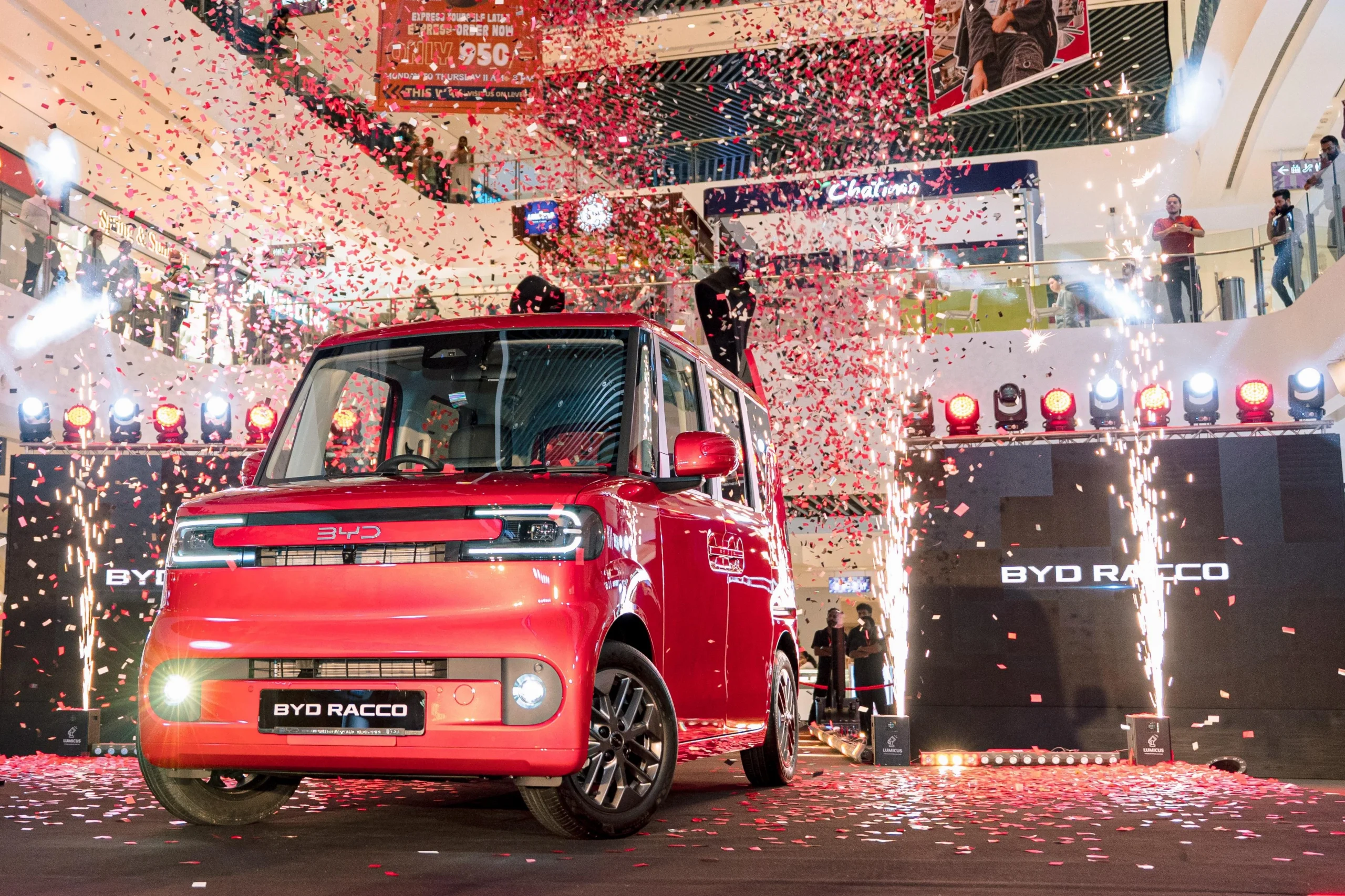
BYD is launching its kei car in the first market outside of Japan. The Racco is now on sale in Sri Lanka with a starting price of $34,600. And that’s just an introductory price that expires next month. In Japan, the Racco is priced between roughly $13,000-$16,000. The reason for the huge gap is Sri Lanka’s expensive import duties and taxes. A Toyota Yaris Cross for example costs just over $19,000 in the Philippines but in Sri Lanka it’s priced at more than $60,000. The Racco will also be available soon in Macau but no word on what it will cost there.
TESLA ROADSTER PRE-ORDERS LACK DELIVERY GUARANTEE
Tesla revealed the new Roadster with a giant spectacle last week. And during the event Elon Musk said it will launch in 2028 “for real.” However, Inside EVs reports that Tesla’s pre-order reservation agreement states that the company “cannot guarantee when your vehicle will actually be delivered or if it will be delivered.” Tesla hasn’t revealed the price of the Roadster but to reserve one it’s $5,000 up front, which the company says is fully refundable, and another $45,000 due via wire transfer within 10 days or the reservation gets canceled. Tesla says the reason for no price yet is because it’s still working on what options, features and hardware the Roadster will have.

HYUNDAI UNVEILS SOFTWARE-DEFINED FACTORY
You’ve likely heard of software defined vehicles but now software defined factories are stepping into the spotlight. In combination with digital twins, automakers can simulate how everything will work in a factory before it’s even built. In fact, they can use the digital twin to run all the equipment in a factory, or use all the data coming from a factory to run the digital twin. Hyundai is hosting a conference and seminars in South Korea this week called E-Forrest Tech Day. It’s showing off 200 new manufacturing technologies, but the real intent is to showcase its transition to software defined factories. A key part of that is developing a unified collection system to get data from all its factories on a real-time basis and use AI agents for data retrieval and interpretation. That way, it can troubleshoot problems and come up with solutions that can be immediately applied to its global manufacturing operations.
STARTUP USES MICROBES FOR COPPER MINING
Here’s something new to us. A startup in Colorado called Endolith is using microbes to improve copper mining. They call it bio-leaching. The microbes love to eat sulfuric acid, which is sprayed on crushed rock that contains copper, iron and sulfur. They eat the iron and sulfur, leaving the copper behind. Bloomberg reports this could breathe new life into copper mines that have passed their peak and now produce a lower grade quality of copper ore. There’s surging demand for copper worldwide, since electric cars use three to four times more copper than IC cars. Data centers and electric grids use large amounts of copper, too. According to S&P Global, the world faces a significant copper shortage by 2040 unless new sources are found. And maybe bio-leaching will be that solution.

TORUS UNVEILS FLYWHEEL ENERGY STORAGE TECH
At the Battery Show in Detroit last week we ran across an intriguing startup from Salt Lake City called Torus that’s using a flywheel to store energy. Torus says it’s a very cost-effective solution for electric utilities and data centers that is easily scalable. When electric demand is low, Torus uses excess electricity to spin up the flywheel, and when demand is high it uses the flywheel to run a generator that charges up battery packs. The flywheel is made of steel for low cost, it’s magnetically levitated and it spins in a vacuum to eliminate most friction. It can be charged and discharged as often as needed, with no degradation compared to batteries. Seems to us it might also be perfect for fast-charging EV stations with lots of charging ports.
But that’s a wrap for today’s show. Thanks for tuning in.
Thanks to our partner for embedding Autoline Daily on its website: WardsAuto.com






Case of Sri Lanka and their taxes and duties is interesting. Is it to discourage automobiles entirely?
They have no auto industry to protect. A country with twice the population of Michigan and 1/4 the area yet about the same miles of public roads. Be interesting to see what they are thinking.
One would need to be a real Elon fan boy/girl with spare money to make a $50K deposit on a car that might never exist.
Sri Lanka has some vehicle assembly and parts manufacturing, but may want to limit number of cars, with the very high population density. This is the current mix of vehicle types there:
• Motorcycles: 5,177,085
• Motor Tricycles (Three-wheelers): 1,201,842
• Motor Cars: 973,376
• Total Registered Vehicles: 8,816,613
Doesn’t Musk’s flying car seem more like a SpaceX thing as opposed to a tesla thing? Imagine what more Tesla could do, then they already have, if they made their full focus that of building competitive, fuel-efficient, cars, SUVs, trucks and semis.