




Follow us on social media:



Runtime: 12:24
0:00 Musk Kills Dojo Project
1:11 Lordstown Assembly Plant to Become Data Center
1:59 Ford Delays Blue Oval Plant, Again
2:49 China Car Sales Up in July
3:25 Xiaomi Poaches Another BMW Designer
5:03 Yangwang Supercar Boasts +3000 HP
6:09 Tesla Model 3+ Gets More Range
7:02 ICE Dodge Charger Gets 430-550 HP
8:08 Grand Wagoneer Gets Mild Facelift
8:31 GM to Import Chinese LFP Batteries to U.S.
9:14 BMW To Import Chinese EV Batteries to U.S.
10:02 Lyten Snaps Up Northvolt’s Assets
Visit our sponsors to thank them for their support of Autoline Daily: Bridgestone, CSP and Intrepid Control Systems.




This is Autoline Daily, the show dedicated to enthusiasts of the global automotive industry.
MUSK KILLS DOJO PROJECT
In a stunning move, Elon Musk is closing down Tesla’s Dojo supercomputer project. Bloomberg reports that 20 people who were working on Dojo quit their jobs and moved to a competitor called DensityAI, which itself was started by former Tesla employees who had been working on Dojo. The rest of the team working on the supercomputer project will be assigned to other jobs at Tesla, and it will now rely on outside tech companies like NVIDIA to continue the work. Elon has been bragging about Dojo for years, claiming it would give Tesla a big advantage over any other automaker, especially for developing autonomous vehicles. Two years ago, Wall Street firm Morgan Stanley predicted Dojo would add half a trillion dollars to Tesla’s market cap. So far, the market seems to have shrugged off the news. Tesla stock was up in pre-market trading. But with its car sales and profits falling, this is yet another piece of bad news for Tesla.
LORDSTOWN ASSEMBLY PLANT TO BECOME DATA CENTER
It looks like the assembly plant in Lordstown, Ohio will never build another car again. Earlier this week, Foxconn announced it sold the plant to a company called Crescent Dunes, which it described as an “existing business partner.” Now Bloomberg reports that Japanese investment firm SoftBank was part of the transaction and will be taking ownership of the plant. SoftBank wants the facility to jumpstart its AI joint-venture with OpenAI and Oracle. The JV is called Stargate, and is investing $500 billion to build data centers and related infrastructure across the U.S. Foxconn will operate the plant for its own AI server manufacturing business and SoftBank could use the site to host a data center.

FORD DELAYS BLUE OVAL PLANT, AGAIN
Three years ago, Ford broke ground on its Blue Oval assembly plant with great fanfare and with all the top management on hand. Including its battery partner SK On, the Blue Oval project represents a $5.6 billion investment. But now it’s being put on the back burner. Ford confirmed that a full-size electric pickup scheduled to be built there will be delayed until 2028. Initially, it was supposed to debut this year, then it was pushed back until 2027 and now it’s being pushed back by another year. With electric pickups selling in small numbers, we wonder if it will ever be built. And Ford’s next-gen electric Transit van, which was supposed to be built in Avon Lake, Ohio will also be delayed until 2028.
CHINA CAR SALES UP IN JULY
Car sales in China were up more than 6% in July compared to last year, hitting 1.8 million units. But they were down 6% compared to June, indicating the market growth is slowing down. Sales of NEVs were up 12% to just under a million units as the segment continues to boom. And exports jumped 25% to 455,000 units. The China Passenger Car Association expects sales to keep picking up pace because a tax break for buying new cars expires at the end of the year.
XIAOMI POACHES ANOTHER BMW DESIGNER
Chinese EV maker Xiaomi poached another BMW designer. Kai Langer, the head of design for BMW’s i series electric vehicles, announced on Linkedin that he joined Xiaomi. Langer worked at BMW for more than two decades but he didn’t reveal what role he will have at Xiaomi or where he will be based. Xiaomi’s current head of design, Li Tianyuan, was also a designer at BMW for nine years before joining the EV maker in 2021.

YANGWANG SUPERCAR BOASTS +3000 HP
This might be the closest thing you can get to an aircraft carrier jet taking off, which will do 0-165 MPH or 265 km/h in about 2 seconds. A Chinese regulator revealed that BYD’s Yangwang brand is coming out with a new version of its U9 hypercar that will have roughly 3,000 horsepower. The Track Edition features four 555 kW electric motors, one at each wheel, and a more aggressive aero package. It also looks like there could be some upgrades to the brakes, wheels and tires and a sportier interior wouldn’t be surprising either. The version of the U9 that’s already on sale in China has nearly 1,300 horsepower and does 0-100 km/h in under 2.4 seconds. So, the new Track Edition should challenge or beat other hypercars, like the Rimac Nevera, which “only” has about 1,900 horsepower. Or maybe it’s trying to take back the Nurburgring lap record from Xiaomi?

TESLA MODEL 3+ GETS MORE RANGE
And the same regulator that revealed the Yangwang also detailed ranges for the new 6-seat version of the Tesla Model Y and the new rear-drive Long Range version of the Model 3. On China’s test cycle, the Model Y L, which is 150 mm or about 6-inches longer, gets 751 kilometers or 466 miles of range. That would be about 350 miles of range on the EPA test. The Model 3+, which combines a more powerful single rear motor with its more powerful battery pack for the first time, is rated at up to 830 kilometers or 515 miles of range. That’s about 80 kilometers or about 50 more miles of range compared to the AWD Model 3 with the same battery pack. Both models should be going on sale soon in China.

ICE DODGE CHARGER GETS 430-550 HP
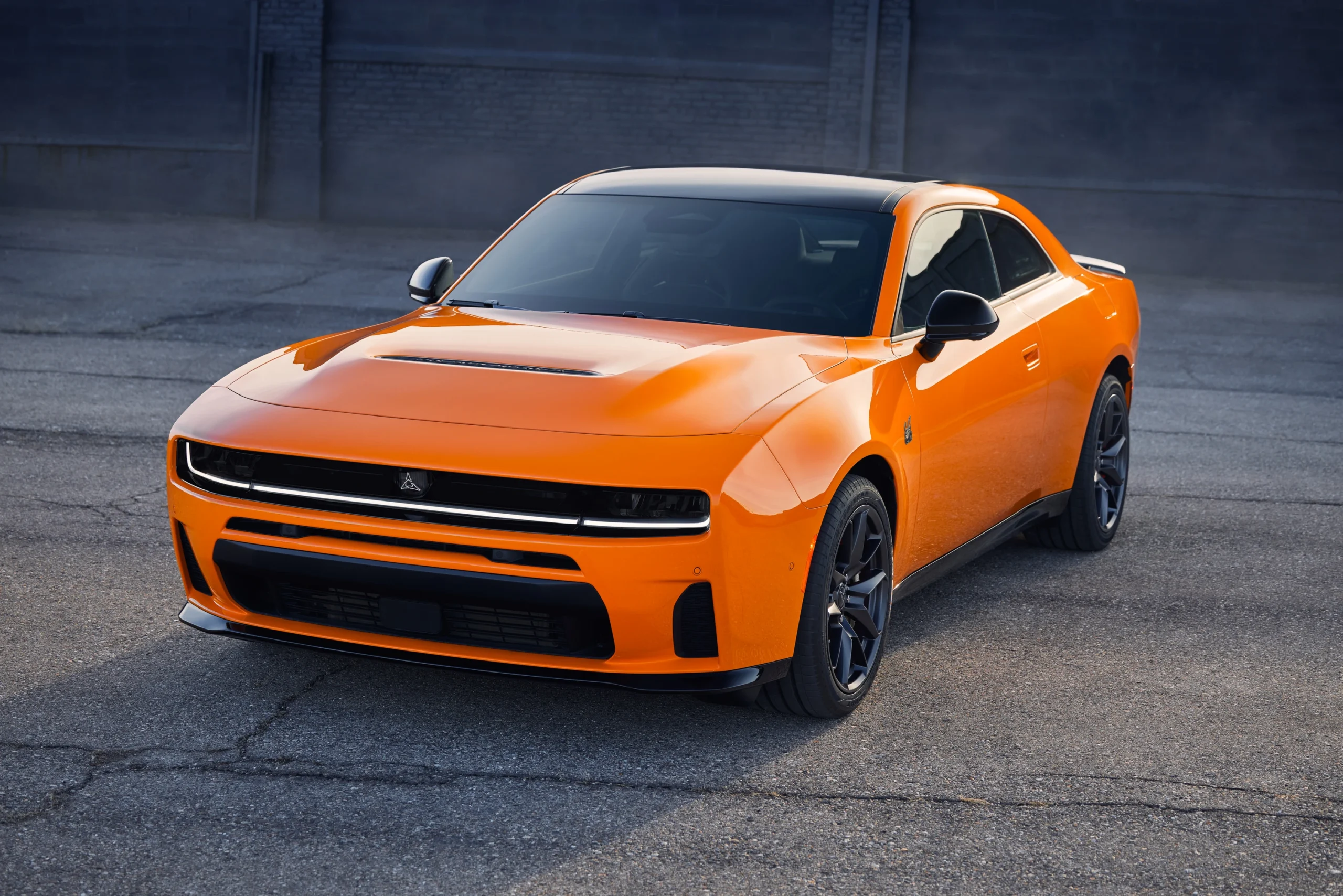
The all-new Dodge Charger won’t be EV-only for much longer. Gas-powered versions with Stellantis’ turbocharged in-line 6-cylinder Hurricane engine will start hitting dealerships before the end of the year. They’ll be available as two- or four-door models and with both the standard output 420 horsepower version and the high-output 550 horsepower version. The engines are mated to an 8-speed automatic transmission and AWD is standard. However, there’s a driving mode that allows owners to send 100% of the power to the rear wheels as well as a line-lock mode for burnouts. Straight line performance is pretty good with the high-output version doing 0-60 MPH in 3.9 seconds. With the cooling and exhaust requirements for the combustion engine, obviously, there’s a few changes to the front and rear styling, but the interior looks mostly untouched. The standard output version of the Charger will start at just under $50,000, while the high-output is $5,000 more.
GRAND WAGONEER GETS MILD FACELIFT
Speaking of Stellantis brands, Jeep revealed a single picture for the refreshed Grand Wagoneer. The front end looks a little more squared off and the grille appears to be inspired by the all-electric Wagoneer S. Although, we’ll have to wait and see if there’s any new powertrain announcements. Jeep says the new Grand Wagoneer is coming later this year.

GM TO IMPORT CHINESE LFP BATTERIES TO U.S.
Ford is going to get LFP batteries for its EVs from a plant it’s building in the U.S. with CATL. And now comes word that GM will import LFP batteries made by CATL in China for the new Chevy Bolt. Though GM has a deal with LG Energy Solution to make LFP batteries in the U.S., the Bolt will go into production late this year, and the LG plant will not be ready for nearly 2 years. LFP batteries are up to 35% cheaper than NMC batteries, but any batteries imported from China get hit with a 25% tariff. So, that will wipe out a good chunk of the savings and next year the tariff could go to 82%.
BMW TO IMPORT CHINESE EV BATTERIES TO U.S.
GM is not the only automaker looking to import Chinese EV batteries into the U.S. So is BMW. The battery company AESC was building a plant in South Carolina to supply BMW with batteries. But with the EV segment in the U.S. expected to stall out or even shrink, AESC halted construction. BMW will start making its Neue Klasse EVs at its assembly plant in South Carolina late next year, so that’s why it’s considering a Chinese supplier, but it will undoubtedly want to find a U.S. source at some point. Last year, AESC also stopped building another plant in Kentucky which was going to supply Mercedes-Benz. So, we could see a similar move from BMW’s German rival.
LYTEN SNAPS UP NORTHVOLT’S ASSETS
One more note on batteries. Lyten, the American company that’s developing lithium-sulfur batteries, is buying up the assets of Northvolt, the European battery maker that went bankrupt. Though Lyten didn’t disclose what it paid for the assets, it sounds like it got a mega deal. And it says this will help it expand more rapidly into the European market.
We’re looking for some of your help. We’ve got a survey we’d like you to fill out to help us do a bit of market research with a new sponsor we’ve got coming on board, Alix Partners. You can find it on the Post tab on our YouTube channel or we’ve got a link in today’s transcript. There’s only 6 questions, and we just want answers right off the top of your head, no need to research anything.
Thanks, and that brings us to the end of this week’s reports. Have a great weekend and we’ll see you on Monday.
Thanks to our partner for embedding Autoline Daily on its website: WardsAuto.com






It is just ludicrous to put a even in the Charger or Challenger, instead of a V8. I could care less if they have as good HP. THey will never sound as great as a big V8.
My next car will be at a minimum a v8, and preferably a V12. So there.
I meant a 6 instead of the proper v8 it should have.
BTW, look at the 10 or so segments of today’s show, Sean.
Maybe you should rename it “Chinese Autoline Daily”, with extra eVs and batteries.
Inline sixes sound and run great. That’s why BMW uses so many of them. I agree, though, that they need to put V8s in the Charger, because potential buyers of that car will want them. They need to make 4wd optional, though, not mandatory.
@Kit and Regulus on six-cylinder engines. Mercedes has had 3 liter V6 engines for several generations since 1999 when they retired the M104 engine. The last V6 being the M276 which I have in my E400. The M276 has been used in many models from 2010 to 2018. Since then Mercedes has moved to the M256 3 liter six cylinder in-line engine and I believe it is a telltale for what is going to happen with the V8 engines.
The move has consequences for the V8 engines IMHO for the following reason: the 3 liter V6 allowed for economies of scale of the V8 engine: same displacement volume per cylinder and the same V-configuration. The outlier used to be the 2 liter engine (for the E300 and GLC 300 among others) which was a 4 cylinder in-line. Now with the 3 liter engine being an in-line engine the economies of scale are with the 2 liter 4 in-line and the 3 liter 6 in-line and the 4 liter V8 being the outlier. I am wondering whether that is a telltale that the 4 liter V8 will disappear in future. Many upscale models like the S580 and 560, and even the Maybach have that 4 liter V8. Also third party customers like Aston Martin have a version of it.
I suspect the Mercedes V8 will be around for a while for the performance versions of S-Class/Maybach, and AMG versions of various other vehicles. The fours and sixes will certainly dominate, though.
I remember when Mercedes went from inline sixes to V6s in the 1990s, maybe first with the Alabama built M-Class CUV. I was surprised, because MB, like BMW, had always used inline, rather than V sixes. Now, their sixes are again inline, unless the V6 diesel is still used in Sprinter, or something like that.
In the previous generation Charger, the Hemi and Hellcat got all the press. However, Stellantis made and sold a lot of 6 cylinder Chargers, as is always the case with pony cars. Mustang would not be a viable product if it only offered V8’s. Not enough volume to make the business case. That has been the case since the debut of the Mustang and Camaro/Firebird. In the old days, they called them the secretary’s car. But the added volume meant they could keep a plant running at a profitable level. In modern times, it appears that turbo 4’s will continue to take the place of sixes in some of these vehicles.
GM Veteran —
I wonder about the future of the HO 4 cylinders in the Mustang, though. One of the other reason of the smaller motor, was to keep emissions down. With the US backing away from those requirements in the near term, why would Ford keep it around? They could de-power a V8, so that it would only produce the horsepower of the twin turbo 4 cylinder, at the same price and keep sales volume in the US and benefit from economies of scale! The issue would arise in over seas and other markets outside the US, where they are still keeping a tight reign on emissions, but they could simply use the 4 cylinder in those markets.
I wonder if Ford is delaying these EVs, to give room for and see how the audience reacts to their skunkworks project(s)? If the vehicle(s) announced on August 8th doesn’t move the needle, investing in the bigger, more products might be the right direction, or they may need to scale back what they had intended to do initially, further. That said, GM/Cadillac has got four hits on their hands, it seems, with the Lyriq, Optiq, Vistiq and the Escalade-iQ! Here in southeast Michigan, I have seen all of these models all over the place, as well as the equinox and Blazer EV! Car and Driver recently compared the Vistiq and EX90 and the Cadillac took home the win by inches. This is not to say the Volvo was bad, but despite it being extremely good! There is no way the XT6 would walk off with the win against the XC90, so may have things changed for Cadillac!
This is what I don’t get, one of the things folks complained about with the EV Charger (me included) was the price, even for the base model. In today’s report, it seems that the base ICE model will be about the same as the EV version?! It appears Dodge removed the base EV model, to replace it with the base ICE version for the same money. I may be mistaken, but I don’t remember the previous generation having a starting price so high ands was hopefully that the new ICE versions would start in the low $40K. Yet, that seems to nor]t be the case.
The previous Charger didn’t have a 35% Trump tariff surcharge because it was from Canada. Also, the base ICE Charger should outperform the 5.7 V8 powered R/T versions of the previous Charger and Challenger.
I suspect Ford’s selling the 2.3 turbo Mustang is largely a marketing thing, given that there would be little difference in manufacturing cost between the turbo four and the V8. By using the four as the base engine, they can charge a larger premium for the V8 GT, than if a detuned V8 were standard. Also, the four gets substantially better gas mileage which matters to some people.
https://www.fueleconomy.gov/feg/Find.do?action=sbs&id=48826&id=48825
Actually, the Mustang turbo four performs quite well, with publications getting 0-60 time of about 5 seconds.
I remember when Marc, a colleague and friend, bought one of these Mustangs with the ‘Ecoboost’ 4s. He paid an arm and a leg for it, considering the tiny engine, and a good reason he bought it was the alleged high MPG.
He told me that that MPG was 100% BS, you would never even see if from afar, if you drove the Mustang as you SHOULD, and only an old lady (and even at that, not Mario Andretti’s mother) driving it to church with a feather-light foot and at 35 MPH, would get the alleged EPA MPG.
Because of the above, disgruntled owners of “ecoboost” Fords made all kinds of derogatory puns on its silly name, such as “Ecofraud”, “EcoBS”, and better ones I forget now.
Sat at noon we have a TV autoshow usually featuring 3 vehicles, 2 cars and a bike. Today more than half the show was devoted to the SERES 5 Chinese EV with 585 HP dual motor, 80kwh battery, and a price here, including VAT (23-24%) and some Government kickback $ (which ranges from 3k euros for the tiny Citroen AMI to upwards of 9k) of 58.5k, which undercuts its target vehicles (Audis, BMWs and Merc EVs) by probably 10-20k Euros.
The 2.5 ton crossover had very nice, sleek exterior styling, a near-luxury interior, more tasteful than EVs from Detroit, and is a far cry from the shitty Wulings and other crappy Chinese EVs shown here in the past, but of course they sell it for 10 times what the Wuling sells in China.
https://www.auto-data.net/en/seres-5-80-kwh-585hp-4wd-electric-51243
This is still unaffordable to the vast majority of natives here, but those who buy EVs are not in that class, they are tax cheats invariably, operate in the underground economy by a large percentage, they have a FLEET of cars, and buy the EV as a curiosity to drive around town, or to prove their green convictions (maybe they can get chix with that crap), as the supercharger network is nonexistent here.
While it’s not an economy car, the Mustang “ecoboost” gets much better mpg than the GT with the V8. Also, the base price is $15K less, a selling point.
Buyers of the ridiculously named Ecoboost 4 Mustang were NOT considering any V8s but were previously buyers of the 6 cyl Mustangs, and the REAL MPG of the Ecoboost, driven properly, was not higher at all than that of the 6.
Next time don’t make apples to watermelons comparisons, Kit, just to negate my 100% valid points.
Also, no amount of stupid MPG will make the 6 ever comparable to the V8.
Regulus, why do you make all of these stupid, nasty comments? Today’s turbo 4 Mustang and the last V6 Camaros are quicker than V8 “pony cars” of not too many yeats ago. Have you ever driven them? The recent turbo 4 and V6 Camaros, which I’ve driven, drive very well. I suspect the turbo 4 Mustang does as well.
Also, Reg, why do you keep mentioning V6 Mustangs? They haven’t sold them for 8 years. Anyway, “Ecoboost” is Ford’s trade name for GDI turbo engines, whether in pickup trucks, Mustangs, Expeditions, or Ford GTs, and whether or not they are especially economical. It’s marketing.
Mr. Regulus,
Do you mean
“I could care less”
or
“I could not care less”
?
Do we mean to say,
“I could care less”
or
“I could not care less”
?
I like the Chevy Bolt, but I would only want it with maximum USA content, including the batteries.
People expecting great fuel mileage because they have a four or a six instead of an 8, and are relying on the turbo, have to understand, dare I say make an analogy to carbureted engines, that a turbo is kind of like a four barrel; stay out of the secondaries and you’ll get that good mileage, get into the secondaries (or the turbo), and say good bye to said ‘claimed’ mileage. Most here know this; just saying.
I’ve found that I tend to average pretty close to the EPA “combined” rating with most cars I’ve had, whether turbo, V8, or hybrid. I “get on it” for fun from time to time with the performance cars, but drive relatively economically most of the time, except that I go fairly fast on the interstates. The recent one that has really surprised me is the FWD Highlander hybrid. The ratings are 36/35/36, cty/hwy/comb, and I get 39-40 most tanks. The driving is mostly moderate speed highway, with a little “across town” mixed it, but still, I’ve been impressed.
2 of our 3 vehicles are turbo – 2004 Volvo V70R & a 2018 Fusion Sport with the 2.7 V6. While Ford refers to it as Ecoboost, I call it Eco or Boost. You can’t have both simultaneously. Fan of both vehicles & performance is adequate.
I’m not generally not a fan of AWD, but that Fusion would need it to get the power to the ground with the 2 7t.
Not generally a fan, that is…
Regulus—
If one’s was to drive a four cylinder Mustang the way it was meant to be driven, it is true, they would not get the ESTIMATED mileage on the window sticker. Yet, the same is true with the V8 model, too, if driven the way it was meant to be driven! What. Is. Your point! While it may be your nature, there is no reason to insult and condescend to other commenters who don’t share your point of view on the subject at hand! All of use have better things to do then come here and be assaulted because we do share another commenter’s opinion. While is fine to respectfully disagree agree, the attacks are unnecessary and unwelcome!
While different cars have very different capabilities, to me, they aren’t “meant to be driven” a certain way. My C8 Corvette had a top speed of 180+ mph, but that doesn’t mean it was meant to be driven that fast by many people who have them. Similarly, Mustangs and other sporty cars are “meant to be driven” however the owner wants to drive them. Too many of the “special edition” cars are just bought to collect, and not driven at all.
Ford delaying ev trucks till 2028. Next election 2028 coincidence? I think not.
I have a new ram with the inline 6 hurricane engine and love it so far. Took it on the Ohio turnpike to a family reunion and got 22.8 mpg. With 420hp. That’s pretty good.
That turbo six should be nice in the Charger.
Lambo, how fast were you driving to get 22.8 mpg?
If set cruise to 70MPH, I get about the same 22.8MPG with a V8 Silverado(cylinder deactivation turned on). It helps that the Ohio turnpike is as flat as a pancake. The highest I saw in the Silverado was 25.7MPG but I was doing a steady 55MPH at that time(2 lane flat rural road). The newer trucks are really not that bad in terms of fuel economy anymore. If I had a Diesel Silverado I would be able to regularly achieve 25MPG with occasional bumps to 30MPG. Of course if you start driving these trucks with some zest, they lose fuel economy with extreme haste.
Kit I had the cruise set at 80. But there is lots of construction about half the trip like 4 miles at a time. It was Saturday so no work being done and traffic would slow to 65 maybe.