




Follow us on social media:



Runtime: 11:34
0:00 VW #1 In EU EV Sales, Tesla Slips To #7
0:38 Model Y No Longer Best-Selling Model in Europe
1:17 Audi Boosts Prices in The U.S.
1:58 Amazon Considering Expanding Used Car Business?
2:57 Singapore & Middle East Aim to Become AV Hubs
3:36 AVs Could Be Goldmine for Insurance Companies
4:21 BMW To Supply Mercedes With Engines
4:59 Jeep Reveals All-New Cherokee
6:56 Chrysler Unveils Off-Road Pacifica
7:42 Nissan Updates Roox Kei Car
8:13 NYC Fleet Operator Snaps Up Unsold Fisker Ocean’s
Visit our sponsors to thank them for their support of Autoline Daily: Bridgestone, CSP and Intrepid Control Systems.




This is Autoline Daily, the show dedicated to enthusiasts of the global automotive industry.
VW #1 IN EU EV SALES, TESLA SLIPS TO #7
The EV sales race in Europe is changing fast. The latest figures from Dataforce show that in July the Volkswagen brand moved into the #1 spot, followed by BMW. Skoda and Audi, which are part of the VW Group, are in 3rd and 4th. Renault and Hyundai are in a virtual tie in 5th and 6th, while Tesla is down in 7th, and not too much ahead of Mercedes. Kia is in 9th spot and BYD just cracked the top 10.
| Brand | July EV sales | % Change |
|---|---|---|
| Volkswagen | 22,355 | 83% |
| BMW | 15,847 | 7.90% |
| Skoda | 15,746 | 235% |
| Audi | 11,023 | 32% |
| Renault | 9,857 | 75% |
| Hyundai | 9,822 | 58% |
| Tesla | 9,668 | -37% |
| Mercedes-Benz | 9,054 | 10% |
| Kia | 8,726 | 44% |
| BYD | 7,492 | 88% |
| Source: DataForce | ||
MODEL Y NO LONGER BEST-SELLING MODEL IN EUROPE
Despite that 37% drop in sales, the Tesla Model Y is still the best selling EV in Europe for the full year. But only two years ago the Model Y was the best-selling car in Europe, not just the best EV. And as recently as June it was #2. To show you just how much Europeans have turned their backs on Tesla, last month the Model Y dropped to #60. Now, Tesla sales are always weakest in the first month of every quarter and it will likely recover some this month and next. But you can’t argue with the numbers. Tesla has a sales crisis on its hands in Europe.

AUDI BOOSTS PRICES IN THE U.S.
Audi is no longer going to absorb the cost of the tariffs in the U.S. and is raising prices. Some 2026 vehicles are going up between $800-$4,700, depending on the trim. It’s doing this because all of Audi’s models sold in the U.S. are built in Europe with the exception of the Q5 which is made in Mexico. Customers will get a few perks from the price hike including free scheduled maintenance and minor equipment upgrades. But Audi is struggling in the U.S. with sales dropping six consecutive quarters. Last quarter they fell 19% and this price boost is going to make it even more difficult to turn things around.
AMAZON CONSIDERING EXPANDING USED CAR BUSINESS?
Two days ago, we reported how Amazon is now selling used cars from Hyundai and Hertz on its website, as well as brand new Hyundais. And that’s why this market analysis from investment banking company Stephens caught our eye. It thinks Amazon is using this as a test bed to decide if it wants to get into selling used cars, hook, line and sinker–including sourcing used cars, reconditioning them, the logistics of delivering them, and even providing financing to buyers. No doubt Amazon is studying Carvana. The used car service has a market cap of about $73 billion, which is $20 billion more than General Motors.
SINGAPORE & MIDDLE EAST AIM TO BECOME AV HUBS
We keep saying that 2025 is the year of the autonomous car. And there are two regions in the world that want to lead the way. No, not China. And not the United States. Instead, countries in the Middle East like Saudi Arabia, the United Arab Emirates, Qatar, as well as the city-state of Singapore have the most aggressive policies to deploy AVs. Even though the autonomous cars going into these regions are made by U.S. or Chinese companies, they’re scaling faster there than anywhere else. Instead of pushing autonomous cars, Singapore is prioritizing autonomous buses, largely because of its famous traffic congestion.

AVs COULD BE GOLDMINE FOR INSURANCE COMPANIES
And autonomous vehicles could be a goldmine for car insurance companies according to analysts at Bank of America. In the U.S., drivers are responsible in the event of an accident but with self-driving cars liability will shift from individuals to carmakers. Insurers typically lose money on liability protection, so shifting responsibility will boost profitability. And while autonomous vehicles are expected to significantly reduce accidents and insurance costs, Bank of America analysts disagree and say the “data suggests otherwise.” While the frequency of accidents has decreased, the severity of crashes has increased despite better safety technology.
BMW TO SUPPLY MERCEDES WITH ENGINES
We’ve been saying automakers should do this for years, but it’s kind of surprising that it’s two luxury brands helping to lead the way. Germany’s Manager Magazin reports that BMW and Mercedes are going to collaborate on internal combustion engines. It says Mercedes would buy 2.0L turbocharged 4-cylinder engines from BMW to use in a good portion of its lineup. While Mercedes is coming out with its own 1.5L turbo engine, it’s said that motor can’t handle PHEV or EREV setups. Mercedes confirmed the deal is in the late stages of negotiations and an announcement is expected before the end of the year.
JEEP REVEALS ALL-NEW CHEROKEE
Jeep revealed the all-new Cherokee, which launches as a hybrid-only model late this year in the U.S. That hybrid is an all-new two-motor setup that will power far more than just the Cherokee in Stellantis’ lineup and will be built in the U.S. in Michigan. Although, the turbocharged 1.6L 4-cylinder engine that it uses was actually originally developed in Europe, but it’s now been adapted for hybrid applications. Mated to that engine is a transmission with two integrated motor-generators. This has several advantages. One is that it eliminates the traditional starter. One of the motor-generators is capable of starting the engine by drawing power from the setup’s 1 kWh battery pack. While that’s pretty small, the setup is capable EV-only driving with zero engine input. In hybrid mode, the engine spins one of the motor-generators to send power to the battery pack and also sends power to the wheels. But the second motor-generator can take power from the battery pack or the first motor-generator to help supplement the engine. In the new Cherokee, the setup produces 210 horsepower, is expected to get 37 MPG and return more than 500 miles or 800 kilometers of range. In terms of size the new Cherokee is a bit bigger than the previous model and offers 30% more cargo capacity. Inside the driver gets a roughly 10-inch digital display, while the 12.3-inch infotainment screen runs off of the newest version of Stellantis’ UConnect 5 system, which offers OTA update capability. The Limited and Overland trims will be the first to launch at the end of this year, the cheaper of which starts at $42,500, including destination charges. But the entry-level Cherokee hits dealers in early 2026 with a starting price of $37,000.

CHRYSLER UNVEILS OFF-ROAD PACIFICA
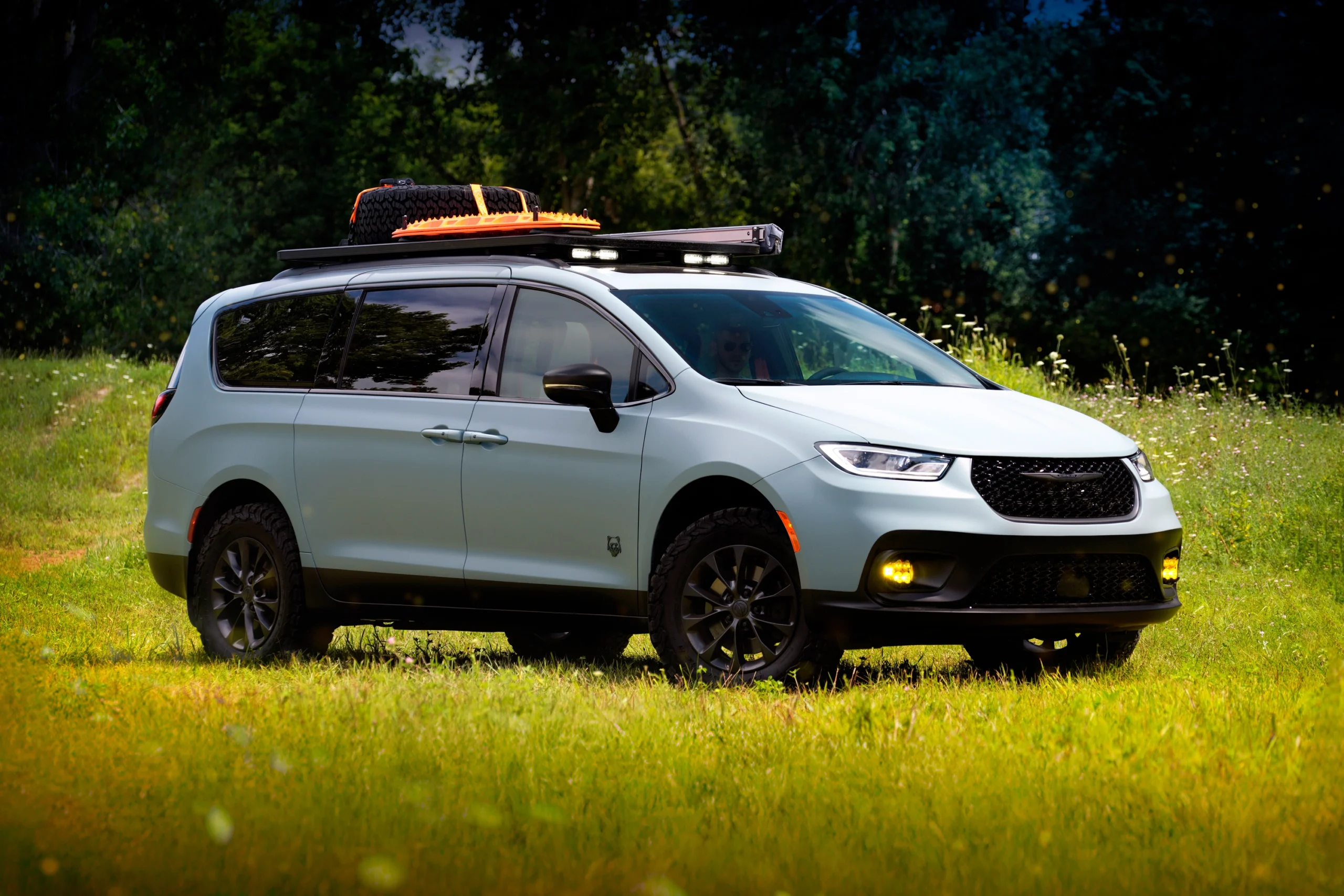
It seems like every automaker wants to get into off-roading and that could even expand to the minivan segment. Chrysler is displaying an off-road concept version of the Pacifica, called the Grizzly Peak, and the brand says it plans to take feedback from customers. While it doesn’t offer any extra underbody protection, the front suspension was lifted by 2 and three quarters of an inch, the rear was lifted by 2 and a half inches and the 18-inch wheels are wrapped in 31-inch all-terrain tires. Designers even replaced the third-row of seats with a cargo panel for extra space and a place to sleep. Since Chrysler is taking feedback, we’d love to know what you think of an off-road minivan.
NISSAN UPDATES ROOX KEI CAR
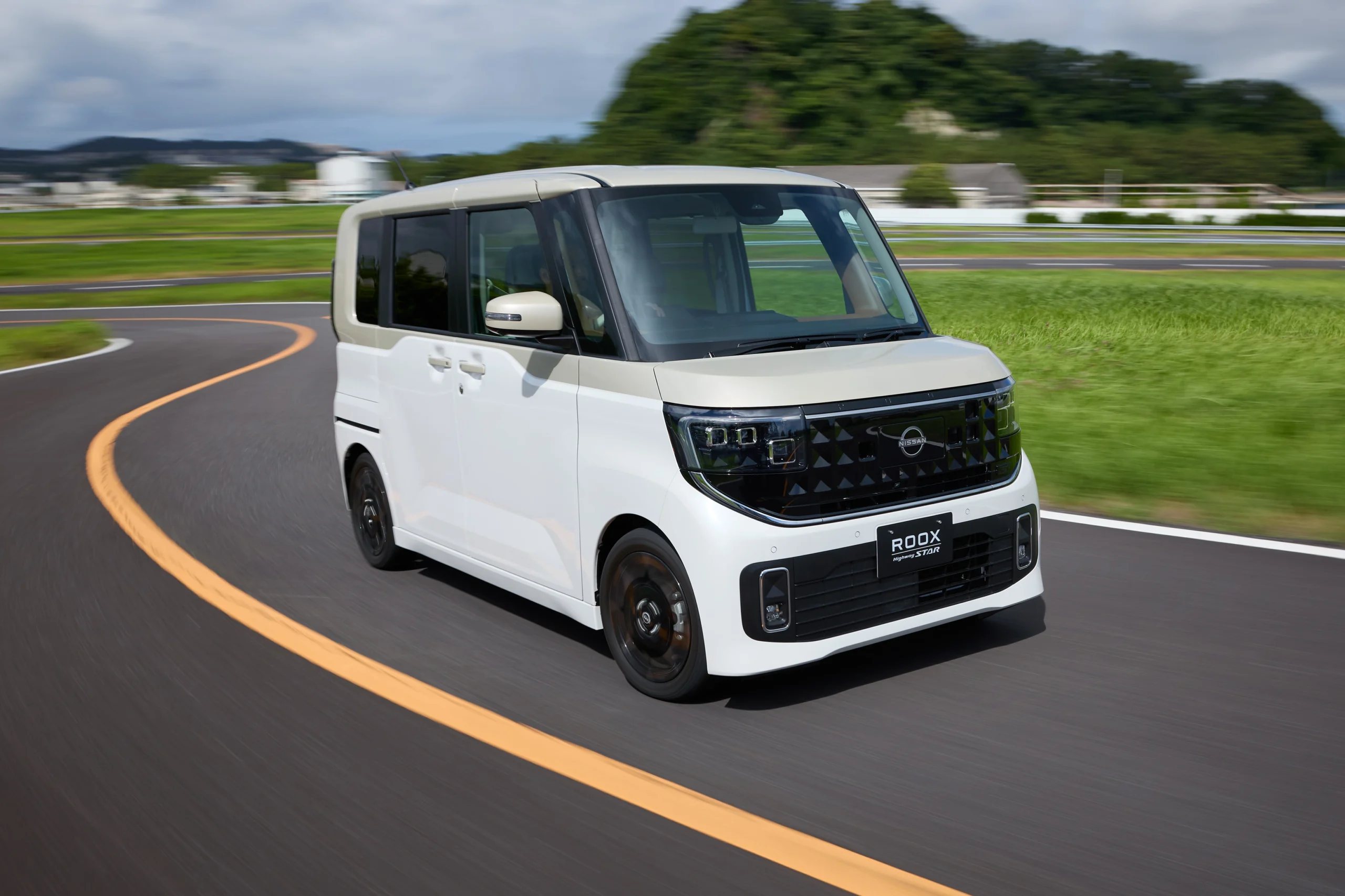
Speaking of vans, Nissan unveiled the refreshed Roox in Japan. The kei car offers updated styling, improved engine efficiency, a quieter cabin and Nissan claims the Roox will be the first model in the segment to be available with a 12.3-inch center display screen. The Roox will be priced starting around $11,000 when it goes on sale before the end of the year. And in case you’re wondering, kei cars account for about a third of Japan’s total sales.
NYC FLEET OPERATOR SNAPS UP UNSOLD FISKER OCEAN’S
Even though EV startup Fisker no longer exists, you’ll still see thousands of its vehicles on the streets of New York for years to come. After Fisker declared bankruptcy last year, American Lease, the largest fleet operator in New York City bought 2,800 unsold Fisker Oceans for $45 million or about $16,000 apiece. American Lease is now renting the vehicles to ride-hailing and for-hire car service drivers for $330 a week. The Ocean, which originally started at $70,000, had many software issues. So, American Lease is working with another EV startup called indiGO Technologies, to maintain the software and ensure the fleet remains connected. And while the vehicles still have some minor software issues, American Lease and other drivers say there haven’t been any major problems with the vehicles.
That wraps up this week’s news, thanks for watching and a special thanks to all our Patreon and YouTube members for your support.
Thanks to our partner for embedding Autoline Daily on its website: WardsAuto.com






That appears to be a Toyota-like hybrid system in the new Cherokee, except for the turbo engine. Hopefully, they did it right, and it will be reasonably reliable.
Yep, that makes a lot of sense to share engines, and the BMW 2 liter is a good start. Except for Mustangs, Corvettes, and Ram trucks, most buyers probably don’t much care who made the engine, as long is it works. The BMW 2.0t is a mild hybrid in many applications. We’ll see if that’s the case with the ones Mercedes buys.
While not included in today’s story, I can confirm that the Pacifica Grizzly Peak concept does include all wheel drive. Knowing how much minivans weigh, and after seeing those tires, it was the first question that came to mind. Its an interesting concept to test market acceptance, though it is surprising that they didn’t do this five years ago. Sean’s revealing interview with Chris Feull, head of the Chrysler brand, included a few tidbits relative to improvements coming to the existing Pacifica models to carry it for a few more years until it is completely redesigned.
Kit, I saw another article that said that the engines M-B has now are not well suited to a hybrid setup. Their research showed that one of the best engines for this application is produced by BMW. I agree that we will probably see more collaborations like this in the future.
I also hope that the new Cherokee has a reliable powertrain, however it would be nice if they put more effort into the exterior styling. This one looks like the styling dept phoned it in at the last minute.
While it is interesting to see the two German arch rivals, BMW and Mercedes, working together on enigines, BMW was supplying Jaguar with V8 engines too, not long ago. Yet, with engines being a big part of the individual identities of such storied automakers, I would have thought it would have made more sense, to collaborate on EV motors and battery tech, looooong before they would have ever worked together of ANY engine or ICE powertrain. For, as powerful as a number of EV motors are, I don’t see Lucid owners bragging about their vehicles motors, their displacement (if that even applies) or anything else, like owners of BMW and Mercedes do about the IC engines in their vehicles! Folks may argue about which is faster between the Model S Plaid and Air Sapphire, but the closest they come to discussions about which has the better motor, is that the motors in Air are lighter and more efficient. But talk to a BMW or Mercedes gear head about what’s under the hood of their vehicle of choice, and be prepared for a deep dive into what separates one motor from another! The mer thought of a BMW engine going under hood of a Mercedes, has no doubt sent shockwaves throughout the Mercedes community! It will be like telling the Chevy faithful that the next generation Camaro, will be using a Ford Mustang four-cylinder as its based engine!
I like the idea of replacing the 3rd row of the Pacifica concept with cargo space, but instead of lifting it, they should lower it about an inch for better handling. Also, it would be great as a front driver with the hybrid system they are going to put in the Cherokee. That would make a great competitor to Sienna.
I also hope the reliability of the new Jeep Cherokee is better than some new vehicles, I wonder if it will have the port fuel injection and direct injection like most Toyota engines have.
The new Cherokee looks okay, but I was hoping for a look that was closer to that of the GC. On that of that, the front over hang just seems to have gotten so long and tall! That price too! Almost $40K!! Ouch!
I’m really surprised that the Pacifica concept, as not given a seven slot grill and was name the Jeep Grizzly! So I guess with it being a Chrysler, there is not hope of it ever being able to ford 20 inches of water like Jeeps can! How many moms would love to pull-up in this in the car pool lane? The kids would need handrails to step out of the van! This minivan would scare most smaller CUV drivers, if they saw it in their rear view mirror! Talk about not messing with Mama bear. Does the Grizzly hibernate over the winter?
…if your on the road and you see a Pacifica Grizzly charging in your direction, pull over to the side of the road and play dead!
I think the BMW mild hybrid 2.0 turbo uses a belt driven MG for its hybridization. That should be doable with about any engine, as long as there is room to package it. Doing a serious hybrid gets a lot more complex, and maybe the BMW 2.0t is somehow better for that.
Is the 4 cylinder turbo engine a big part of the identity to buyers of GLC, GLE and other generic MB vehicles? I guess it could be, probably depending on the specific market.
Kit, the existing Pacifica hybrid system is front wheel drive only, gets 82 MPGe, 540 mile range, and 260 hp. It does use a V6 instead of the 1.4 liter 4 in the Cherokee, but seems like comperable stats, especially for its age. It may need the larger engine due to the weight. Also, the 3rd row does fold flat for cargo room, so other than lowering it, the current Pacifica should meet your qualifications. We had rented one previously, and those Stow&Go seats really do come in handy for cargo/seating capability without having to remove the seats completely (like the old vans).
Edit: I thought the seats were just folded down, but the Chrysler link does say “Concept cargo floor panel replaces third-row seating”, so maybe the cargo floor is a little lower (more room) without the stowed seats? Seems like it was fairly flat with the seats stowed, so other than weight savings and a few more inches of cargo, I don’t know if that does much more than save Chrysler some money.
The current Pacifica plug-in hybrid has a 30 mpg EPA “combined” rating when running on gas, and 32 mile plug-in range. That’s pretty good, considering the size and weight. A downside is that it’s pricey, over $50K base, and has very poor reliability in CR’s surveys.
Removing the 3rd row would allow a cargo compartment under the floor at the back, but yeah, stow-and-go is nice, allowing easy change between passenger and cargo use. The hybrid loses stow-and-go due to space taken by the battery.
The hybrid only looses Stow ‘n Go for the 2nd row due to battery. The third row can still be stowed. That’s why I thought the third row was just stowed on the concept. The second row seats can still be removed. When the third row is stowed, the floor is flat between the hatch opening and the second row floor, so if the Grizzly removes the third row seats entirely, I would guess instead a deep well between the 2nd row and the hatch, the “cargo floor panel” probably still leaves the floor flat, but you can lift it up like a trunk and put things underneath (where the seats normally stow).
Danny, I have two Toyota hybrids with direct and port injection. They work really well, but it sounds like a lot of complexity. I hope they keep working.
The current Jeep 2.0 turbo is direct injection only, but that 1.6 would be a completely different engine family. I hope it’s not too closely related to the Peugeot 1.6 used in second generation BMW Minis. While one I had with the base non-turbo engine was reliable, I’ve heard that the turbo version of that engine was notoriously unreliable.
Ukendoit, thanks for info.