




Follow us on social media:



Runtime: 9:36
0:00 Aluminum Plant Fire Could Cost Ford $1 Billion
0:56 Ford Scaling Back on Lithium
1:31 EV Charger Installation Growth Continues
2:11 EU Automakers Can’t Hit CO2 Targets
3:22 GM Abruptly Cancels EV Tax Credit Workaround
4:27 GM Reveals the New Bolt
5:56 Ferrari Reveals Its 1st EV Chassis
Visit our sponsors to thank them for their support of Autoline Daily: Bridgestone, CSP and Intrepid Control Systems.




This is Autoline Daily, the show dedicated to enthusiasts of the global automotive industry.
ALUMINUM PLANT FIRE COULD COST FORD $1 BILLION
Ford is going to take a big hit due to that fire at aluminum supplier Novelis’ plant in New York. Production of the F-150 is expected to be disrupted for months, which analysts estimate could cost Ford $1 billion. The automaker announced that production of the F-150 Lightning will be paused next week. Ford didn’t say if production will be disrupted at the other plants the truck is built at but it wouldn’t surprise us if that happens. Ford is the biggest user of aluminum from Novelis’ New York plant and is scrambling to find other sources. But this likely won’t just impact Ford. Around a dozen other automakers get aluminum from Novelis and it supplies 40% of the aluminum to the U.S. auto industry.
FORD SCALING BACK ON LITHIUM
And in other Ford news, the automaker is scaling back supplies of lithium because of weaker than expected EV demand. Australian lithium producer Liontown Resources says Ford will not be taking shipments in 2027 or 2028 and that Ford is cutting the amount of lithium that it receives in half. It’s not too surprising to see Ford reduce its supply of lithium. Last week, CEO Jim Farley said he expects U.S. EV market share will also be cut in half now that the federal EV tax credit has been eliminated.

EV CHARGER INSTALLATION GROWTH CONTINUES
EV chargers are opening in the U.S. at a record pace. According to the Department of Energy, about 780 fast chargers opened in the third quarter and through the first nine months of the year, the charging infrastructure grew by 19%. And while most analysts expect EV sales to fall now that the federal EV tax credit is gone, executives at the charging companies aren’t too concerned. They expect more chargers to open because the infrastructure is still catching up to EV adoption and they believe EV sales could remain steady since more affordable models will soon be hitting the market. More on that in the second half of the show.
EU AUTOMAKERS CAN’T HIT C02 TARGETS
Automakers in Europe are continuing to push the EU to rollback CO2 emission targets for vehicles. Automakers must hit intermediate CO2 emissions targets by 2030 before cutting emissions 100% by 2035. But the European Automobile Manufacturers Association or ACEA says the industry can no longer achieve the targets because EV demand is weaker than expected and the charging infrastructure is inadequate. So, the Association is proposing that plug-in hybrids and range-extended electrics be given a larger role in reducing the targets and that small EVs should get a higher credit for meeting the goals. Automakers also want carbon-neutral fuels to count towards CO2 reduction as well as incentives for decarbonizing like using green steel.

GM ABRUPTLY CANCELS EV TAX CREDIT WORKAROUND
While it was said to have cleared the move with the IRS, GM has abruptly cancelled its workaround to the expired $7,500 EV tax credit. Right before those credits were set to expire at the beginning of this month, the company was going to make down payments on EVs already at dealers, which would have allowed it to claim the $7,500 and then it was going to pass those savings along to lease customers. However, the move was even criticized by a U.S. senator, who urged for the loophole to be closed. So, GM says after “further consideration” it has decided not to claim that tax credit money and will instead provide about $6,000 out of its own pocket for EV leases. But instead of making the offer until the end of the year like the previous deal was supposed to be, the new discount will only last until the end of this month. As you may remember, both GM and Ford were involved in this tax credit workaround. But so far, Ford has commented on the matter.
CHEVY REVEALS NEW BOLT
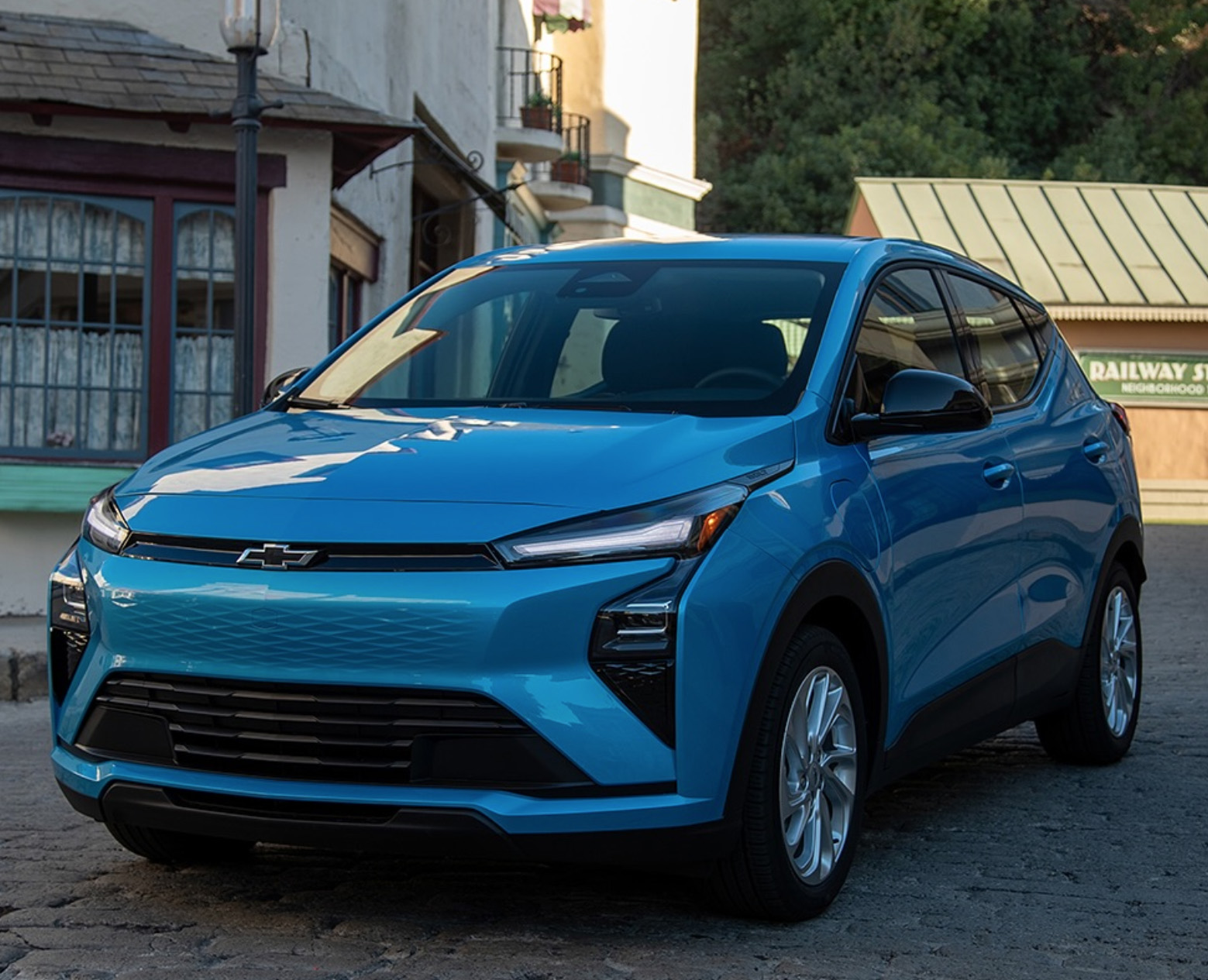
And in other GM EV news, Chevy held a special reveal event for the new Bolt and more details are pouring in about the entry-level electric. As we already knew, styling is mostly unchanged from the old model, but there are a few tweaks to the front and rear fascia and a larger infotainment screen with GM’s newest operating system is also offered. The new Bolt is going to feature a 65 kWh LFP battery pack that the company estimates will provide up to 255 miles of range. Charging rate was increased to 150 kW and it will also offer Plug & Charge and bidirectional charging capability. Power comes from the same 210 horsepower electric motor that’s found in the Equinox EV. A few other highlights include a native NACS charger, heat pump and torsion bar rear suspension. Look for the new Bolt to start hitting dealer showrooms early next year. Two trims will be offered at launch; LT and RS. LT starts just under $30,000, including destination charges, while the RS trim starts at about $32,000. Another even cheaper LT version is expected to follow at just under $29,000. That will make the Bolt the cheapest EV in America, just undercutting the new Nissan Leaf, which starts at a little over $31,000, including destination.
FERRARI REVEALS 1ST EV CHASSIS
And speaking of new EVs, Ferrari revealed its all-new 800-volt EV chassis and the name of its very first fully electric model, the Elettrica. But the company says it won’t be a supercar because current battery tech can’t provide the kind of performance and handling it wants. So, it will be some kind of larger 4-door vehicle. The 122 kWh battery pack is located inside of the center frame structure, but Ferrari says 85% of the batteries are located at their lowest possible position to keep weight down low. It claims the center of gravity of the Elettrica is 80 mm or 3.1 inches lower than an equivalent gas-powered model. The front and rear are fitted with e-axles that each have two electric motors, which will combine for nearly 1,000 horsepower and provide 0-60 performance of 2.5 seconds. To help control all that power is an updated version of Ferrari’s 48-volt active suspension system, which it says takes ride comfort, body control and vehicle dynamics to even greater heights. The model is expected to weigh about 2,300 kilograms or just over 5,000 pounds and offer more than 530 kilometers or roughly 330 miles of range. First deliveries are expected about a year from now with pricing around $500,000.

If you haven’t noticed already, we posted some videos John shot from this year’s Battery Show, which is going on right now in Detroit. There’s two interviews you can watch right now and we’ll have a few more coming later today. So, don’t miss out on that.
Also, be sure to tune into Autoline After Hours later today. We’ll be talking about some of the hottest news topics from Rivian and Tesla as well as getting into some of the most compelling vehicles you can buy today. You can join us live on our website or YouTube channel at 3PM EST today.
But that brings us to the end of today’s show. Thanks and I hope to see you later today.
Thanks to our partner for embedding Autoline Daily on its website: WardsAuto.com








Ferrari has had some great model names over the years. Elettrica isn’t one of them. Perhaps they will revisit this before they start production.
I smell an EV price war between Nissan and Chevy! Who will win? The consumer.
I was expecting the Bolt styling to be a little more evolutionary. It’s kind of underwhelming.
GM Veteran,
GM stated at the outset that the new Bolt would be the old Bolt with a few minor cosmetic tweaks. They did that to keep the cost low as the tooling for the old Bolt was already paid for so they can make them cheap. Or at least make them profitable. Not so sure why they bothered covering development mules with camouflage as nobody would have noticed anyhow.
The name Elettrica is a terrible name. Makes me think of the 1980-1982 Jet Electrica 007(Dodge Omni 024 based) and the 1981 Jet Electrica(Ford Escort based); which is not a good thing to be reminded of.
Will the Ferrariosa buy a half million dollar car without a V12, or at least a V8?
Kit,
I doubt Ferrari buyers will be lining up for an electric Ferrari. The Ferrari owners who race them(which is more than you would think) won’t be able to race them for long on a single charge and it will be heavy, which is exactly what you don’t want in your sports car. The ones that buy them as a fashion accessory want their Ferrari to be bold/loud as they are seeking attention. If it was a “family” friendly Ferrari with 4 seats or another SUV, then they might find some buyers.
I read on the AutoCar website (claiming to have broken this story and having had an in depth discussions with the Ferrari CEO and head designer) that the Electrica was not the final name and that they will reveal that it closer to vehicle’s on sale and release date. They also said the same thing regarding the name of their SUV, only to later change course, if I’m not mistaken! An as indicated in today’s report, it is not a super car, or hyper car, but a GT, for BEV technology have not advanced enough for such a vehicle, according to the AutoCar article.
IMHO, Ferrari was wise not to build a two door EV, for, as you look at the current track record, two door EVs from mainstream OEMs have had very little success at the moment. While sedans and SUV/CUVs sells have been growing in the market (all be it slower then anticipated), two doors and coupes have not, with the electric Maserati grand coupe and the Charger two door EV being examples of this! Were that not reason enough, if Ferrari had gone the EV coupe route, out raged fans would have most certainly compared it to Ferrari’s other super cars, only to pick the EV apart for not living up to its past and present stable mates. As a four door/four door coupe (less I say wagon!), there will nothing to directly compare it with and may more likely stand (roll?) on its own merit.
While I’m excited by the news of the Ferrari EV, I do take issue with two things (as if Ferrari would care, right?!), the use of four EV motors and the range. The Model S Plaid and Air Sapphire make similar horse power four digit horsepower, with a comparable size battery, but with only three motors! What gives?! And they both do it while making an EPA certified 400 miles of range! Don’t get me wrong, I know the Plaid and Sapphire will NEVER drive like a Ferrari, selling for nowhere near as much money, but the Electrica was a clean sheet, ground up, new design, so 350 to 375 miles of range should have the minimum at least! Yet, Ferraris, Lamborghinis and vehicles of this type are gas guzzlers in ICE form, so it should surprise that their BEV counterparts are far from economy vehicles! If this vehicle has any type of success (and why not, it is a Ferrari after all), with Aston Martin having a technical alliance with Lucid, I wonder how long it will be before their highly competitive CEO will have their designs creating an EV vehicle of their own!
GM’s decision to walk away from their $7500 offer, while surprising after the noise they made about it, might have everything to do with the low price that the Bolt EV has and not wanting to get on the wrong side of the administration. I wonder if data suggests that, while buyers of GMs EVs are using the text credits, this is only allowing them to get more expensive versions of the vehicles they do get, but not a deal breaker if they couldn’t use it?! So, why would GM risk upsetting the admin, especially if it was in fact the GM’s CEO that was asking the Trump White House to read of California’s ability to set their own vehicle emissions standards?
wmb, regarding Charger, people who want large two door cars don’t want EVs. Neither do they want six cylinder engines or 4WD. If they can properly make ICE versions of the “designed as an EV” Charger, they need RWD two door Chargers with the 5.7, 6.4, and maybe Hellcat V8s. Those are what Mopar fans would want. They got off to the wrong start, though, so maybe the new Charger is doomed, even if they change direction now.
Remember the whining about the recently discontinued Charger being four door? People got over it, and that car had a following. Done right, the new two door Charger should have a following.
Kit —
Personally, I think the two and four EV Chargers are cool and I do not understand all the bad press for what the are. I do understand that the two door EVs are not what many fans wanted as. a Challenger replacement and the 260 mile range of the most powerful EV, while instep with the Mach-E GT, was disappointing! To me, if they would have come out with the four models first, they EVs might have stood a better chances. Coupes are already a small market and only getting smaller, with Maserati being the only legacy OEM with a two door EV that I can think of! The four EV Charger is more in line as a comparison to the Model S, then a direct replacement to the previous ICE Charger. In R/T form, it had 300 miles of range and made good power and I think it might have been cheaper, if Dodge had not discontinued it before it came to market. But it is what it is and the ICE four and two door Chargers will soon be here, if not already! They say hind sight is 20/20, so hopefully Dodge can get the Charger experiment sorted out and make Mopar fans happy in the years to come!