




Follow us on social media:



Runtime: 10:30
0:00 Musk’s Pay Package Pays Him Billions Even If He Misses Goals
1:13 Tesla Boosts Sales in China
1:52 Ford Scraps EV Tax Credit Workaround
2:28 New Chevy Bolt Will Be Limited Run Model
2:56 China Tightens Grip on Battery Supply Chain
4:16 Lyft Buys Robotaxis For First Time
5:02 Mercedes Tests Heavy-Truck EV Charging for Pass Cars
6:38 Auto Industry Hit with More Cyber-Attacks
7:32 Bosch Now Operating Fuel Cell Truck at Plant in Germany
Visit our sponsors to thank them for their support of Autoline Daily: Bridgestone, CSP and Intrepid Control Systems.




This is Autoline Daily, the show dedicated to enthusiasts of the global automotive industry.
MUSK’S PAY PACKAGE PAYS HIM BILLIONS EVEN IF HE MISSES GOALS
Last month, Tesla’s board proposed a new 10 year pay package for CEO Elon Musk that could eventually be worth $1 trillion. But in order to earn all of that, the board said Musk would need to hit “Mars-shot milestones” and that he would get “zero” unless he meets the goals. However, a new in-depth analysis by Reuters found that Musk can still rake in tens of billions of dollars without meeting most of those targets. Some of the product development goals he must achieve are vaguely written and could earn Musk a big payout without significantly boosting Tesla’s profit. For example, there’s no requirement that Tesla makes FSD fully autonomous, instead it only needs to deliver an “advanced driving system.” Musk can earn $26 billion alone from hitting two of the easiest targets, along with modest stock growth, which would be more than the next 8 best-paid CEOs combined. There’s a lot more detail in Reuters’ report and we’ll provide a link if you want to dive deeper.
TESLA BOOSTS SALES IN CHINA
And in other Tesla news, the EV maker has started to flip the script on car sales in several key markets and now we can add China to that list. From January to September, Tesla China sold a little over 600,000 vehicles, which includes exports. While that’s down just over 10% from a year ago, its sales in the third quarter were up over 26% compared to the second quarter. And sales of about 91,000 units in September were up both over last month and over last year. So, there’s some very encouraging signs from Tesla right now in China.

FORD SCRAPS EV TAX CREDIT WORKAROUND
Ford is following in GM’s footsteps. It’s also getting rid of its workaround to the expired EV tax credit. In its place, Ford says it will continue offering the same EV lease payments that it does today until the end of the year. As we reported yesterday, GM and Ford were said to have cleared the workaround with the IRS, which would have still allowed them to claim the $7,500 credit, but some criticized the plan and urged for the loophole to be closed. As you can see it didn’t take long for either automaker to change their mind.
NEW CHEVY BOLT WILL BE LIMITED RUN MODEL
And in another follow up from yesterday, Chevy finally put out an official press release about the new Bolt and it slipped in a detail we didn’t have yesterday. It says it will be a limited run model. To us that means the new Bolt will have at least a year on the market, but there certainly won’t be a next-gen model. Chevy didn’t provide any other info but GM obviously sees a clear end in sight for the Bolt.

CHINA TIGHTENS GRIP ON BATTERY SUPPLY CHAIN
China is tightening its grip on its battery supply chain. The country’s Ministry of Commerce announced that exports of some lithium-ion batteries, cathode and graphite anode materials as well as certain related technology and equipment, will now require government permits for exports. China dominates global production of the materials and analysts believe this is a move to protect its market control while also slowing development of a battery supply chain outside China. And while this requirement could hurt battery production, analysts don’t believe China will be as restrictive as it was with rare earth exports earlier this year, which forced several automakers to temporarily halt production. And there is a glimmer of hope for battery production outside of China. Check out our interview at the Battery Show with Bob Galyen, one of the people that helped start CATL. He says the U.S. is working on battery production tech that could leapfrog China.
LYFT BUYS ROBOTAXIS FOR FIRST TIME
Ride hailing company Lyft is adding robotaxis to its fleet for the first time. The company has reserved hundreds of robotaxis from Silicon Valley startup Tensor Auto which will be deployed in Europe and North America starting in 2027. In addition to that, Tensor will install Lyft’s platform in all of its vehicles, which will allow owners to offer rides through Lyft’s network where Level 4 autonomous technology is available. Financial details weren’t revealed and the companies didn’t say exactly where the vehicles will initially operate. Lyft does have partnerships with other companies like May Mobility and Waymo to offer autonomous rides but this is the first time it will purchase and own its own fleet of robotaxis.

MERCEDES TESTS HEAVY-TRUCK EV CHARGING FOR PASS CARS
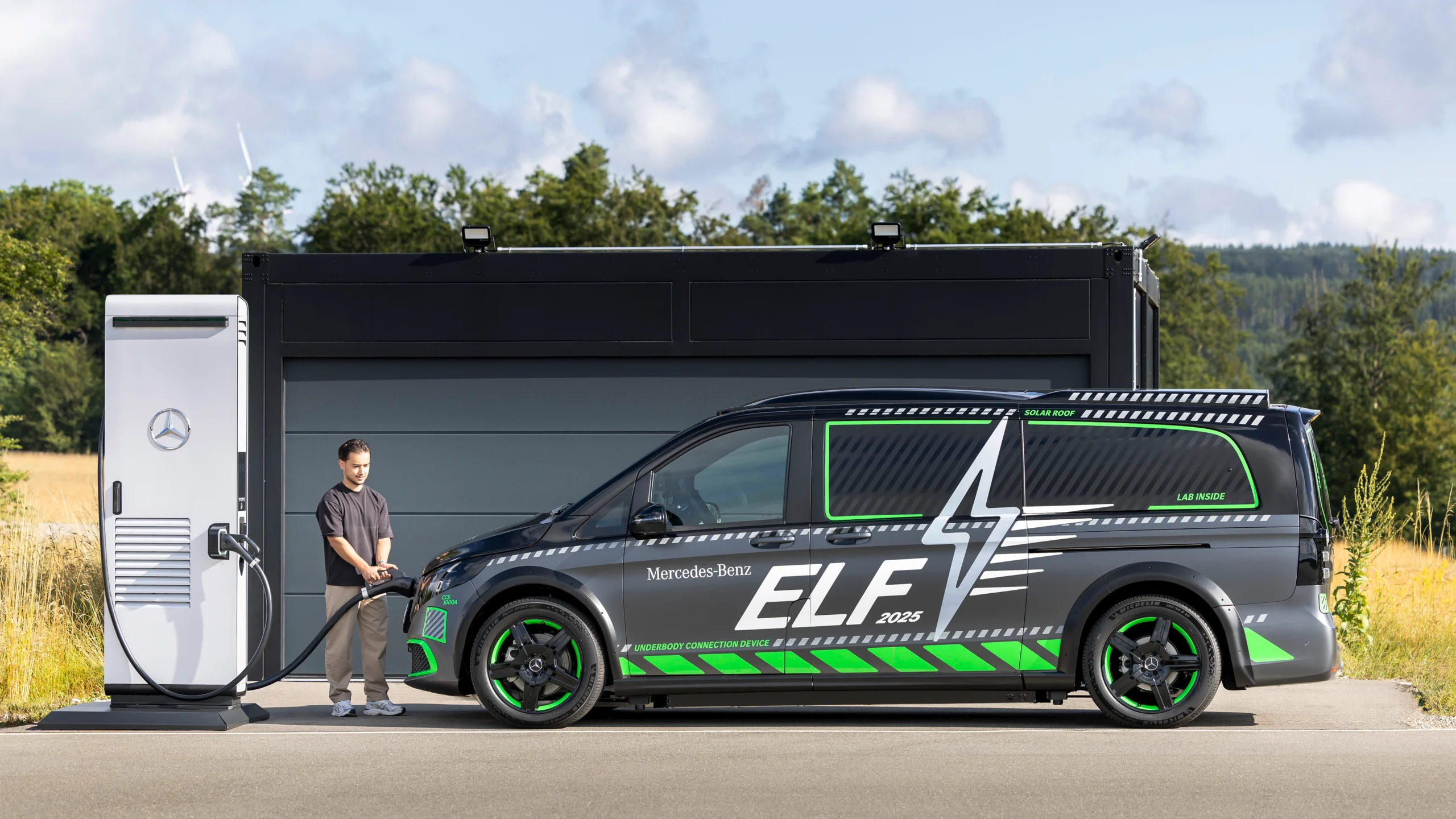
This might just look like an electric Mercedes V-Class van with a bunch of decals on it, but there’s some interesting tech under those stickers. For one, it’s testing ways to adapt the Megawatt Charging System that it developed for heavy-duty trucks into passenger vehicles. It says it will take those findings to develop long-distance vehicles and fleet solutions with short downtimes. But this van actually has dual charging capability. It’s also equipped with a CCS charging port as well, but Mercedes is testing how to really ramp up the charging rate. It says the van is capable of charging at 900-kW, which could fully charge a 100-kWh battery pack in 10 minutes. To pump out that power, the company converted one of its megawatt chargers for big trucks by slapping a CCS cable on it. And it sounds like Mercedes plans on supplying these units to charging stations in the future. But it’s also testing ways to make charging more convenient. It’s looking into inductive charging, which requires no physical connection, and wants to know things like the best place to put the hardware on the vehicles. Automated conductive charging could be another solution as well. There’s still a physical connection between the vehicle and charger, but Mercedes is testing how to do that automatically with a charger that pops out of the ground and plugs into the bottom of the vehicle. So, it looks like Mercedes has identified charging time and charging convenience as key aspects of improving the EV ownership experience.
AUTO INDUSTRY HIT WITH MORE CYBER-ATTACKS
Cyber security is a growing concern in the auto industry. As we’ve reported, Jaguar Land Rover was hit with a cyber-attack that crippled its operations for more than a month. But it’s not the only automaker that’s been hit recently. Earlier this week, Renault’s UK operations said a hacker stole customer details from a third-party supplier. Stellantis said some customer contact information in Europe has been exposed recently. In Germany, both BMW and Volkswagen had data stolen earlier this year. And some Volvo North America employees had personal data stolen. This could turn into some scary stuff. According to password manager NordPass, the hackers are testing the maturity of the auto industry’s cybersecurity and that they could be gathering data for attacks in the future.
BOSCH NOW OPERATING FUEL CELL TRUCK AT PLANT IN GERMANY
The giant supplier Bosch says it’s operating a fuel cell truck at one of its plants in Germany for the first time. It’s an Iveco truck that’s been fitted with Bosch’s own fuel cell stack, which gives it a range of up to 800 kilometers or nearly 500 miles. The truck will primarily transport products from the plant and is expected to cover 12,000 kilometers or about 7,500 miles a year. In addition to reducing emissions, Bosch will also take what it learns from the project to further develop its fuel cell system.

But that brings us to the end of today’s show and this week. Thanks for tuning in and I hope you have a great weekend.
Thanks to our partner for embedding Autoline Daily on its website: WardsAuto.com







Don’t know about Reuters article of Elon changing his stripes, that’s like saying John McElroy is going to become a journalist covering French couture dresses?? I think John will continue to be a fine automotive journalist.
I still don’t get the rush for robtaxies! It makes since, I guess, in a congested metropolitan area, where traffic can be a nightmare, so having fewer vehicles ont eye road can help with that. Yet, Lift’s investment only seems intent on removing the driver, so that they don’t have to pay drivers and they get to hold on to more money! It seems that they have all kinds of money to invest in robtaxies, yet look to pay their driver employees as little as possible!
I think it’s good to see that Mercedes is investing in EVs in more ways than just the vehicles themselves. While having vehicles that are efficient and have amazing range, designing charging stations that recharge them as quickly as possible, at an appropriate speed that the vehicles electrical architecture can support, is the third of three hurdles facing EVs: range, charging stations and how long it takes to charge! With EV adoption not being as quickly as many OEMs had hoped, I could see them focusing on other things as the the technology matures and public interest grows. This attention to the chargers, can help with acceptance and further reduce range anxiety, as well as the availability of chargers to support long distance travel. While these types of stations may still be years away, knowing that they may be coming is very promising.
Odd Bosch claim. That using fuel cell-based trucks would decrease their emissions. Unless the majority of hydrogen used by the fleet trucks is independent of fossil fuel for its production (no methane reformation + heat energy from fossil fuels), it’s an unsupportable claim.
Renewable energy based H2 production (and distribution) is a bit part of what keeps hydrogen from being a renewable fuel.
Yep, until hydrogen used as fuel comes from electrolyzing water using wind and solar power, it is not a renewable fuel. It is from an energy intensive process using natural gas as the base stock.
Might be a little off topic, but maybe a story you can look into covering, to balance all the EV news;
Christopher Rünge at Rünge Motors has created a 5.3L aircooled flat-8 ICE with compatibility for a Porsche 911! I wonder if it will fit in my dune buggy?
https://www.facebook.com/share/p/1BGTfaXfBo/?mibextid=wwXIfr
A little more about the Runge; they are based out of a farmhouse in Minnesota, where Chris makes an aircooled 2.4L flat-4 that makes 300 HP @9200 RPM. This new 5.3L flat-8, named the Hetzer, is small enough to fit in the space of a Porsche 3.6L flat-six. The official HP has not been announced, but speculation is around 600 HP. It most definitely would fit the rear of my dune buggy, but I’m sure it will be pricey.
https://rungecars.com
I think the limited run of the new Chevy Bolt is a great move for the brand! It creates exclusivity and excitement. Looking forward to seeing how it competes with Tesla in terms of sales and features.