




Follow us on social media:



Runtime: 10:24
0:00 Ford’s 48-Volt “Game Changer”: Radical Reduction in Parts for $30K Maverick EV
1:51 GM Gambles on South Korea: Production Scaling to 500K Units Despite Tariffs
2:49 Dodge Wins Durango Hellcat Lawsuit: Judge Rules No Deception
4:13 Canadians Now Open to Chinese EVs as Import Barriers Weaken
5:08 Rivian to Upgrade Vans with AWD & 30% More Range
6:18 EuroNCAP Pushes for Buttons Over Touch Controls
7:11 The SDV Dilemma: Maintenance Costs & Residual Value Risks
Visit our sponsors to thank them for their support of Autoline Daily: Bridgestone, CSP and Intrepid Control Systems.




This is Autoline Daily, the show dedicated to enthusiasts of the global automotive industry.
FORD’S 48-VOLT “GAME-CHANGER”: RADICAL REDUCTION IN PARTS FOR $30,000 MAVERICK EV
Ford dropped a video about its upcoming low-cost EV platform, and it’s truly a game-changer for the company. That video has a ton of details, so here’s some of the highlights.
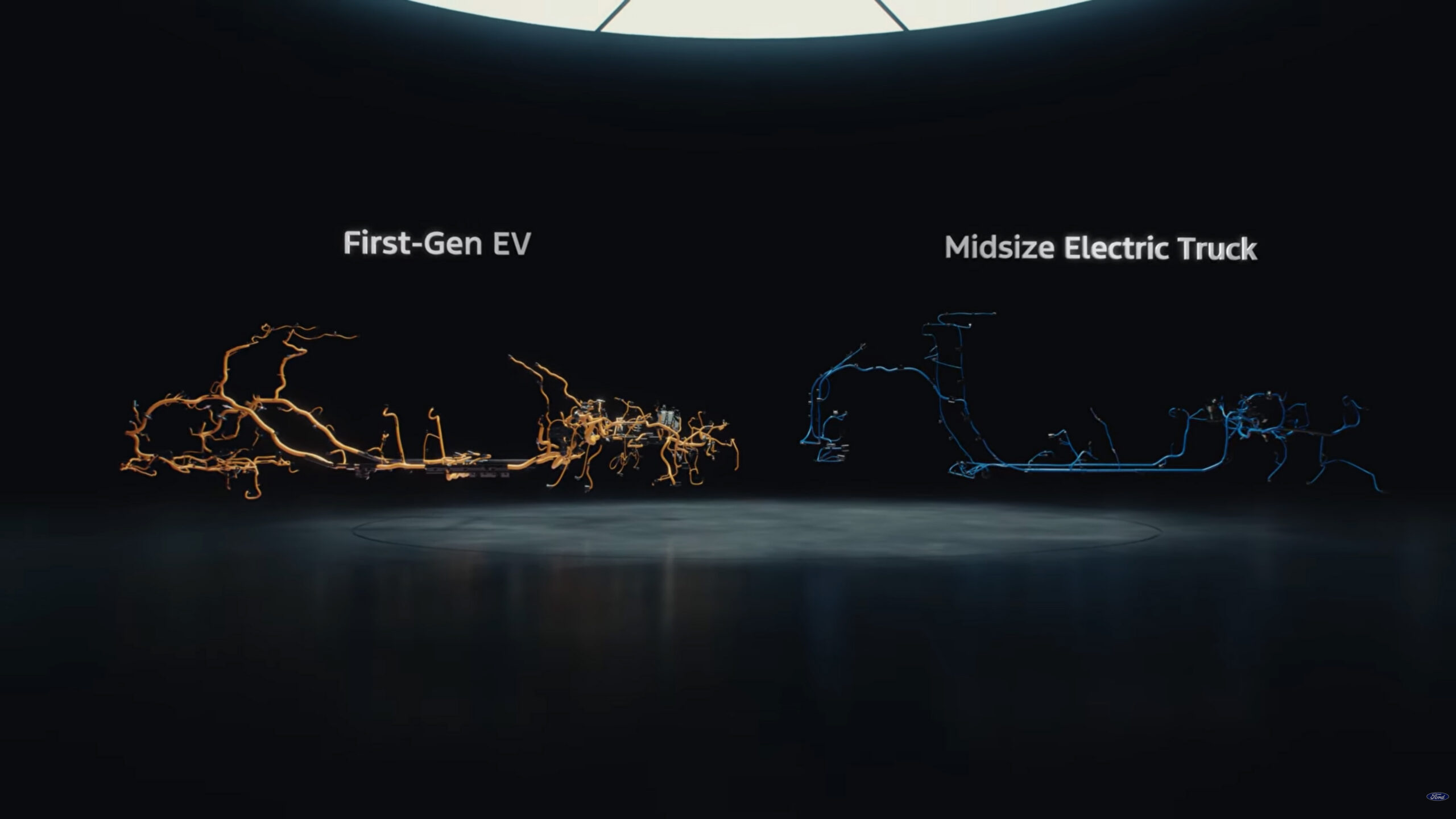
– It’s going to 48-volts! The platform uses a 48 volt zonal architecture with only 5 main computer modules.
– That took out 4,000 feet and 22 pounds of wiring compared to its Gen 1 EVs.
– Its uni-castings are 27% lighter than competitors castings and eliminate 146 parts compared to a Maverick, with 25% fewer fasteners.
– Ex-Formula One aerodynamicists were brought in, working on things like shallow bolt holes on the undercarriage and designing it so the wake coming off the front tires goes directly to the rear tires to reduce turbulence, resulting in another four-and-a-half miles of range.
– Even the mirrors were redesigned for better air flow, adding another 1.5 miles of range.
– And by enhancing the regen braking, the team cut the cost of the battery pack by $100.
Alan Clark, who led the development of this platform, says the team took a true systems engineering approach to maximize the efficiency of the platform. Ford says the first model to use all this will be an electric mid-size pickup priced around $30,000 that will go into production next year. And Autoforecastr Solutions reports it will be called the Maverick EV. We’ve got a link to Ford’s video in today’s transcript because we think anyone working on EVs or pickups is going to want to watch this and take notes.
GM GAMBLES ON SOUTH KOREA: PRODUCTION SCALING TO 500,000 UNITS DESPITE TARIFFS
Despite uncertainty with tariffs, General Motors is planning to boost production in South Korea to full-capacity this year to help meet demand in the U.S. GM operates two plants in Korea, which build the Chevrolet Trax and Trailblazer and the Buick Envista and Encore GX. It’s now aiming for output at the two plants to hit 500,000 units this year, which would be up from about 461,000 vehicles last year. But tariffs could impact its plans. Last year, the U.S. raised tariffs on Korea from 0 to 15%. And then last month President Trump threatened to raise tariffs to 25% because the Korean parliament hasn’t approved the trade deal the two countries reached last year. But GM appears willing to deal with any potential tariff headaches, since its Korean made models are big sellers in the U.S. thanks to more affordable prices.
DODGE WINS DURANGO HELLCAT LAWSUIT: JUDGE RULES NO DECEPTION
Dodge was able to win a lawsuit brought on by customers that felt deceived by the brand. In 2021 Dodge marketed the Hellcat Durango as a 1-year run vehicle that would be limited to just 2,000 units. But even with a price tag around $115,000 orders blew past that number in only three-months. However, Dodge decided to honor all those orders, which likely makes the real number closer to 3,000 units. But that’s not what ticked owners off. It’s when the brand brought the Hellcat Durango back for the 2023 model year. Due to the popularity of the first one, Dodge felt like was leaving money on the table. However, the move triggered the consumer fraud lawsuit. But a judge in Delaware just ruled in Dodge’s favor, saying there’s nothing about a limited 1-year run included in the vehicle’s warranty and there’s no evidence the brand intended to deceive customers. The model is still popular enough with customers that Dodge continues to offer the Hellcat Durango today.

CANADIANS NOW OPEN TO CHINESE EVS AS IMPORT BARRIERS WEAKEN
Car buyers in Canada are warming up to the idea of Chinese EVs. According to a new poll from Nanos Research Group, 53% of respondents said that knowing a vehicle was made in China would not have an effect on their purchasing decision. That’s up from 25% in 2024. And 15% of Canadians said they’re more likely to buy an EV knowing it was made in China, which is up from 9% in 2024. Last year, around 1.9 million vehicles were sold in Canada, so that 15% of buyers has the potential to represent about 285,000 vehicles. That’s significantly more than the 49,000 Chinese made EVs Canada will allow imported into the country at a lower tariff rate, which is part of a new trade deal that was reached last month.
RIVIAN TO UPGRADE AMAZON VANS WITH AWD AND 30% RANGE
Amazon was able to boost its fleet of all-electric delivery vans from Rivian by 50% last year, but even at that pace the two companies will fall short of their original deal signed in 2019, which said Rivian would supply 100,000 vans to Amazon by 2030. At the end of last year Amazon had over 30,000 Rivian vans in its fleet, up from over 20,000 in 2024, but at that rate the EV maker will only deliver 80,000 vans by the end of the decade. However, if Rivian is able to ramp up production, there’s a few updates coming that will increase their appeal. According to the company’s Q4 shareholder letter, the van will be getting the option for a bigger battery and a dual-motor AWD setup. The battery is said to add 30% more range, which would take it from the current 160 miles, which is provided by a 100 kWh LFP pack, up to about 208 miles of range. But no word on when the van gets the updates or how it will affect the current $79,000 starting price tag.

CHINA AND EURO NCAP PUSH FOR BUTTONS OVER TOUCHSCREENS
Regulators and safety advocates around the globe are putting pressure on automakers to bring back knobs and buttons. Last week, China proposed mandating physical controls for things like turn signals, hazard lights, gear selectors and emergency calling. And over in Europe, starting this year, cars must have physical controls for turn signals, wipers, hazard lights, horn and SOS calls, in order to earn a 5-star safety rating from the EuroNCAP. While this isn’t mandated by European law since the EuroNCAP is a voluntary safety rating program, its 5-star ratings are highly coveted by automakers, which use them for bragging rights in sales and marketing campaigns. Automakers are facing increased scrutiny over touchscreen controls because of safety concerns over screen failures and driver distraction.
THE SDV DILEMMA: MAINTENANCE COSTS AND RESIDUAL VALUE RISKS
Every automaker in the world is working on SDVs, or software defined vehicles. And the benefits can be tremendous, especially with over the air updates that can improve a car over time, or fix warranty problems and recalls without having to take it to a dealership. But there are downsides to SDVs. Automotive News reports that there’s a lot of work required to maintain the software over the life of a car. There’s a lot of software engineering, software tools, and the cost of the cloud infrastructure. Also, connectivity technology evolves every decade, so if your car has a 3G modem today, not everything will work in the future. Even more importantly, unless automakers can monetize their investment in SDVs, how long will they keep updating the software in older cars? And what happens to the residual value of those cars if it doesn’t have full use of their features? So, while SDVs offer a lot of promise, automakers need to really think out their strategy over the long term.
And that wraps up today’s report, thanks for watching Autoline Daily.
Thanks to our partner for embedding Autoline Daily on its website: WardsAuto.com







As a Maverick owner, I’m a total fanboy of the new Ford BEV truck. As an engineer, I loved every single design feature those engineers presented. But my absolute favorite part of the video was the honesty. They said “IF we’re able to deliver this”. No arrogance. No gaslighting. Just engineering honesty. It was hugely refreshing and promising.
I think most of the little Korean GM products look decent, inside and out, for their class, but they need to work on the powertrains. The 1.3 turbo triple powered TrailBlazer is slower and thirstier than the bigger, heavier, late non-hybrid RAV4.
https://www.fueleconomy.gov/feg/Find.do?action=sbs&id=49481&id=48935
The TrailBlazer and RAV4 were essentially tied in mpg in CR’s tests.
I’ve noticed that there is not a direct relationship between the size of the vehicle and efficiency. When you get to the very small, like a Yaris, it’s less efficient than the Corolla, even if neither is a hybrid. The very small 3 cylinder engines also don’t necessarily guarantee better efficiency. There seems to be diminishing returns as you go smaller. Smaller can be less expensive to buy but not to run.
Yeah, there can be such a thing as too small in engines, especially for highway efficiency. Actually, I’d think the n/a 2.5 in the RAV4 might be cheaper to make than the turbo 1.3 in the TrailBlazer. I could be wrong, though.
The best mpg I ever got from a non-hybrid, non-diesel was a small car with a small engine, a Chevy Sprint, Suzuki Cultus or Sprint about everywhere but the US and maybe Canada. It had a 1.0 liter n/a triple, and a 5-speed manual transmission. It was a very small car, at least for North America, weighing less than 2000 pounds.
“In 2021 Dodge marketed the Hellcat Durango as a 1-year run vehicle that would be limited to just 2,000 units.” What part of 1 year run and just 2000 units did the judge not understand, and why would the warranty have anything at all to do with false advertising? Sounds like the judge got paid off by Stella and the customers that actually believed Stella got it in the shorts. I guess corruption isn’t limited to our government, the auto industry is alive and well and swimming in it.
Any word on exactly which Chinese cars will be imported into Canada? Some Chinese cars are amazing looking (MG Cyberster of BYD Shark 6 pickup anyone?) but the older models are ugly. I especially don’t like the BYD Ocean models like the Seagull, Seal and Dolphin)
Kit, my sister had the replacement for the Chevy Sprint, it was an early (maybe 1990) Geo Metro hatchback, also based on the Suzuki Cultus (the 2nd gen). In fact, I just read that the Metro name came from a trim of the Sprint, the “Chevrolet Sprint Metro”. Her car got amazing gas mileage, was a cute little thing, and I might even admit it was fun to drive. Not sporty, but just a fun little go-kart feel. It also had the 1.0L 3 cylinder engine, but with the 5 speed, it wasn’t bad. It had a big Fisher-Price looking key that said Briggs & Stratton on it! I don’t know if that was OE, but we got a kick out of it.
The thing I remember similar to the “only 2000 Hellcat Durangos” was, Cadillac promoted the 1976 Eldorado convertible as the “final American-made convertible” due to projected federal safety regulations, leading to the cars being bought up by collectors and speculators. Then, Chrysler sold K-car derivative convertibles starting in the early 1980s, and there was another Eldorado convertible in the mid ’80s. Of course, there have been a number of other convertibles since then. GM was sued about the diminished value of the ’76 Eldorados to collectors and speculators. The case was dismissed.
Ukendoit, my Sprint was a first generation, and had a carburetor. The second generation, called Geo Metro in the US, had the same engine, but with throttle body injection. That car needed the manual transmission. Both the fuel economy and performance were much better with the manual.
https://www.fueleconomy.gov/feg/Find.do?action=sbs&id=5382&id=5383
GM was all over the map with their small cars in the late 80s to early 90s.
They had the turbo sprint which was a fun little car and looked the part. The sprint itself was sold in few numbers but the turbo sprint was nearly non-existent. The Geo metro (2nd gen sprint) was nearly indestructible. Rust was what killed those. The Metro was more bubbly/cute but I preferred the sprint with its more 80s angular look.
The Isuzu I-Mark based Geo spectrum was also kind of quirky weird cool. It only existed for 1 year and got replaced with the Isuzu I-Mark based Geo Storm. It is hard to find a Spectrum as they only sold it for 1989 and yet GM offered it in both hatchback and sedan form then. Very odd.
Then they had the Daewoo based Pontiac Lemans which did not really sell all that well either.
They also had the Corolla based Chevrolet Nova(very rare) later becoming the Geo Prizm and even later going back to chevrolet as a prizm.
At the same time they had the J-Cars and Saturn was on the way with its own small cars starting in 1990.
GM was just all over the place in the small car segment back then.
I think Spectrum was the last car sold in the U.S. with a carburetor. It would have been one of the last without power steering. They were bargain priced, and there were a lot of them in my “GM/Chrysler” town” at the time. I haven’t seen one in ages. I suspect most of them in Indiana succumbed to rust.
This $30K Ford EV architecture is confusing, for on the one hand they keep calling it a compact truck, but at other times they are calling it a midsize platform?! Which is it??? I should have my Maverick paid off around when this pickup comes out. I’m strongly considering making my next vehicle an EV, but with my Maverick paid off, I could trade it in for that truck, or keep my Maverick and get another EV. I don’t want or need to pickups, but if the EV truck is midsize, it’s bigger then I want. Nicely equipped I’m sure it will cost well over $30K and will probably be closer to $40K, if not more. I wonder if the new electrical hardware will translate and be useful on the Mach-E or its replacement/redesign? Why hasn’t Ford built an EV Lincoln? I’m sure potential costumers would more readily spend $50-60K for a Lincoln then a Ford, without thinking twice! Maybe Ford already has a plan in place to fill that space.
wmb, I’ve read multiple places that Lincoln plans to have EVs “eventually,” but so far, none are actually announced with timelines. I guess they figured, probably correctly, that a Lincoln version of Mach-E or Lightning would not make sense.
Kit —
The Lightning fir sure would not make sense, but making a Lincoln version of the Mach-E, that is more than just a light restyling of that vehicle could work. The Blazer EV, Lyriq and Vistiq are good examples of this, that, done well, such a move could be successful.
Regarding the size of Ford’s UEV, Jim Farley has several times said the interior of the UEV would be about the size of the RAV4, but throughout that video presentation the presenters kept saying that it was a midsize truck! The RAV4 in the US is classied a compact vehicle, if im not mistaken, while the 4Runner is Toyota’s midsize vehicle. So I ask again, which is it? I guess we’ll just have to wait till later this year or next to answer that question.
Highlander and Grand Highlander are Toyota’s mid-size crossovers. 4-Runner is their “trucky” offering.