




Follow us on social media:



Runtime: 11:15
0:00 China Passes Japan As Top Car Exporter to Australia
1:03 Tesla Plans Major Expansion Across Japan
1:42 Uber Expands $4,000 Electric Vehicle Driver Grants
2:34 Unifor Opposes Stellantis Kit Car Plan
3:33 China Dominates Global Humanoid Robot Supply Chain
4:39 UBTech Humanoid Robot Revenue Skyrockets
5:27 Mercedes EQS Debuts Yoke and Steer-By-Wire
5:58 Tariffs Lower U.S. Auto Deficit Despite Costs
7:15 Hyundai Closes Sales Gap with Ford in U.S.
8:02 Ford Pro Software Reduces Fleet Fuel Waste
Visit our sponsors to thank them for their support of Autoline Daily: Bridgestone, CSP and Intrepid Control Systems.




This is Autoline Daily, the show dedicated to enthusiasts of the global automotive industry.
CHINA PASSES JAPAN AS TOP CAR EXPORTER TO AUSTRALIA
China has now passed Japan as the top vehicle exporter to Australia. According to Australia’s Federal Chamber of Automotive Industries, Chinese automakers exported 22,300 vehicles to the country in February, compared to 21,600 for Japanese automakers. It’s the first time since 1998 that Japan hasn’t held the top spot. There are now more than a dozen Chinese automakers selling vehicles in Australia and analysts predict that they could control 40% of the new car market by 2030 if their growth continues at its current pace. And this sort of thing is happening all across south-east Asia, a region the Japanese have dominated for decades. As a result, we think Japanese automakers will lose several million units of sales in the region before the decade is over.
TESLA PLANS MAJOR EXPANSION ACROSS JAPAN
And Japanese automakers aren’t just being threatened overseas, they’re going to see more competition in their home market. Tesla is planning a big expansion in the country. It will increase its number of stores to at least 60, up from 35 and it plans to boost its number of service centers to 30, more than double what it currently has. Tesla says it’s aiming to become the top importer to Japan by as early as next year. Last year, it sold 10,000 vehicles in the country but it still has a ways to go to catch up to Mercedes, who was the top importer last year with 51,000 vehicle sales.

UBER EXPANDS $4,000 ELECTRIC VEHICLE DRIVER GRANTS
Uber is helping its drivers make the switch to electric, now that the $7,500 federal EV tax credit is gone and along with rising gas prices. Uber is expanding a program that allows drivers to apply for a $4,000 grant to switch to an EV. It was initially available in New York City, California, Massachusetts and Colorado but now it’s open to any eligible Platinum and Diamond driver in the U.S. They just have to apply on Uber’s website. In addition to the grant, Uber has partnered with Kia, to give its drivers a $1,000 discount for switching to a new Niro EV or EV6 and a $1,500 discount for an EV9. Uber drivers can also get a $1,000 discount if they buy a new or used EV through online retailer TrueCar.
UNIFOR OPPOSES STELLANTIS KIT CAR PLAN
Stellantis is in talks with its Chinese partner, Leapmotor, to build vehicles at its idled Brampton plant in Canada. But that’s receiving pushback from Canadian union Unifor over concerns that the plant will be used to assemble “knock-down kit cars.” That means all the parts and systems for the vehicle will be made in China then shipped to Canada for final assembly. The union is against that because most of the manufacturing operations and jobs will stay in China. The head of the Canadian Automotive Parts Manufacturers’ Association warns allowing this will “kill Canadian industry.”
CHINA DOMINATES GLOBAL HUMANOID ROBOT SUPPLY CHAIN
Most countries and automakers are trying to untangle themselves from China’s stranglehold on rare earth minerals, which are used in EV batteries and electric motors. And the rest of the world may find itself in a similar situation with humanoid robots. While most major automakers are testing or have plans to test humanoids in their plants, China dominates the supply chain of parts needed to make those robots, including specialized motors, gears and sensors. Chinese companies are said to currently control 90% of the humanoid market. Even Tesla’s Optimus will use several Chinese components. Some of those components are considered best in the world, but like many things from China, this is also about price. China can produce the parts much cheaper. That has resulted in some durability issues, but companies are already working to improve operation life. And with everything they need right at home, Chinese humanoid makers were able to get to market faster and are expected to continue to dominate sales through the end of the decade.

UBTECH HUMANOID ROBOT REVENUE SKYROCKETS
Here’s an example of the kind of growth these companies are seeing. UBTech, which supplies humanoids to NIO, BYD, FAW-VW, Dongfeng and Geely, saw revenue from selling its robots and tech go from just over $5 million in 2024 to nearly $120 million last year. And since the company sold just under 1,100 robots last year, that means each one cost as much as $110,500. Overall, UBTech actually posted a net loss of about $115 million, but that’s 32% better than the year before and it now has the production capacity to make 6,000 units a year. So, it expects a lot more demand for its robots.
MERCEDES EQS DEBUTS YOKE AND STEER-BY-WIRE
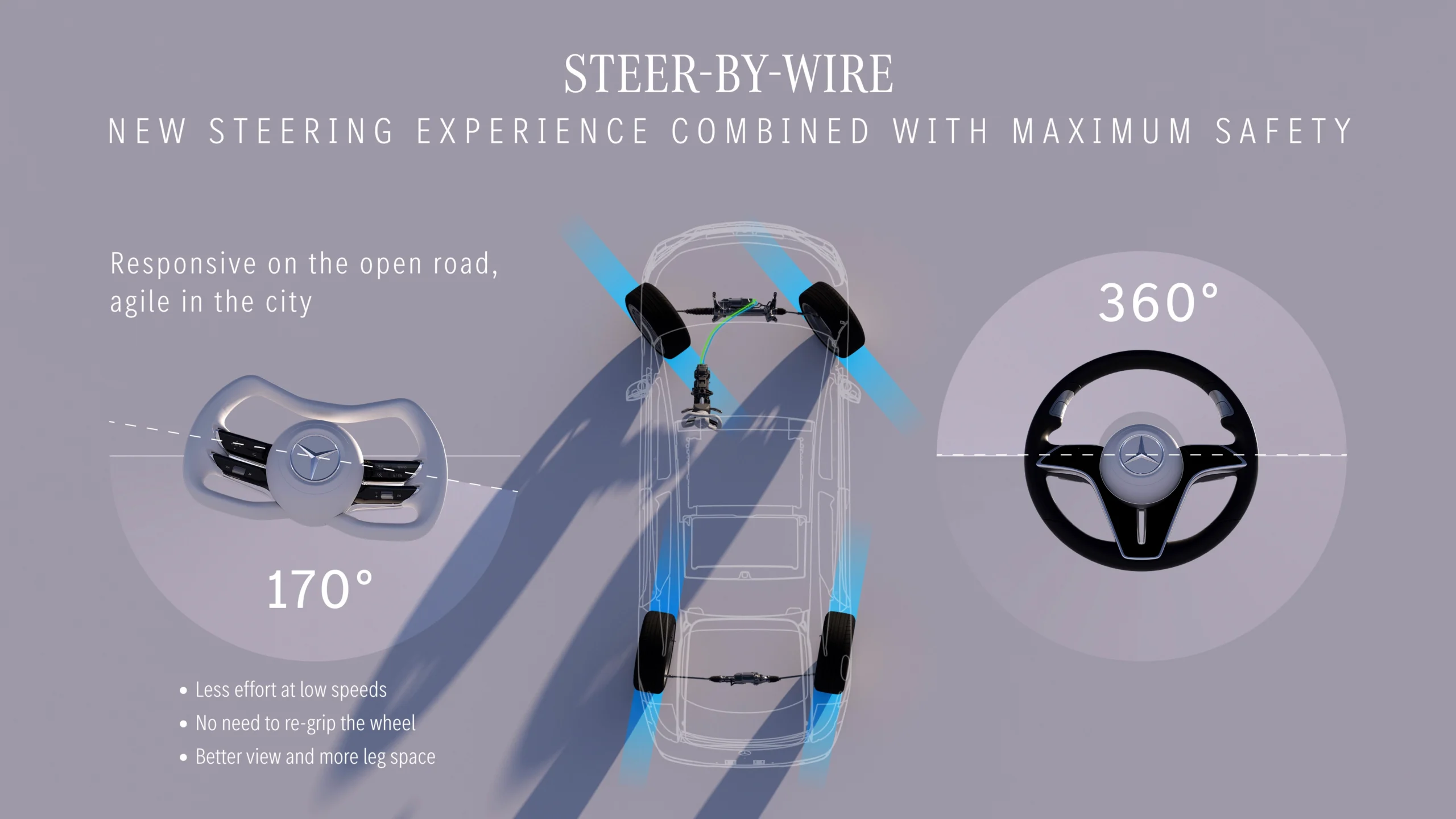
While some automakers are shying away from yoke steering wheels, Mercedes is embracing them for the new EQS sedan. And not only that, the car will debut steer-by-wire tech, where there’s no physical connection between the steering wheel and the wheels. Add in the option for rear-wheel steering and for every one full revolution that a normal round steering wheel would do in low-speed maneuvers, the Mercedes yoke wheel rotates less than a half turn.
TARIFFS LOWER U.S. AUTO DEFICIT DESPITE COSTS
Yesterday was the one year anniversary of President Trump’s “Liberation Day” when he imposed all kinds of tariffs on imported goods. So what’s been the impact on the auto industry? Well, it’s kind of a mixed bag. The total value of imported cars, trucks and parts fell more than 15%. But exports also fell to their lowest in 5 years. That left the U.S. with an automotive trade deficit of about $273 billion. Even so, that was about 18% lower than the year before according to data from the U.S. Census and Bureau of Economic Analysis. So the tariffs definitely reduced the automotive trade deficit. But they also cost automakers and suppliers $35 billion in higher cost and lower profits. For the overall economy, the trade deficit in goods hit an all-time record of $1.1 trillion. But the trade surplus in services also hit a record of nearly $340- billion. So overall, the total trade deficit came in at $901 billion, about $2 billion less than the year before.
HYUNDAI CLOSES SALES GAP WITH FORD IN U.S.
Ford reported its Q1 sales yesterday for the US market, and they dropped 8.8% to 457,000 vehicles. Ford was hurt by phasing out the Escape and Edge and from a 16% drop in F-Series sales which still hasn’t caught up to the production it lost from a fire at a Novelis aluminum plant. But here’s what we’re really watching. Last year, the Hyundai Group, including Kia and Genesis, were 55,000 sales behind Ford in the first quarter. This year they were only 27,000 units behind. So now the race is on. Can the South Korean automaker surpass Ford in sales in the American market by the end of the year?
FORD PRO SOFTWARE REDUCES FLEET FUEL WASTE
With gas prices soaring, Ford says it has solutions to help fleet operators save at the pump. According to its own data, 29% of work vehicles in North America idle excessively, compared to just 10% in Europe. But the automaker says its Ford Pro Telematics software can help prevent wasted fuel by showing which vehicles are idling and for how long. Ford says fleets using its coaching feature reduced idling by 52%. Another feature helps reduce speeding and harsh driving, which can also improve fuel economy. This coaching led to 25% less speeding, 16% less hard braking, and 11% less hard acceleration. And lastly, the software can monitor the vehicle’s health, so it can be properly maintained, which can lead to less fuel waste.
But that’s a wrap for today’s show. Thanks for tuning in and I hope you have a great weekend.
Thanks to our partner for embedding Autoline Daily on its website: WardsAuto.com







I would certainly expect Hyundai/Kia to overtake Ford in sales in the near future, even before H/K is selling their upcoming trucks. Ford has not only dropped all of their cars, except Mustang, but they have dropped Escape, their “mainstream” entry in the largest market segment in the U.S. Bronco Sport is sort of a replacement, except it’s 4wd only, with no hybrid version. Also, not everyone wants the off-roady styling of the Bronco Sport.
While the incentives from Uber sound good, they are also the same company that is heavily investing in AD. So, if a Uber driver gets new EV, while the money they give may help offset the cost, if they are financing the pu4chase over several years, what will they do when Uber’s AD vehicles come out? They’ll be competing with Uber’s own vehicles that will cost them less to operate! They run the risk of being fired by Uber, with an outstanding car EV car note! I see Uber hedging their bets over which technology will come to market faster, but should the EV AD vehicles take off, that could be an expensive investment should the time come when Uber does not need vehicles with drivers!
Kit, I think you’re right about Ford not building car and dropping the Escape and expecting everyone to buy the Bronco, not everyone wants that trail ready look. And since I’ve own a Hybrid there’s very little chance I would ever buy a vehicle that’s not a Hybrid in the future.
Sometimes I really wonder if the large old American automakers think with a brain or just listen to a young person in the industry that’s not got a lot of experience and only thinks like a 20 something, different age groups want different products
Kit and Danny, I agree. Without a comfortable 2-row hybrid vehicle (with an easy to park small shadow area), I am no longer a Ford shopper. WCF2 is running a risk to his reputation… the demise of his great grandfather’s company.
I can’t believe Ford cancelled the Edge, that is all you see in my neighborhood, really popular with all demographics, my wife owned one and it was your typical Ford POS after the warranty expired but it is a really good car if you don’t factor in the post-warranty reliability, it was fast, decent fuel economy, good interior space, comfortable on long rides, etc. I think Farley really screwed up this time.
I suspect Ford considered the Edge too close to Explorer, though Explorer is 3 row. The Edge was pretty quick with the 2.7 turbo. Edge is close to the size of the outgoing Highlander, which would be nice as a two row. The third row is only for very small people, and if it were gone, there’d be space for a nice under-floor storage area. I’ve never used the 3rd row in my Highlander, and it’s unlikely I ever will.
I wonder if Ford’s reason to eliminate the Escape and the Edge, is due to the fact that one or two of the new vehicles on the UEV platform with cover those spaces, with an EV and an EREV?! That still leaves them no hybrid, should potential customers no warm to either of these, for, while similar, and EREV is not the same as a hybrid.
I find that Chevy Equinox sold 299,441 in 2025, and Ford has abandoned that market segment. Go figure.