



By John McElroy
The state of Georgia is quickly turning into an automotive powerhouse. I recently had the chance to visit two major manufacturing facilities there: Hyundai’s brand-new Meta plant near Savannah, and Kia’s established assembly plant over in West Point near Atlanta.
While they both operate under the same corporate umbrella, visiting them back-to-back gives you a fascinating look at the contrast between a bleeding-edge, highly automated facility that’s still finding its footing, and a mature, hyper-efficient manufacturing machine running at absolute full tilt.
Unfortunately, these were very quick tours, and we were rushed through operations without much time to watch or ask questions. But I’ve been through enough plants to know what to look for. So let’s dive into what I did see on the factory floor, starting with the Meta plant.
HYUNDAI’S META PLANT
When you first pull up to the Meta plant, you’d swear all the buildings are painted crisp white. But Hyundai says it’s actually a very light sage green, to blend in better with the rural surroundings. And the exterior of every building has rounded corners. Hyundai says that’s an intentional choice to make this massive industrial complex look more natural and a little less hard edged.
The original plan was to have this plant only make electric cars, starting with the Hyundai Ioniq 5 and Ioniq 9. But when EV sales didn’t materialize, they added the Kia Sportage to get some badly needed manufacturing volume.
Inside, it’s all about advanced technology and automation. This is probably the most automated facility I’ve ever visited. And yet, the plant is operating at very low volume, and the lines move at a snail’s pace. Even though production started in October, 2024, they don’t expect to get to full line speed until 2028. I think two things are going on here. The plant needs more models to fill the assembly lines, and all that advanced automation needs a lot tweaking and adjustment.
The metal stamping operation uses one massive transfer press line made by Rotem, a division of Hyundai. I was surprised there’s only one transfer press, because if that ever goes down, there’s no backup. And because there’s only one press line, it has to make all the panels for all three models that are made there. So I saw racks and racks of stampings stacked all the way to the ceiling. They make all the major A-class panels here—body sides, roofs, floors, and fenders. The rest of the smaller stampings are shipped in from suppliers.
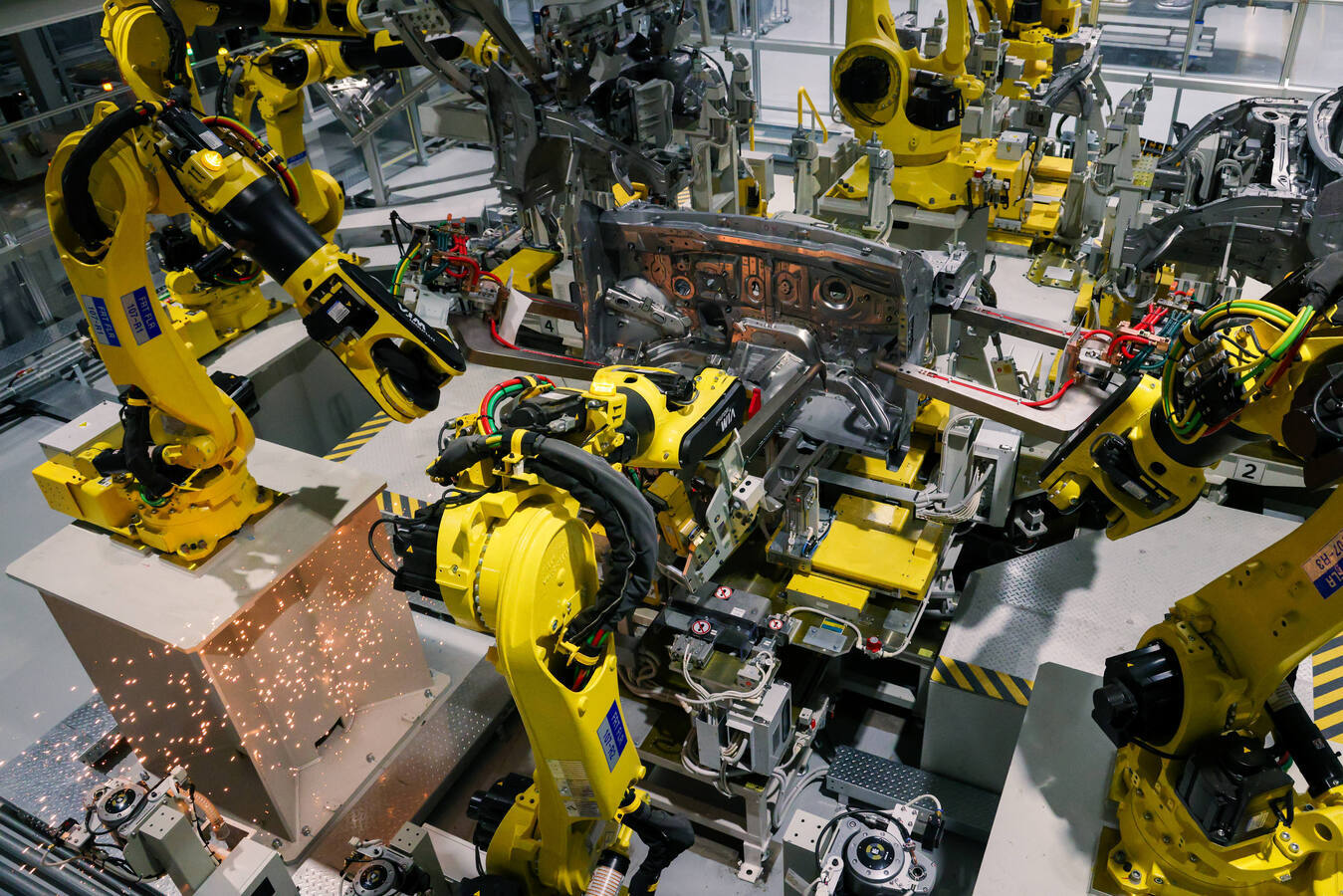
To move those racks of panels over to the body shop, there are absolutely no forklifts. Everything is handled by Automated Guided Vehicles, or AGVs, and heavy-duty electric tuggers. Once in welding, it’s a ballet of robotic automation. I watched huge Fanuc robots pick up entire body-in-white structures effortlessly.
But it’s not all smooth sailing yet. This is a brand-new facility, and they are clearly ironing out the kinks. As the bodies came out of metal finish, I noticed a line worker was hammering away at the door sill of a Sportage hatch opening, while a group of Korean technicians hovered around a body-in-white in deep discussion. There were also quite a few bodies that were pulled off the line, which I’m sure needed to go through a repair loop.
From welding, the cars spend six to eight hours in the paint shop, using one gallon of paint per vehicle. We were not allowed inside the paint shop, which is very typical of any plant tour because they don’t want any kind of contamination–dust and dirt–getting in there.
As the cars move to final assembly, there’s another sign of automation that I haven’t seen elsewhere: taking the doors off for interior assembly and putting them back on later is entirely handled by robots.
On the final line, every single car rides on an AGV equipped with an automatic up-and-down lift. This allows the vehicle to set itself to the perfect ergonomic height at every single workstation for the operators.
As you go through the facility, it becomes obvious how Hyundai leverages all its subsidiaries. Hyundai Steel makes the steel that makes the cars. Hyundai Rotem makes the presses that stamp the panels. Hyundai Glovis handles all the shipping, receiving and logistics. And Hyundai Mobis handles battery pack assembly.
The plant employs about 1,800 people right now, but they are aggressively hiring to add a second shift, which will push employment to 2,600. Make no mistake, production is still very low. They only shipped about 6,000 cars the month before my visit, and they don’t expect to hit full line speed until 2028. When they do hit capacity, Kia will get about 40% of the production.
Walking the floor, you see huge amounts of open space. Part of that is to provide plenty of room to let the AGVs maneuver, but it’s clear Hyundai has massive expansion plans. The current capacity is 300,000 units, but they plan to boost that to 500,000. And they are already planning to add a second plant—likely by knocking out an exterior wall—to add another 250,000 units of capacity. My bet? That extra space will be tooled for the upcoming midsize body-on-frame trucks and SUVs coming from both Hyundai and Kia.
KIA’S WEST POINT PLANT
After touring Hyundai’s Meta plant, we drove across Georgia the next day to Kia’s assembly plant in West Point. This place is a seasoned veteran, which began making cars 16 years ago. It spans roughly 1.7 million square feet under roof (stamping, paint, body shop and final assembly) and is tooled to make 350,000 vehicles a year.
And look at the mix they run on a single line: the Telluride, Sorento, Sportage, and the all-electric EV6 and EV9. Building gas, hybrid, and pure EVs sequentially on one line is incredibly complex, but they make it look easy.
They have 3,200 employees working three shifts, eight hours a day, five days a week. To keep the line moving, they do “on-the-fly” handoffs from shift to shift—the line never stops. They squeeze all of their daily maintenance into brief 30-minute lunch breaks and on weekends. It’s a masterclass in asset utilization.
But it’s also a headache for the people in the plant. With no breaks between shifts, the parking lot is jam packed and I was told that it’s hard to find a place to park.
In the stamping shop, they run two Rotem transfer presses, not one like the Meta plant. One thing I liked is that the die sets for each vehicle are color-coded, and even the storage racks for the stamped panels are color-coded to each specific model. That eliminates mistakes or any confusion about what goes where. Robots pick the panels off of the press line to put in racks, and they keep a “last hit” panel on a rack for each model to verify quality. They maintain about 36 hours of inventory in stamped panels.
In the body shop, there is zero batch building. They build different bodies, one right after the other, to better match sales orders. The secret weapon here is a modular body buck that adapts on the fly to accommodate the different models built in the plant. Different parts of the buck index in or out, depending on the model, to clamp the panels perfectly into place to weld the body-in-white.
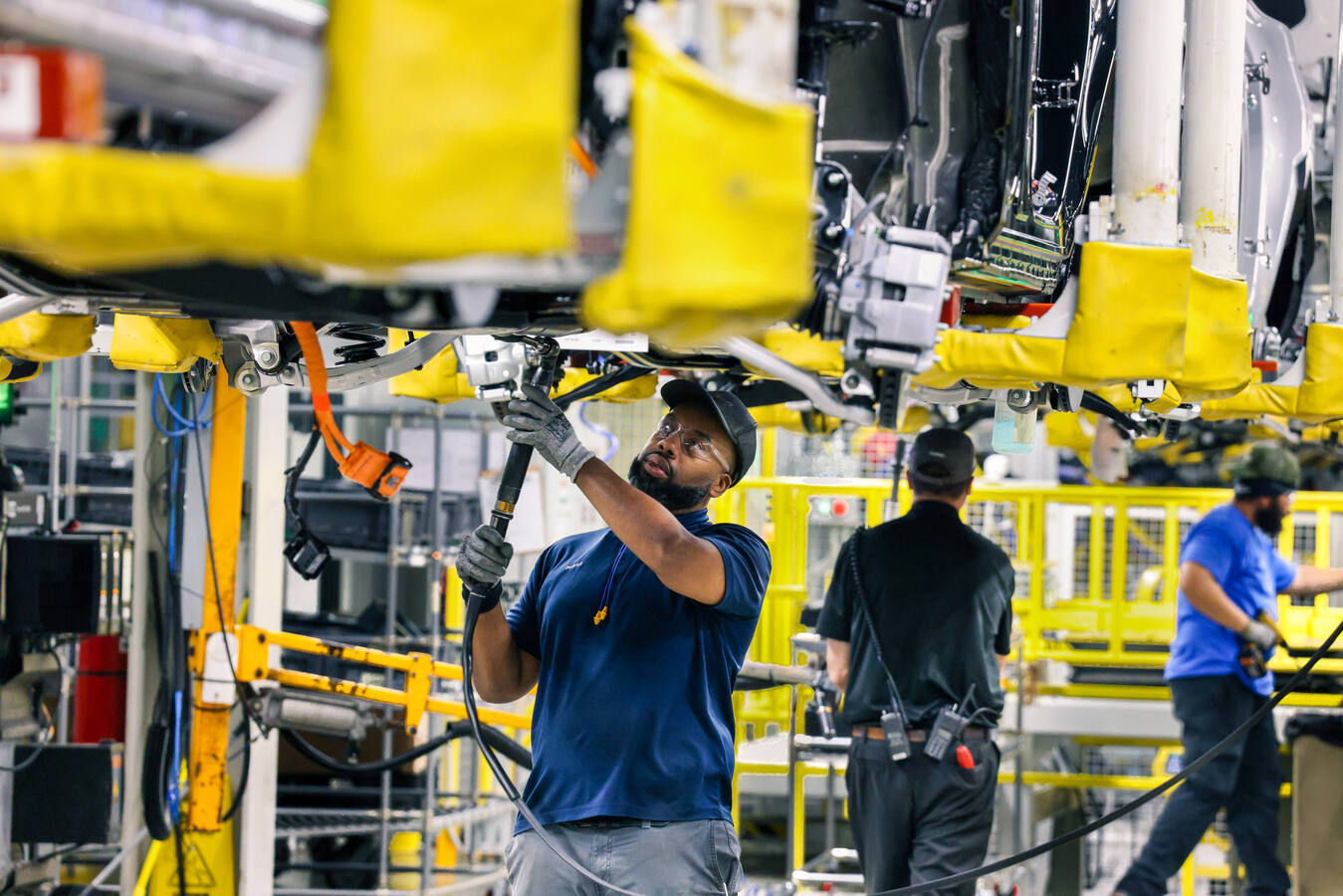
When you move to General Assembly, you notice how open the sightlines are. None of the parts racks are higher than chest-high, which makes the floor feel organized and visible. Unlike the automated doors at the Meta plant, West Point uses two separate trim lines where human operators, assisted by mechanical lift equipment, handle the doors-on and doors-off processes. To prevent fatigue and boredom, everyone on the final line rotates jobs every two hours.
They paint 14 different colors here—though, as you might guess, it’s mostly white, black, and silver.
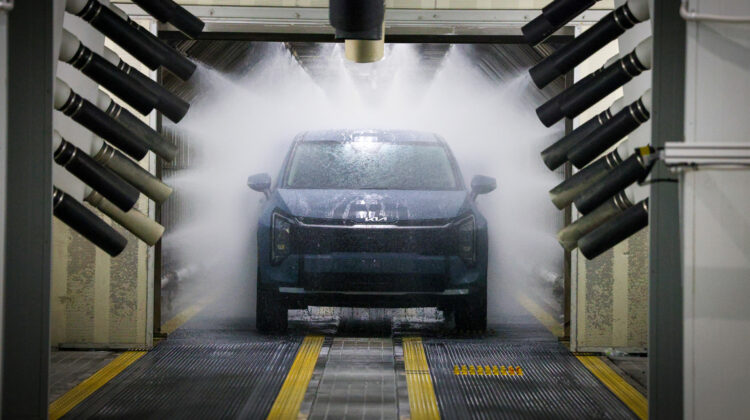
The final assembly line is tightly packed—only about four feet of clearance between each car—and they are pumping out 1,500 cars a day. Every single vehicle goes through a test on their 2.2-mile on-site track. They told me this track is absolutely vital for testing the calibration of the lane-keeping systems.
West Point also features an on-site transmission assembly plant—and get this, Kia actually sells these transmissions to outside competitors like Nissan and Volkswagen.
Finally, if you look outside at their massive 13,000-spot parking lot, you’ll see protective roofs built over part of the staging areas. A severe hail storm caused massive damage to their inventory last year, and it cost a fortune to fix them. So management added the roofs to protect the vehicles, and added solar panels at the same time. But they’re still assessing whether it’s cost effective to cover all the cars in the staging area.
CONCLUSIONS
So, what’s the takeaway?
The Meta plant is the future—vast, highly automated, whisper-quiet, and utilizing AGVs for everything from moving stampings to carrying the cars themselves. But it’s running at a snail’s pace as they slowly ramp up production and dial in quality.
Meanwhile, West Point is the present powerhouse. It’s tight, it’s fast, and it relies heavily on hyper-disciplined human logistics and flexible tooling to churn out high-margin SUVs at maximum velocity. By my calculation, it uses about 17 labor-hours to make each vehicle, including stamping, which is extremely efficient.
By my calculation, Hyundai and Kia are on track to make more than 1.4 million vehicles a year in the U.S. That would be more than what Toyota or Honda currently make. And it shows the kind of ambition the Hyundai Group has for the American market.







Interesting report, John. I’ve driven past that West Point plant many times. It is huge, but I haven’t gotten a close look; thanks for your insight. Next time you are in the area we’ll have to meet up and do lunch.