




Follow us on social media:



Runtime: 10:07
0:00 Ford’s Q3 Results
0:54 BYD’s Q3 Results
1:27 Mercedes’ Q3 Results
2:02 Tesla Wins FSD Lawsuit in South Korea
3:30 BYD’s Workforce Tops 1 Million
4:18 Ford Has Made 5,000 Gigacastings
4:56 Used EV Prices Going Up Fastest
5:48 LFP Battery Use Taking Off
6:39 Japanese Market Share Falling Fast in China
Visit our sponsors to thank them for their support of Autoline Daily: Bridgestone; CSP and Intrepid Control Systems.




This is Autoline Daily, the show dedicated to enthusiasts of the global automotive industry.
FORD’S Q3 RESULTS
Automakers around the world are posting their third quarter financial results. Let’s look at the numbers from Ford, BYD and Mercedes, and we’ll start in the ‘States. Ford sold just over a million vehicles in the last three months, down 9% from a year ago. That generated $49.5 billion in revenue, down 2%. It posted an operating profit of $1.4 billion, down 6.6%. And it posted a net income of $2 billion, down 16%. Ford blames discontinued products like the Escape, higher commodity costs and the impact of the Iran war for the drops. Even so, it expects slightly better earnings in 2026 than it predicted at the beginning of the year.
BYD’S Q3 RESULTS
Now, over to China where BYD sold 1.3 million vehicles in the third quarter, which was up nearly 19% from a year ago. Heavy exports offset a decline in sales in China. The sales gain boosted revenue to $32 billion, up more than 13%. It posted a net profit of $1.5 billion, up 28%. Most automakers would kill for this kind of growth, but BYD actually missed estimates from analysts, and its stock was down 2.5% on the news.
MERCEDES’ Q3 RESULTS
Meanwhile, in Europe, Mercedes reported sales of 407,000 vehicles, down 8%. That brought in €30.7 billion in revenue, down 5%. But here’s where the story turns brighter. Mercedes posted an EBIT of €1.7 billion, up 136% from a year ago. And it put €1.5 billion on the bottom line, up 28%. Mercedes credits the stronger profits to its Financial Services and Vans units, as well as cuts to R&D and capex.
TESLA WINS FSD LAWSUIT IN SOUTH KOREA
Tesla just won an important lawsuit in South Korea brought by owners who claimed the company didn’t deliver FSD features on time. Tesla launched FSD in South Korea in 2017 but most models aren’t able to run all of its capabilities. That’s because only U.S. built Teslas can operate FSD in the country thanks to trade agreements between the U.S. and South Korea. China made Teslas, which account for the majority in the country, have to get government approval to activate the technology. So, 89 owners sued Tesla for not having full access to FSD in a timely manner and were seeking reimbursement of $5,800. But a South Korean court rejected the claims because Tesla did deliver some features and it ruled that buyers knew rollout timelines were indefinite, so the delays didn’t amount to a breach of contract.

BYD’S WORKFORCE NOW TOPS 1 MILLION
BYD’s chairman says the company’s global workforce now has over 1 million people. That’s 150,000 more than it had at the end of last year and more than Toyota, Stellantis, Ford and GM put together. One reason it has so many workers is because BYD is much more vertically integrated than those other automakers. The company makes all its batteries, chips and motors in-house. It also set the goal of becoming bigger than Toyota, so it needs an expanding workforce. But BYD needs to be careful because it seems like there’s some inefficiency in its system. It has roughly 2 and a half times more employees than Toyota, which is the best-selling automaker in the world, yet Toyota produces about twice as many vehicles as BYD.
FORD HAS MADE 5,000 GIGACASTINGS
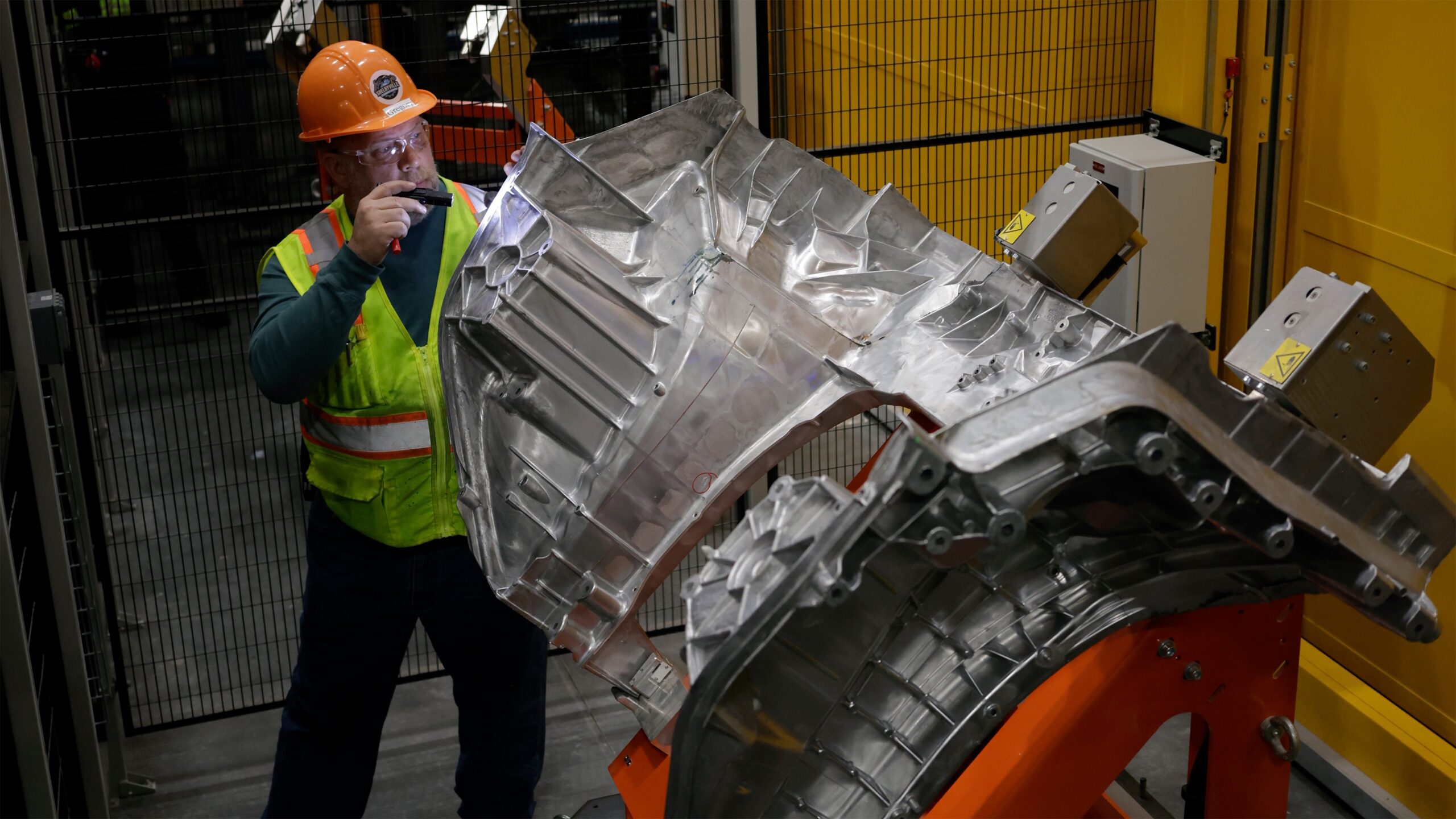
Ford says it’s trying to improve the process of making the large aluminum castings for the Fathom pickup truck, which goes on sale late next year. These are just like Tesla’s gigacastings, large front and rear structures that reduce 146 structural parts down to just two, except Ford calls them Unicastings. The company says it’s now produced more than 5,000 Unicastings at its tech center in Kentucky, which are then sent to the Louisville Assembly Plant to build Fathom prototypes. The team is now trying to speed up the cycle time as it gears up for series production.
USED EV PRICES GOING UP THE FASTEST
Due to rising gas prices, used EVs are becoming more expensive. According to ISeeCars, prices for used EVs have risen nearly 10% since last September, compared to about 5% for hybrids and only 0.3% for gas cars. Last year, used EVs were about $2,200 cheaper than the average used gas car, but now they’re $580 more expensive. But even with those higher prices used EVs are now selling about two weeks faster than gas cars, likely because of an increase at the pump. While used EV prices have increased the fastest, used hybrids are still more expensive. They’re about $34,500 on average, which is $1,900 more than a used EV.
LFP BATTERY USE TAKING OFF
Sales of EVs are taking off in Europe and so is the use of LFP batteries. According to the International Energy Agency about 5% of Europe’s EVs used LFP batteries in 2024, but that jumped to 13% last year and it’s expected to grow even more this year as automakers make the switch to LFP, which is about 40% less expensive than more traditional batteries. Stellantis is making the switch to help boost EV sales in the region. It says it will start introducing models with LFP batteries next year across “many nameplates.” But Europe still has a long way to go to catch China. 67% of EVs had LFP batteries in 2023, which then jumped to 81% last year.

JAPANESE MARKET SHARE FALLING FAST IN CHINA
Japanese automakers have seen a dramatic market share shift in China over the last several years. According to the China Passenger Car Association, Japanese automakers’ retail share of the passenger car market five years ago was 23% but in September it tumbled to just 10.7%, down 1.4% from a year ago. And while the overall Chinese car market is struggling with sales down 25% last month, Japanese brands performed worse with a 33% drop in sales. They’re struggling because they didn’t pivot to EVs as fast as Chinese brands and they’re also behind on new technology. But it’s not just China where they’re losing ground. As we reported earlier this week, Chinese brands outsold Japanese brands in Europe for the first time in the third quarter.
Don’t forget to tune into Autoline After Hours later today. We’ll be diving into some of the top automotive news stories with industry analysts Paul Waatti and Adam Bernard. So join the action live with John and Gary at 3PM EST today.
But that’s a wrap for this show. Thanks for tuning in and I hope to see you later.
Thanks to our partner for embedding Autoline Daily on its website: WardsAuto.com






Sean—
Is the uni-casting that Ford is working, going to be for their EVs only? Do you know or hear if they are looking to apply that assembly process to their ICE vehicles too? I don’t know how these things work behind the scenes, it seems that Ford is putting a lot of resources into this particular application, which doesn’t seem to make any since. I just have a hard time seeing a rear megacasting for a pickup, being suitable for a SUV/CUV/Crossover, or a sedan, even if the pickup is unibody. Yet, with the Fathom being nearly the size of the Maverick, the perhaps it might be serviceable for the next generation Maverick, if there is one. Or, since they say the UEV is scalable, perhaps it might be able to do duty on the next generation Ranger?